

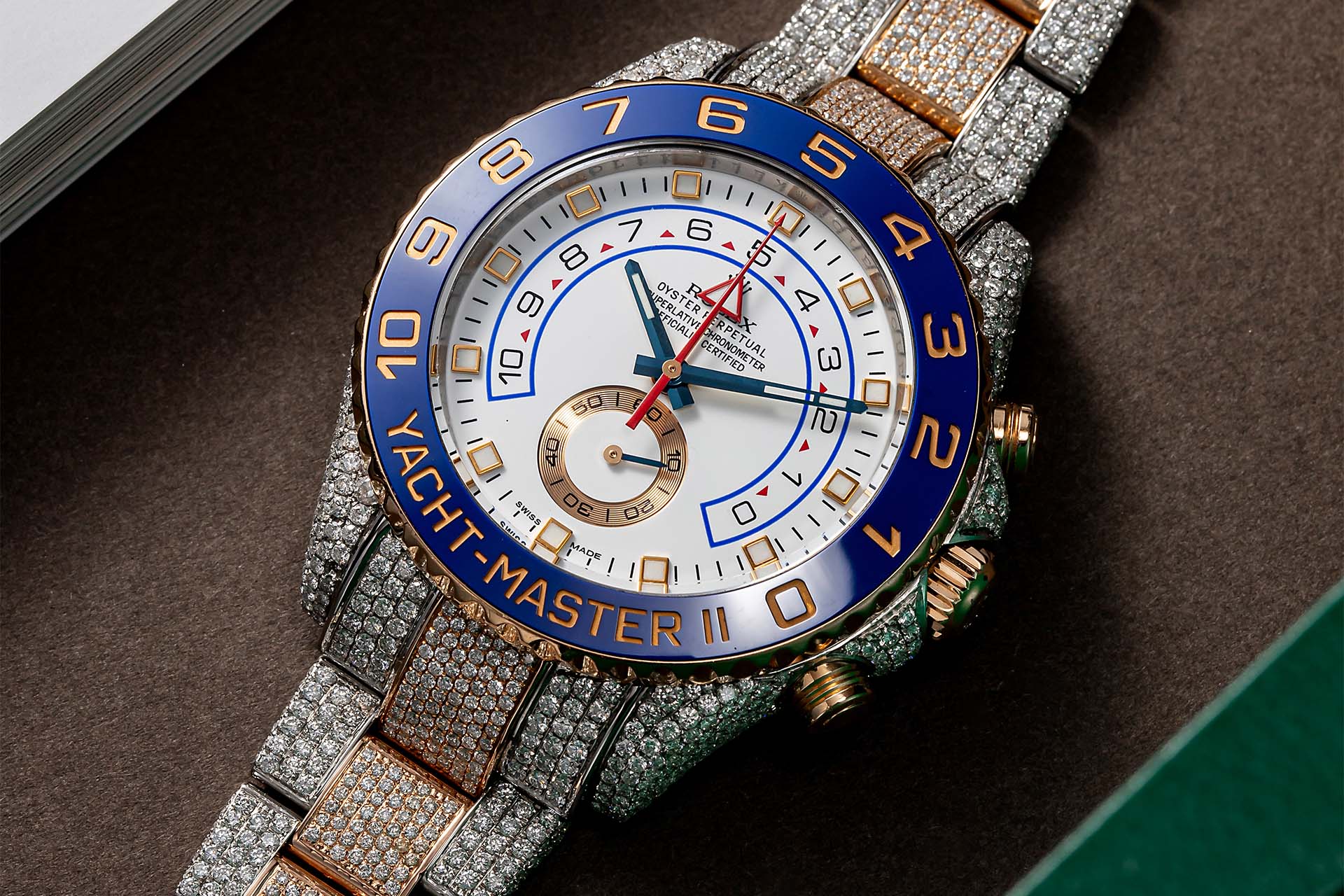
Diamonds vs Gemstones on a Watch: Hardness, Colour, Cost and Care Compared

Summary: Diamonds are the hardest stone you can set on a watch at 10 on the Mohs scale, but sapphires and rubies at 9 are tougher against knocks and carry colour a diamond cannot. Emeralds sit at 7.5 to 8 and need the most care. On a bezel, coloured stones typically cost around half the price of a diamond setting of the same cut.
- Diamond is pure carbon and rates 10 on the Mohs hardness scale, roughly four times harder than corundum on absolute measurements
- Sapphire and ruby are both corundum at Mohs 9 and have no cleavage plane, which makes them more resistant to chipping than diamond
- Emerald rates 7.5 to 8 and over 90 percent of emeralds are fracture-filled, so they must never go in an ultrasonic cleaner
- Diamonds are graded on the GIA 4Cs from D to Z colour and FL to I3 clarity; coloured stones have no single universal grading scale
- A white gold Patek Philippe Nautilus 5711 bezel at Time 4 Diamonds costs 9,995 pounds set with diamonds and 4,995 pounds set with emeralds or rubies
The question we hear most often at the setting bench is not which stone is prettier. It is which stone will still look right in ten years on a watch that gets worn every day. Diamonds and coloured gemstones answer that differently, and the differences come down to mineralogy rather than taste. This guide compares diamond, sapphire, ruby and emerald as they behave on a bezel, a dial or a bracelet, from a workshop that has been setting all four into Rolex, Patek Philippe and Audemars Piguet cases since 2005.
One point of terminology first, because it trips people up. A diamond is a gemstone. The trade separates the two out of habit, since diamonds have their own grading system and their own market, but geologically a diamond is one gemstone among many. When this article says gemstones it means coloured stones, chiefly the three that matter on a luxury watch: sapphire, ruby and emerald.
Diamonds vs Gemstones at a Glance
| Stone | Mineral | Mohs hardness | Toughness | Ultrasonic safe | Nautilus 5711 bezel at Time 4 Diamonds |
|---|---|---|---|---|---|
| Diamond | Carbon | 10 | Good, but has cleavage planes | Yes | 9,995 pounds |
| Sapphire | Corundum (aluminium oxide) | 9 | Excellent, no cleavage | Yes, unless fracture-filled | Built to order |
| Ruby | Corundum (aluminium oxide) | 9 | Excellent, no cleavage | Yes, unless fracture-filled | 4,995 pounds |
| Emerald | Beryl | 7.5 to 8 | Poor to fair, usually fractured | No | 4,995 pounds |
Prices are for our white gold Patek Philippe Nautilus 5711 bezels as listed at the time of writing and include fitting by our watchmakers. They move with the metal and stone markets, so treat them as a snapshot rather than a quote.
What Separates a Diamond From Other Gemstones
Chemistry, mostly. A diamond is a single element, carbon, locked into a cubic crystal lattice under pressure at depths of around 150 kilometres and brought to the surface in kimberlite eruptions. Every other stone on a watch is a compound. Sapphire and ruby are the same mineral, corundum, which is aluminium oxide; trace chromium turns it red and earns it the name ruby, while iron and titanium turn it blue and it becomes sapphire. Emerald is beryl, a beryllium aluminium silicate coloured green by chromium or vanadium.
Those recipes explain almost everything that follows. Carbon bonds give diamond its unmatched scratch resistance. Corundum's crystal structure has no cleavage plane, which is why a ruby will shrug off a knock that could chip a diamond. Beryl forms in turbulent geological conditions that leave most emeralds riddled with fractures, which is why they need the gentlest handling of the four. The old idea that diamonds are somehow more pure or more natural than coloured stones is marketing. All four are natural minerals; they simply behave differently on the wrist.
Gemstone Hardness Scale: Where Diamond, Sapphire, Ruby and Emerald Sit
Hardness means resistance to scratching, and the industry measures it on the Mohs scale devised by Friedrich Mohs in 1812. Talc sits at 1, diamond at 10, and each mineral can scratch anything below it. The scale is ordinal, not linear. The gap between corundum at 9 and diamond at 10 is far larger than the gap between 8 and 9. On absolute hardness measurements diamond comes out close to four times harder than corundum, and only a diamond can scratch a diamond.
| Mohs rating | Stone | What it means on a watch |
|---|---|---|
| 10 | Diamond | Nothing in daily life will scratch it, including another watch or a steel door frame |
| 9 | Sapphire, ruby | Only diamond or another corundum will mark it; suitable for a daily-wear bezel |
| 8 | Topaz, spinel | Hard enough for bezels, rarely used on luxury watches |
| 7.5 to 8 | Emerald | Resists scratching well but fractures make it vulnerable to impact |
| 7 | Quartz | The hardness of household dust, the threshold below which stones dull over time |
The quartz line matters more than people expect. Airborne dust is largely quartz at 7, so any stone softer than 7 is being slowly abraded every time you wipe your watch with a sleeve. Everything we set on a watch sits above that line, which is why you do not see amethyst or turquoise on a Daytona bezel.
Sapphire is the practical answer for a coloured stone that will be worn hard. A single-colour blue sapphire bezel on a yellow gold Submariner, for example, sits at Mohs 9 and takes daily wear in a way an emerald never could. This is the piece we build for that brief.
 Pre-order · UK
Rolex Submariner Yellow Gold Custom Blue Sapphire Bezel
Fits Rolex Submariner
- Metal18ct yellow gold
- StonesBlue sapphires, Mohs 9
- Price3,000 pounds, fitting included
- DeliveryWithin 30 days
Hardness vs Toughness: Why the Hardest Stone Can Still Chip
Hardness is scratch resistance. Toughness is resistance to breaking, and the two do not travel together. Diamond, the hardest natural material, has perfect cleavage along four octahedral planes. Strike it at the wrong angle and it can split cleanly, which is exactly how diamond cutters divide rough stones. Gemmologists put it bluntly: a jade cannot scratch a diamond, but a jade can break one.
Corundum has no cleavage at all. That makes sapphire and ruby the toughest of the four stones in practical terms, better able to survive the knocks a bezel takes against a car door or a desk edge. Emerald is the weak point. GIA's guidance puts the proportion of fracture-filled emeralds at 90 percent or more, meaning the surface-reaching fissures have been filled with oil or resin to improve clarity. Heat, solvents and vibration can all disturb that filling or extend the fracture.
For a watch owner the consequence is simple. A diamond or sapphire bezel can go through the ultrasonic tank and steam cleaner at a routine service. An emerald bezel cannot. Our watchmakers remove or shield emerald-set components before any ultrasonic cleaning and clean the stones with warm water and a soft brush, and we tell every emerald client this before they buy, because it changes how the watch has to be serviced for the rest of its life.
 Pre-order · UK
Custom White Gold Bezel Set with Green Emeralds for Patek Philippe 5711
Fits Patek Philippe Nautilus 5711
- Metal18ct white gold
- StonesBaguette-cut emeralds, Mohs 7.5 to 8
- Price4,995 pounds, fitting included
- CareNo ultrasonic cleaning
Colour: Where Coloured Gemstones Beat Diamonds
A white diamond is graded on the absence of colour. GIA's scale runs from D, completely colourless, to Z, visibly yellow or brown, and to an untrained eye the tint is invisible down to around J. That is why we set natural diamonds graded G to H colour and no lower than VS1 clarity on our bespoke watches: they read as white on the wrist without paying for a D that nobody can distinguish once it is set in a bezel.
Coloured stones are graded on the presence of colour, and colour drives their value more than any other factor. Gemmologists describe it in three parts: hue, the actual colour; tone, how light or dark it is; and saturation, how vivid it is. The most valuable rubies show a pure, strongly saturated red. The most valuable emeralds are a slightly bluish green with strong saturation. Two rubies of identical weight and clarity can differ in price several times over on colour alone.
This is where coloured stones win outright. A diamond bezel signals quality but reads as a single idea, brightness. A ruby bezel on a white gold Nautilus is a design decision, and it is the one we see most from clients who already own a diamond-set piece and want the next watch to look different from across a room. Fancy coloured diamonds do exist, but at the saturations that compete with a fine ruby they cost far more than the corundum does.
 Pre-order · UK
Custom White Gold Bezel Set with Red Rubies for Patek Philippe 5711
Fits Patek Philippe Nautilus 5711
- Metal18ct white gold
- StonesBaguette-cut rubies, Mohs 9
- Price4,995 pounds, fitting included
- DeliveryWithin 30 days
How Diamonds and Coloured Gemstones Are Graded
Diamonds have the most standardised grading of any gem. The GIA 4Cs, colour, clarity, cut and carat, are applied the same way by every major laboratory. Clarity runs from Flawless (FL) through VVS, VS and SI to Included (I3). Cut is graded Excellent to Poor for round brilliants and is the factor most buyers underrate, since a well-cut G VS1 will outshine a poorly cut D IF. Carat is weight, not size: one carat is 0.2 grams, and two stones of the same weight can have very different face-up dimensions depending on how they were cut.
Coloured stones have no equivalent universal scale. Laboratories such as GIA, SSEF, Gübelin and GRS issue reports that describe colour, identify treatments and, for fine stones, state a geographic origin, but there is no agreed D to Z equivalent for rubies or emeralds. Clarity expectations also differ by species. An emerald with visible inclusions, the internal garden the trade calls jardin, is normal and does not carry the penalty an equivalent inclusion would in a diamond. A ruby of the same clarity would be marked down more heavily.
In practice this means a diamond bezel can be specified on paper and delivered to that specification. A coloured stone bezel has to be selected by eye. Matching 36 baguette rubies so that none reads pinker or darker than its neighbour is the slow part of the job, and it is the reason we hand-pick every coloured stone rather than ordering to a grade.
Where Diamonds and Gemstones Come From
Diamond supply is concentrated and well documented. Kimberley Process figures for 2025 put global rough production at 98.8 million carats, with Russia the largest producer at 31.5 million carats, Botswana second and Angola third by volume ahead of Canada. Australia, once a major source, dropped away after the Argyle mine closed in 2020. Botswana and Namibia lead on quality, with Namibia's marine diamonds averaging over 340 US dollars per carat against Russia's 86.
Coloured stones are more scattered and origin carries a premium that diamonds do not have. Sapphire comes chiefly from Sri Lanka, Madagascar and Myanmar, with historic Kashmir material commanding the highest prices at auction. Ruby is dominated by Myanmar's Mogok valley and, since 2009, Montepuez in Mozambique. Emerald is led by Colombia, followed by Zambia and Brazil. A laboratory report stating Burmese origin for a ruby or Colombian origin for an emerald can double the stone's value against an otherwise identical stone from elsewhere, which has no parallel in the white diamond market.
How Rolex Uses Gemstones at the Factory
Coloured stones on watches are not an aftermarket invention. Rolex fitted single-colour gem-set bezels using sapphires, emeralds and rubies, usually paired with diamonds, through the second half of the 1990s. The modern reference point is the Cosmograph Daytona Rainbow, launched in 2012 in yellow and white gold and revived in Everose gold in 2018 as reference 116595RBOW. Its bezel carries 36 baguette-cut sapphires in a graduated spectrum and the case adds 56 brilliant-cut diamonds on the lugs and crown guards. The 2024 Daytona update carried the design forward as reference 126595RBOW.
The reason those watches trade at multiples of retail is stone selection. Rolex's stated standard is internally flawless stones, and assembling 36 sapphires that step through the spectrum without a visible jump means rejecting the overwhelming majority of candidates. That is the same problem we face on a custom rainbow bezel, at a fraction of the entry price, and it is why our Rolex Daytona Rainbow guide spends as long on stone matching as on the reference itself. The lesson for a buyer is that a coloured stone bezel is only as good as the matching. Ask to see the stones together under daylight before they are set.
What Diamonds and Gemstones Cost on a Watch
On a like-for-like bezel, coloured stones come in at roughly half the price of diamonds. Our white gold Patek Philippe Nautilus 5711 bezel is the cleanest comparison because the metal, the cut and the labour are identical across the three versions: set with baguette diamonds it lists at 9,995 pounds, set with baguette emeralds or rubies at 4,995 pounds. The gap is the stones. Gem-quality baguette diamonds of consistent colour and clarity cost more per stone than calibrated sapphires, rubies or emeralds of commercial grade, and the price difference flows straight through to the finished part.
That ratio flips at the top of the market. A fine untreated Burmese ruby or a Kashmir sapphire can cost more per carat than a white diamond of the same weight, which is why the factory gem-set Rolex and Patek Philippe pieces command what they do. For most custom work the stones are commercial-grade calibrated goods chosen for colour match rather than auction pedigree, and at that level the diamond premium holds. For an overview of the full diamond range we build, from a single bezel to a fully iced case and bracelet, see our guide to the best custom diamond-set Rolex watches and our iced out watches collection.
The diamond version of that same 5711 bezel is the benchmark against which the coloured stone options above are priced.
 Pre-order · UK
Custom White Gold Bezel Set with Diamonds for Patek Philippe 5711
Fits Patek Philippe Nautilus 5711
- Metal18ct white gold
- StonesNatural diamonds, G to H colour, VS1 or better
- Price9,995 pounds, fitting included
- DeliveryWithin 30 days
Setting, Servicing and Water Resistance
The stone is only half the decision. How it is set and how the watch is serviced afterwards decide whether a gem-set watch lasts. Baguette stones on a bezel are channel-set or claw-set into a gold ring machined to the exact profile of the factory part, and that ring replaces the stock bezel without touching the case, movement or case back. Softer or more fractured stones need more metal around them, which is why an emerald bezel often carries slightly heavier walls than a diamond bezel of the same design.
Fitting is where most aftermarket gem-set watches go wrong. A Submariner or GMT-Master II depends on bezel seating and gasket compression for its water resistance, and a bezel pressed on at a jeweller's bench can leave the watch reading fine on the wrist and leaking at the first swim. Our watchmakers are ex-Rolex trained and fit every bezel we sell, replace gaskets as needed and pressure test the case before it goes back to the client, through the same luxury watch servicing team that handles routine work.
At service time, tell whoever is working on the watch which stones are set. Diamond and untreated corundum tolerate ultrasonic and steam cleaning; emerald and any fracture-filled stone do not. Heat from a soldering torch during a repair can ruin an emerald's oil filling in seconds. A workshop that sets stones and services movements under one roof avoids that handover risk, and it is the reason our bezels and dials are fitted in-house rather than shipped loose.
Diamonds or Gemstones: Which Should You Choose?
There is no universal winner, but there is usually a right answer for a specific watch and a specific owner. The way we frame it at the bench:
- Choose diamonds for a daily-wear watch you never want to think about, for resale liquidity, and for a look that suits any metal and any dial colour
- Choose sapphire for colour with almost no compromise on durability, and for rainbow or gradient bezels where the full spectrum is available in one mineral
- Choose ruby for the strongest single colour statement on white gold or steel, with the same Mohs 9 hardness and no-cleavage toughness as sapphire
- Choose emerald for a dress or occasion watch you will service with care, and accept that it needs a protective setting and no ultrasonic cleaning
- Choose a mix, diamonds on the dial and a single coloured stone on the bezel, if you want colour without giving up the brightness a diamond brings to the hour markers
Whatever the answer, the stones should be seen together in daylight before anything is set. If you are weighing options for a specific reference, our customise your watch page is the starting point, and our guide on how to customise a Rolex covers the dial and bracelet options that sit alongside a bezel change.
Diamonds vs Gemstones FAQs
Is a diamond a gemstone?
Yes. A diamond is a gemstone made of pure carbon. The trade tends to talk about diamonds and gemstones separately because diamonds have their own standardised grading and their own market, but geologically a diamond is one gemstone among many.
What is the hardest gemstone after diamond?
Corundum, which is the mineral that forms both sapphire and ruby, at 9 on the Mohs scale. Moissanite is sometimes cited at 9.25 but it is almost always lab-created. Among natural stones commonly set on watches, sapphire and ruby are the hardest after diamond.
Are sapphires more durable than diamonds?
Sapphires are less hard, so they scratch more easily than diamond, but they are tougher because corundum has no cleavage plane. A sapphire is less likely than a diamond to chip or split from a sharp knock, which makes it a very practical stone for a bezel that gets daily wear.
Can you put an emerald watch in an ultrasonic cleaner?
No. Over 90 percent of emeralds are fracture-filled with oil or resin, and ultrasonic vibration can weaken the stone or disturb the filling. Steam cleaning carries the same risk. Emeralds should be cleaned with warm water and a soft brush and the stones shielded or removed before any ultrasonic work on the rest of the watch.
Are diamonds more expensive than sapphires, rubies or emeralds?
At commercial grade, yes. A diamond bezel typically costs around twice as much as the same bezel set with calibrated sapphires, rubies or emeralds. At the top of the market the position reverses, and fine untreated Burmese rubies or Kashmir sapphires can exceed white diamonds of the same weight on a per-carat basis.
What is the difference between precious and semi-precious stones?
Historically the trade called diamond, sapphire, ruby and emerald precious and everything else semi-precious. Gemmologists now regard the split as commercial rather than scientific, since a fine spinel or Paraiba tourmaline can outprice a mediocre sapphire. On luxury watches the four traditional precious stones remain the ones you will see set at the factory.
Does Rolex make watches with rubies, sapphires or emeralds?
Yes. Rolex set single-colour sapphire, emerald and ruby bezels on gold Daytonas through the late 1990s, and the Cosmograph Daytona Rainbow with its 36 graduated baguette sapphires has been in the catalogue since 2012, most recently as reference 126595RBOW. Coloured stones also appear as hour markers on gem-set Day-Date and Datejust references.



Leave a comment
This site is protected by hCaptcha and the hCaptcha Privacy Policy and Terms of Service apply.