

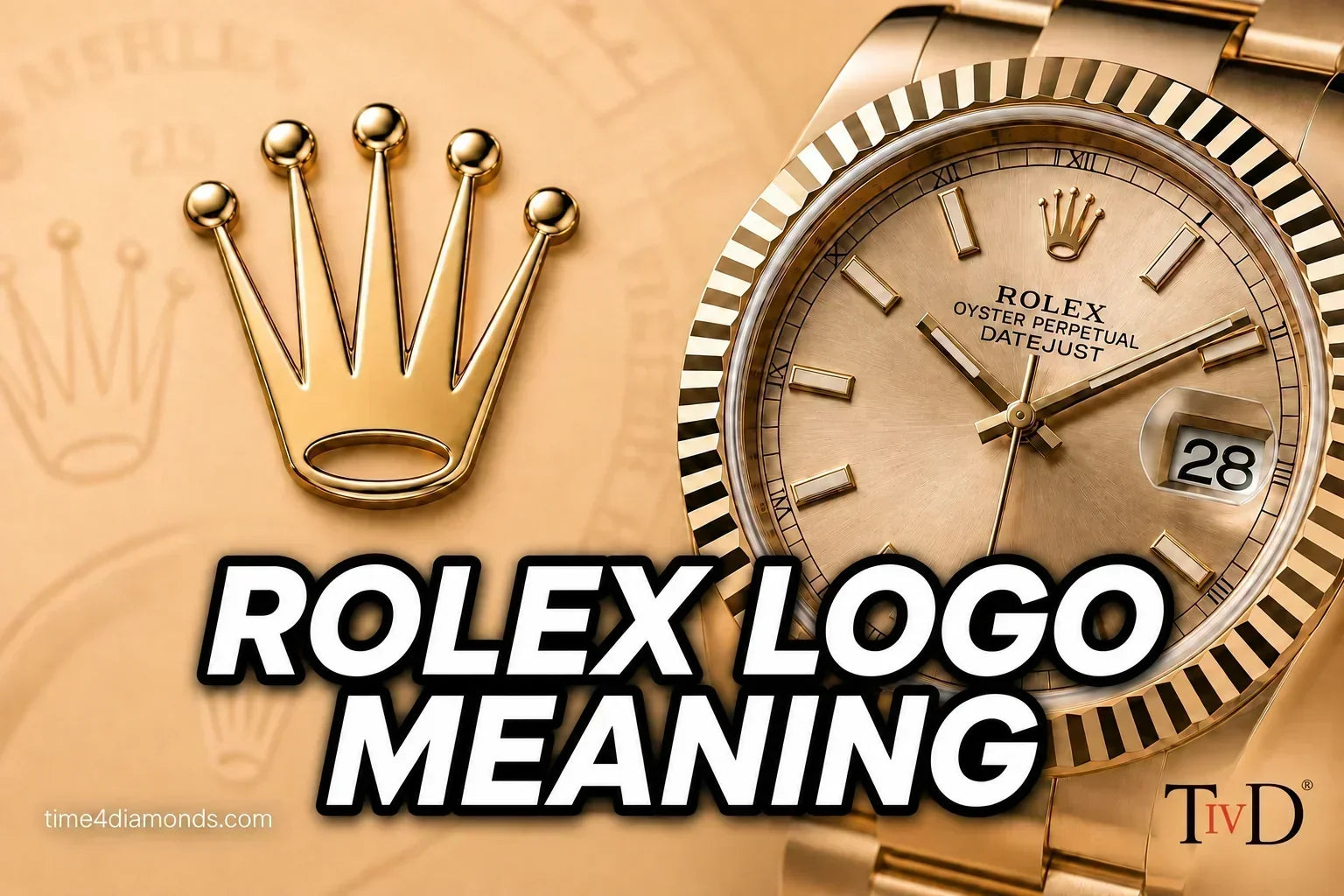
Rolex Logo Meaning: The Story Behind the Crown
Article Summary: The Rolex logo is a five-pointed crown called the coronet, trademarked in 1925, and it symbolises prestige, victory and personal achievement, an idea Rolex reinforces with the slogan "A Crown for Every Achievement". The brand has never confirmed what the five points mean, and the tiny markings beneath the coronet on the winding crown identify the watch's sealing system and case metal.
- Hans Wilsdorf founded the company in London in 1905, registered the Rolex name in 1908 and trademarked the coronet in 1925.
- Rolex has never explained the five points; the two leading theories are the five fingers of a hand and the five letters of R-O-L-E-X.
- A bar or one or two dots under the coronet marks a Twinlock winding crown rated to 100 metres; three dots mark a Triplock rated to 300 metres, with the dot pattern showing steel, gold or platinum.
- Since 2001 Rolex has laser-etched a microscopic coronet into the sapphire crystal at 6 o'clock, an authenticity check counterfeits usually fail.
Ask ten people to draw a luxury watch logo from memory, and most will sketch the same thing: a five-pointed crown. The Rolex coronet is arguably the most recognised emblem in watchmaking, yet the meaning behind it is less settled than you might expect. Rolex has never published a definitive explanation of its own symbol, which has left a century of theories, half-truths and collector folklore.
This guide separates what is documented from what is speculation. It covers where the crown came from, what the five points might represent, why the brand pairs gold with green, and something far more practical: how to read the tiny dots and lines stamped beneath the coronet on your winding crown, and how the symbol itself has become one of Rolex's most effective weapons against counterfeiting.
What Does the Rolex Logo Mean?

The Rolex logo is a crown, referred to by the brand as the coronet, and its meaning operates on two levels. The obvious one is hierarchy: a crown says king, and Rolex has spent a century positioning itself as the king of watches. The subtler one is achievement. Rolex framed its watches as rewards for accomplishment long before luxury marketing became an industry, and the crown is the visual shorthand for that idea, wearing one being presented as a small coronation of its own.
That reading is supported by the brand's long-running advertising slogan, "A Crown for Every Achievement", which ties the emblem directly to personal accomplishment rather than aristocracy. It is why Rolex sponsorship gravitates towards individual excellence: tennis, golf, motorsport, exploration. The crown marks the winner's wrist.
The History of the Rolex Crown Logo
The crown arrived surprisingly late in the Rolex story. Hans Wilsdorf and his brother-in-law Alfred Davis founded the company in London in 1905, trading as Wilsdorf and Davis. Wilsdorf wanted a brand name that was short, pronounceable in any language and small enough to sit on a dial, and registered "Rolex" in 1908. By his own account, the word came to him while riding a horse-drawn omnibus through London. The company relocated to Geneva in 1919, where it remains headquartered today.
For the first two decades, dials carried only the ROLEX wordmark or the Wilsdorf and Davis initials. The coronet was registered as a trademark in 1925, a year before the launch of the waterproof Oyster case in 1926, and began appearing alongside the wordmark on dials during the 1930s. Early versions of the coronet had five points of roughly equal height; the design was later refined into the modern silhouette with a taller central point. Beyond typography adjustments and small proportional changes, the emblem has remained essentially the same for a hundred years, which is itself a branding lesson few companies have matched.
| Year | Milestone |
|---|---|
| 1905 | Wilsdorf and Davis founded in London |
| 1908 | The name Rolex registered |
| 1919 | Company moves to Geneva |
| 1925 | Coronet registered as a trademark |
| 1926 | Waterproof Oyster case launched |
| 1930s | Coronet begins appearing on dials |
Collectors pay close attention to coronet variations when dating vintage pieces, since the shape, proportions and printing of the crown changed subtly across production eras. If you are hunting a specific vintage reference with a period-correct coronet and dial, the watch sourcing service at Time 4 Diamonds can locate examples through our dealer and collector network, with delivery within 30 days.
Why Five Points? The Theories Behind the Coronet
Here is the honest answer: nobody outside Geneva knows, and Rolex has never confirmed a meaning. The two theories with the longest pedigree are these.
The first holds that the five points represent the five fingers of a human hand, a nod to the handcraft behind each watch, and possibly to the hand that wears it. Some collectors point to early advertising imagery of an outstretched hand modelling a wristwatch as circumstantial support. The second theory is simpler: five points for the five letters of R-O-L-E-X. Both are plausible, neither is documented, and any article telling you definitively what the five points "stand for" is presenting speculation as fact.
What is documented is the effect. The five-pointed silhouette is distinctive enough to be legible at a few millimetres tall on a dial, on a clasp, or etched microscopically into sapphire. That functional versatility, more than any hidden symbolism, is probably why the design has survived unchanged.
Why Gold and Green?

In brand applications, the coronet is rendered in gold and the ROLEX wordmark in green. Gold needs little decoding: it is the metal of crowns, and refers to the precious metals Rolex works in. Green is more interesting, becoming the brand's signature colour, used on presentation boxes, warranty cards, and retail interiors. Green carries associations of prosperity and exclusivity, and Rolex has protected it so consistently that a particular shade of green now functions as a trademark in its own right.
That colour association runs deep in collector culture too. Green-dialled and green-bezelled models have earned some of the most famous monikers in the hobby, from the "Hulk" to the "Kermit" and "Starbucks." We have covered the full glossary in our guide to Rolex nicknames.
Note that on the watches themselves, the dial coronet is not always gold. Rolex matches the applied coronet to the dial furniture, so it may appear in yellow gold, white gold or pink gold tones depending on the model and hour markers.
Where the Crown Appears on a Rolex Watch
Once you start looking, the coronet is everywhere on a Rolex, and each placement has a purpose.
On the dial at 12 o'clock. The applied coronet sits above the ROLEX wordmark and is a genuine three-dimensional component, raised from the dial surface rather than printed on modern models. Its finishing quality is one of the first things an authenticator inspects. The coronet is also a fixed element of factory and custom dial design; every piece in our Rolex dials collection carries it, whether factory original or custom made.
On the winding crown. The coronet is stamped on the winding crown itself, above a set of small markings that identify the sealing system and case metal. More on decoding those below.
On the clasp. Modern Oyster and Jubilee bracelets carry the coronet on the clasp cover, and many use it as the hinge of the folding safety catch.
In the crystal. Since 2001, a microscopic coronet has been laser-etched into the sapphire crystal at 6 o'clock. It is nearly invisible to the naked eye, which is precisely the point.
Winding Crown Markings: What the Dots and Lines Mean
The most practical part of the Rolex crown story sits under the coronet on your winding crown. Those tiny dots and dashes are a factory code, which identifies the sealing system the crown uses and the metal the watch is made of.
Rolex uses two screw-down systems: the Twinlock and the Triplock. The Twinlock, introduced in 1953, uses two sealed zones and delivers 100 metres of water resistance on models such as the Datejust, Day-Date, Oyster Perpetual, Explorer and Air-King. The Triplock, introduced in 1970 alongside the Sea-Dweller, adds a third sealed zone for 300 metres and beyond, and equips the dive watches as well as the Daytona, GMT-Master II and Yacht-Master.
| Marking under the coronet | System | Case & Metal |
|---|---|---|
| Horizontal bar | Twinlock | Steel (including White Rolesor) |
| Two dots | Twinlock | Gold (and yellow Rolesor) |
| One dot | Twinlock | Platinum |
| Three equal dots | Triplock | Steel |
| Three dots, larger centre | Triplock | Gold |
| Three dots, smaller centre | Triplock | Platinum |
A common misconception is that the dot count counts the seals, but it does not. Two dots on a Twinlock crown indicate a gold case, not two gaskets; a single dot means platinum rather than a single-seal system, which Rolex does not make. Check the marking against the table, and you can read a Rolex's crown system and case metal from across a counter.
The Submariner is the textbook Triplock watch, three equal dots on a steel case rated to 300 metres. We currently have the modern reference in stock at our London showroom, ready to hand over the counter rather than join a waiting list.
 In stock · UK
Rolex Submariner Date 41mm Stainless Steel
Ref 126610LN
- Case: 41mm, Oystersteel
- Dial: Black
- Bezel: Black, Cerachrom
- Movement: Calibre 3235
The Crown as an Anti-Counterfeiting Weapon
Counterfeiters can print a coronet on a dial. What they struggle to replicate is how Rolex executes it, and the brand has leaned into that gap.
The clearest example is the laser-etched coronet, known to collectors as the LEC. From 2001, Rolex began etching a microscopic crown into the sapphire crystal at the 6 o'clock position, rolling it out across the range over the following two years or so. It is deliberately difficult to see: you typically need a bright light angled across the crystal, and often a loupe. Fakes tend to get it wrong in one of two ways: either omitting it entirely or etching it so crudely that it is visible to the naked eye, which on a genuine watch it should not be. On crystals fitted during a Rolex service, the etched coronet carries a small sideways S at its base, identifying it as a service replacement part.
The applied dial coronet is the other tell. On a genuine modern Rolex, it is a crisply finished metal component with clean edges and consistent proportions. Counterfeit coronets are frequently misshapen, poorly polished or sit at slightly the wrong angle. We cover these checks and a dozen others in our full guide on how to spot a fake Rolex, which walks through the crystal etching, dial, cyclops, movement and paperwork in detail.
If a crystal on your own watch has been replaced outside the Rolex network and you want it inspected, or the crown gaskets need attention to restore water resistance, our watch servicing workshop is led by an ex-Rolex-trained watchmaker who handles crown, tube and crystal work to factory standards.
A Crown for Every Achievement
The slogan does much of the symbolic heavy lifting. "A Crown for Every Achievement" reframes the emblem from a claim of royalty into a promise of reward: reach the summit of your field and the crown marks it. Rolex has spent decades reinforcing that message by putting the coronet on the wrists of people at the top of theirs, from Roger Federer to Tiger Woods. Our running guide to Rolex ambassadors tracks who wears what, reference by reference.
The crown also presides over the customisation world. Diamond-set bezels, stone dials and coloured ceramic work all happen around the coronet, never over it; the emblem stays untouched because it is the anchor of the watch's identity. If you are considering a personalised piece, our bespoke watches collection shows what our in-house workshop produces, and you can start a commission through the customise your watch service.
Frequently Asked Questions
What does the Rolex logo represent?
The Rolex logo, a five-pointed crown called the coronet, represents prestige, victory and achievement. It positions Rolex as the king of watchmaking and its watches as rewards for personal accomplishment, an idea reinforced by the slogan "A Crown for Every Achievement". Rolex trademarked the emblem in 1925.
What do the five points on the Rolex crown mean?
Rolex has never confirmed a meaning. The two most repeated theories are that the five points represent the five fingers of a hand, symbolising handcraft, or the five letters of the name Rolex. Both remain speculation.
What do the dots on a Rolex crown mean?
The markings under the coronet on the winding crown identify the sealing system and case metal. A bar, one dot or two dots indicate a Twinlock crown rated to 100 metres, on steel, platinum and gold cases respectively. Three dots indicate a Triplock crown rated to 300 metres or more, with the centre dot's size showing the metal.
Does every Rolex have a crown etched on the glass?
No. The laser-etched coronet at 6 o'clock was introduced from 2001 and phased in across the range over the following couple of years, so watches made before then do not have it. On genuine watches it is nearly invisible without angled light and magnification, and a crystal fitted at a Rolex service carries a small sideways S inside the etched crown.
What is the Rolex slogan?
Rolex's best-known advertising slogan is "A Crown for Every Achievement", which links the crown emblem to personal accomplishment. It has appeared in the brand's advertising for decades alongside campaign lines for individual models.
Is the Rolex crown worth anything on a pre-owned watch?
The coronet itself is not a separate item of value, but its condition matters to a valuation. A crisp applied dial coronet, correct winding crown markings and an intact laser-etched crystal all support authenticity and originality, which directly affect what a watch is worth. If you are weighing up a sale, Time 4 Diamonds provides valuations through its sell your watch service, in person in London or Dubai or remotely.




Leave a comment
This site is protected by hCaptcha and the hCaptcha Privacy Policy and Terms of Service apply.