

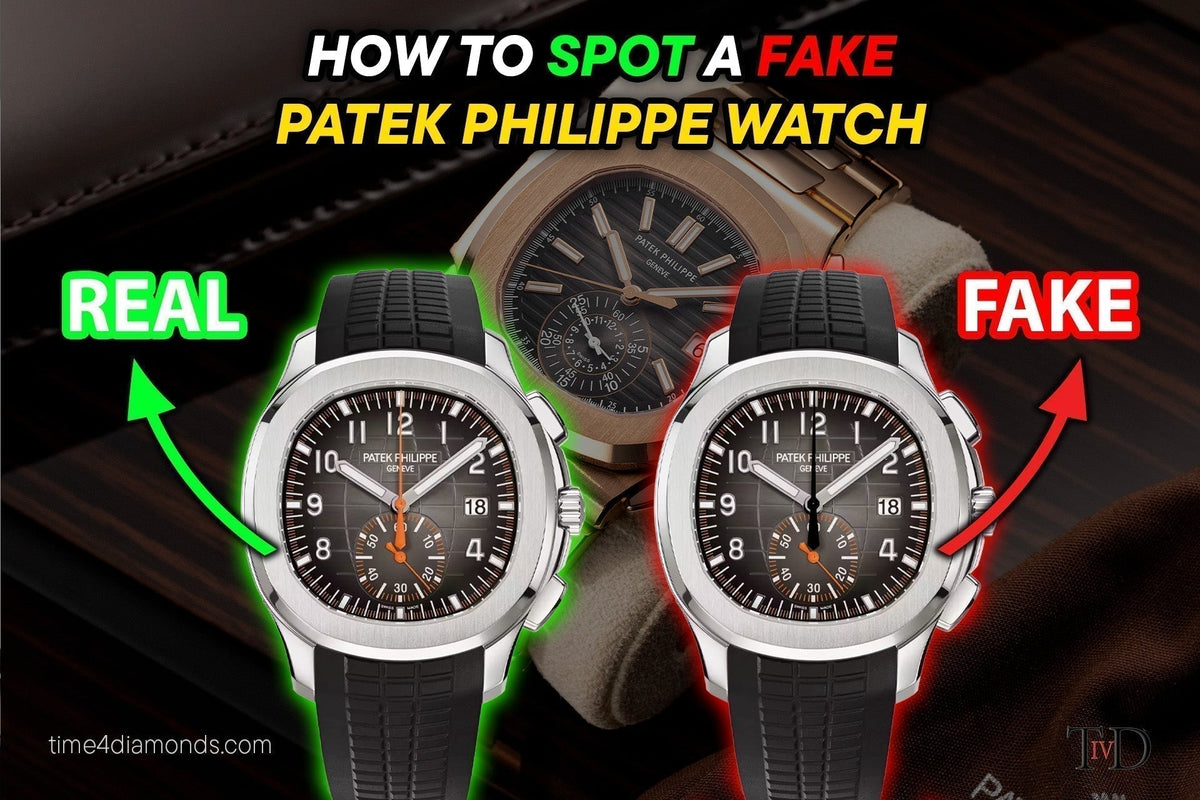
How to Spot a Fake Patek Philippe Watch
Summary: To spot a fake Patek Philippe, check the case proportions, dial printing, hallmarks and paperwork, then have a watchmaker open the caseback and compare the movement number and case number with the Certificate of Origin. No single outside check is conclusive. Papers can be forged, and an Extract from the Archives is not proof of authenticity.
- Every Patek Philippe carries two numbers: a movement number engraved on the movement and a case number engraved inside the caseback. Neither appears on the outside of the case.
- The Patek Philippe Nautilus 5711/1A measures 40mm from 10 to 4 o'clock and 8.3mm thick. A copy that sits visibly taller is usually hiding a generic movement.
- Patek Philippe began replacing the Geneva Seal on its mechanical movements with its own double P Patek Philippe Seal in 2009.
- An Extract from the Archives costs 500 Swiss francs and covers watches first sold at least ten years ago. Patek Philippe states that it is not proof of authenticity.
- Time 4 Diamonds authenticates Patek Philippe watches in its London workshop in 3 to 5 working days and issues a certificate of authentication.
A pre-owned Patek Philippe is one of the most expensive watches most people will ever buy, which is exactly why it gets copied. The better counterfeits, often sold as super clones, now reproduce the weight, the engravings and even the paperwork. A quick look is no longer enough.
This guide works through the checks in the order you would carry them out, starting with the watch in your hand and ending with the movement. Some checks only raise a warning. Others come close to proof, so each one below is rated by how much it tells you.
Fake Patek Philippe Checks at a Glance
Use this table as a running order. The first five checks need nothing more than good light and a loupe, which is a small jeweller's magnifying glass. The last two need a watchmaker.
| Check | What a genuine Patek Philippe shows | How much it proves |
|---|---|---|
| 1. Weight and finish | Dense in gold or platinum, with no sharp edges on case or bracelet | Low. Good copies pass |
| 2. Case proportions | Thickness matching the reference, such as 8.3mm on a Nautilus 5711/1A | Medium |
| 3. Dial under a loupe | Crisp printing, even spacing, cleanly finished markers and date window | Medium |
| 4. Crown | A small, sharply defined Calatrava cross on modern pieces | Low. Crowns get replaced |
| 5. Caseback | No serial or reference number engraved on the outside | Medium |
| 6. Hallmarks | Sharp fineness, Swiss control and oval PPCo stamps on precious metal cases | Medium |
| 7. Certificate of Origin | Reference, movement number and case number, stamped and dated by the retailer | Medium. Papers are forged too |
| 8. Extract from the Archives | Patek Philippe's record of how the watch left the workshops | Supporting evidence only |
| 9. Numbers against papers | Movement and case numbers that match the documents exactly | High, once the case is open |
| 10. Movement inspection | The correct calibre, seal and finishing for the reference and year | Highest, read with checks 1 to 9 |
Quality & Weight

Start by holding the watch. Patek Philippe cases are made in 18ct gold, platinum and, for a small part of the range, stainless steel. Gold and platinum are far denser than steel, so a precious metal Patek feels heavier than its size suggests. A gold-coloured watch that feels light is probably plated steel.
Run a fingertip along the case sides, the lugs and the bracelet links. Every edge on a genuine piece is smoothly finished, so nothing should catch your skin or a soft cloth. The rose gold chronograph pictured above is covered in our guide to the Nautilus 5980, a reference whose mix of brushed and polished surfaces is hard to copy cleanly.
Treat this as a first filter only. Weight and finish will catch a poor copy, but the best counterfeits are built to pass exactly this test.
Visual Features
If the watch feels right, move on to the details that are expensive to copy well. Compare everything against the exact reference and production year, because a feature that is correct on one Patek Philippe can be wrong on another.
Case
Counterfeit Patek Philippe watches are often thicker than the real thing, because a generic movement needs more room than a Patek calibre. The steel Nautilus 5711/1A is only 8.3mm thick. Its 40mm diameter is measured from 10 to 4 o'clock, so it is wider than that across the crown and hinge. A copy that stands noticeably proud of the wrist deserves suspicion before you look at anything else.
Shaped cases are harder to reproduce than round ones. The rounded octagon of the Nautilus, one of the most copied Patek Philippe designs, shows poor workmanship quickly. So does the Aquanaut. The round case of a Calatrava is more forgiving, so judge it on its lugs and bezel profile.
Platinum cases have their own tell. Since the late 1990s Patek Philippe has set a single small diamond into most platinum cases, normally in the case band between the lugs at 6 o'clock.
It is not universal: the minute repeater ref. 6301P carries it at 12 o'clock, the Cubitus 5822P uses a baguette-cut stone in the bezel and platinum pieces made before the practice began have none. A missing diamond on a recent platinum watch is a red flag. On a vintage one it proves nothing.
Dial
Put the dial under a loupe. Patek Philippe printing is crisp at ten times magnification, with even letter spacing and no bleeding at the edges of the text. Look at the hour markers, the frame of the date window and any subdials, since these are where misalignment and rough finishing show first.
On a Nautilus, the horizontal embossing should be sharp and evenly spaced across the whole dial. Then check that the configuration exists at all. Many fakes pair a dial colour, case metal or complication that Patek Philippe never made for that reference.
Crown
Modern Patek Philippe crowns are signed with the Calatrava cross, the brand's emblem. On a genuine crown it is small, sharply defined and centred. A shallow, oversized or soft-edged cross points to a counterfeit crown.
It does not settle the question either way. Crowns are replaced during servicing and some vintage pieces were never signed, so read this alongside the other checks.
Caseback
Find out whether your reference should have a solid caseback or a sapphire display back, then check the watch matches. Patek Philippe does not engrave serial or reference numbers on the outside of the caseback. A long number stamped on the back of a supposed Patek is a strong sign of a fake.
A display back lets you study the movement without opening the watch. On an automatic movement, look at the rotor first: its engraving should be fine and even, with the Calatrava cross cleanly cut. Manually wound movements have no rotor, so go to the bridges. Then look at the screws. Patek Philippe rarely uses blued screws, with the 2026 Cubitus 5840P a notable exception, so bright blue screw heads on any other modern reference are a warning to check against the correct calibre.
Documentation

Box and papers add confidence, but both are forged, as we explain in our guide to spotting a fake Rolex. Patek Philippe does not issue a plastic warranty card. It issues two paper documents, and they do very different jobs.
Certificate of Origin
The Certificate of Origin is the watch's birth certificate and its guarantee. It records the reference, the movement number and the case number, and it is stamped and dated by the retailer that sold the watch new. Those two numbers are what you will later compare against the watch itself.
Patek Philippe never reissues a lost certificate. A watch without one is not automatically fake, since plenty of genuine pieces have lost their papers over the decades, but it is worth less and needs closer inspection. A certificate that looks freshly printed for a watch that is 20 years old deserves the same scrutiny as the watch.
Extract from the Archives
If the certificate is missing, you can order an Extract from the Archives from Patek Philippe. It costs 500 Swiss francs and is available only for watches first sold at least ten years before the request. Patek Philippe asks for photographs of the watch, allows one extract per watch in any 12 months and quotes delivery within ten weeks.
The extract states how the watch left the workshops: type, movement number, case number, calibre, dial, date of manufacture and date of sale. It does not authenticate the watch in front of you. Patek Philippe says it is neither proof of authenticity nor a warranty, and the small print on the extract pictured above says the company takes no position on the watch's current condition, components or materials.
Treat it as useful supporting evidence. A refusal is informative too, because Patek Philippe will not issue an extract when the watch no longer matches its records.
Engravings

Three sets of engravings matter on a Patek Philippe. Two of them are visible from outside on precious metal watches. The third, and most important, sits inside the case.
Serial Numbers
Patek Philippe does not use a single serial number. Each watch has a movement number, engraved on the movement, and a separate case number, engraved on the inside of the caseback. Both are seven digits on modern watches, and both should match the Certificate of Origin or extract exactly.
You cannot read either number without removing the caseback. Patek Philippe says this should only be done by one of its retailers or service centres, and we would add any qualified watchmaker with the correct tools. Do not attempt it at home: a slipped case knife damages the watch and its value.
Matching numbers are strong evidence, not proof. Counterfeiters can copy real numbers from auction listings and sale photographs, so the numbers must also sit on a movement and case that are right for the reference.
Precious Metal Symbol & Purity
Gold and platinum Patek Philippe cases carry small hallmarks on the back of the case or the underside of the lugs. The fineness mark reads 750 for 18ct gold, meaning 75% pure gold, or 950 for platinum, meaning 95% pure platinum. Modern cases add the element symbol, so you will see Au750 or Pt950.
Alongside it sits the Swiss hallmark, the head of a St Bernard dog, used on Swiss precious metal since 1995. Many cases also carry a set of scales containing the fineness number, the Common Control Mark added for international trade, but its absence alone does not condemn a watch. Whatever stamps are present should be tiny and sharp, so blurred or shallow hallmarks on a watch sold as solid gold are a serious warning.
PPCo
The remaining stamp is an oval containing the letters PPCo. Swiss law requires every precious metal article to carry a responsibility mark identifying who made it, and this is the one used on cases from Patek Philippe's own case workshops. Older cases made by outside suppliers carry a numbered key or hammer head mark, so the absence of PPCo on a vintage piece is normal.
Internal Properties
The movement carries the most weight in an authentication. Everything up to this point narrows the odds, but a correct movement does not clear the whole watch. A watchmaker reads it together with the case, dial, components and documents before reaching a conclusion.
Movement
Start with the seal. Patek Philippe movements carried the Geneva Seal until 2009, when the company began replacing it with its own Patek Philippe Seal, a double P emblem. The change was gradual and covers mechanical watches, so judge the seal against the production period and not the sale date alone. A double P on a movement from the 1990s is wrong.
Then check the calibre against the reference and year. The Nautilus 5711 is a good example: it launched in 2006 with calibre 315 S C, moved to the 324 S C the following year and received the 26-330 S C in 2019. Only the 26-330 S C stops the seconds hand when the crown is pulled out, so a 5711 sold as a 2015 watch should not do that.
Finishing is the last layer. Bridges should show even Geneva stripes, bevelled and polished edges and clean, deep engraving, with screws finished the way that calibre should have them. A decorated rotor can be fitted over a generic movement, which is why the parts underneath the rotor matter more than the rotor.
Function
Test everything the watch claims to do. Chronograph pushers should start, stop and reset cleanly, the date should change crisply and a second time zone or moonphase should adjust as the manual describes. On poor copies of complicated models, the extra subdials are decoration and do nothing.
Watch the seconds hand as well, because its behaviour must match the reference. The 324 S C and 26-330 S C beat at 28,800 vibrations an hour, which gives a smooth sweep, while the earlier 315 S C runs at 21,600. A one-second tick is correct on Patek Philippe's quartz watches and on a few mechanical pieces built with jumping seconds, such as the ref. 6301P, but it is wrong on a Nautilus 5711.
Genuine, Customised or Counterfeit?
These are three different things, and sellers blur them. A counterfeit was never made by Patek Philippe. A customised watch is a genuine Patek Philippe that has been altered after it left Geneva, for example with a diamond-set bezel or an aftermarket dial. An original watch still has the parts it left the workshops with.
There is a fourth case worth knowing. A watch fitted with Patek Philippe replacement parts during a service is genuine, but it is no longer fully original. That distinction matters most on vintage pieces, where an original dial can account for much of the value.
We build customised watches ourselves, so we are plain about what that means. A customised Patek Philippe is real, but it is no longer original. Patek Philippe will not issue an Extract from the Archives for a watch modified outside its workshops, and some collectors only buy factory specification pieces.
The rule is disclosure. A reputable seller states in writing exactly what has been changed, and a customised watch should never be described or priced as an untouched one. If a listing mentions a custom part such as one of our Patek Philippe dials, ask whether the original component comes with the watch.
Think Your Patek Philippe Is Fake? What to Do Next
- Keep everything. Save the listing, the messages, the receipt and the payment record, along with the box and papers.
- Leave the caseback closed. Opening it without the right tools can mark the case and weaken your position with the seller.
- Book an authentication. The watch comes to our London workshop, where it is opened and examined by our watchmakers, who previously worked at Rolex. Allow 3 to 5 working days. The fee is £100 to £150 depending on the watch. Message us on WhatsApp to arrange it.
- If it is genuine, you receive our certificate of authentication. Should you then prefer to sell, we can value and buy your Patek Philippe.
- If it is not, we will explain what we found so you can take it up with the seller, your bank or the marketplace.
Authentication sits alongside our watch servicing and repairs. If the inspection shows the watch is due a service, the workshop can quote for that at the same visit.
Buying a Patek Philippe Watch from the Secondary Market

The safest way to avoid a fake is to buy from a seller who has already done this work and stands behind it. Ask who inspected the watch, whether the case was opened, what paperwork comes with it and what warranty applies. If a dealer cannot answer those four questions, ask for a written inspection report before you go any further.
Time 4 Diamonds has sold and serviced pre-owned watches in London since 2005. Every Patek Philippe we list is inspected by our watchmakers before it goes on sale and is sold with a 12 month warranty, and you can read more about our workshop and team. If the reference you want is not in stock, our sourcing service can find an inspected example.
The white gold World Time Chronograph pictured above is one of the Patek Philippe Complications currently in stock. It is a 2017 watch supplied with its original box and papers.
 In stock
Frequently Asked Questions
How can I tell if my Patek Philippe is real?
Check the case thickness, dial printing, hallmarks and paperwork first. Reliable confirmation needs a watchmaker to open the case, read the movement number and case number and assess the calibre, case, dial and documents together.
Do fake Patek Philippe watches have serial numbers?
Yes. Many fakes carry numbers, and better ones use real numbers copied from photographs of genuine watches. A number engraved on the outside of the caseback is a warning sign in its own right, because Patek Philippe engraves the case number inside the caseback and the movement number on the movement.
Does an Extract from the Archives prove a Patek Philippe is genuine?
No. The extract confirms what Patek Philippe recorded when the watch was made and first sold. Patek Philippe states that it is neither proof of authenticity nor a warranty, so it supports an authentication but cannot replace a physical inspection.
How much does a Patek Philippe Extract from the Archives cost?
Patek Philippe charges 500 Swiss francs. The watch must have been first sold at least ten years before the request, only one extract is issued per watch in any 12 months and the fee is refunded if the watch turns out to be ineligible.
Do all platinum Patek Philippe watches have a diamond?
No. The small diamond between the lugs at 6 o'clock was introduced in the late 1990s, so earlier platinum watches do not have it. A few later references place it elsewhere or use a different cut.
Is a customised Patek Philippe a fake?
No. A customised Patek Philippe is a genuine watch that has been modified, typically with diamond setting or a new dial. It should always be sold with the changes disclosed, and buyers should know that Patek Philippe will not issue an Extract from the Archives for a watch altered outside its workshops.
Can Time 4 Diamonds authenticate a Patek Philippe?
Yes. The watch needs to be with us in London for 3 to 5 working days, where our watchmakers open and examine it. The fee is £100 to £150 depending on the watch. A watch that passes is returned with our certificate of authentication.


Written by
Adam Dedman
Adam is a watch specialist at Time 4 Diamonds and a collector in his own right. He works with the pieces passing through the London showroom daily, covering condition, references and what separates a strong example from an average one.



1 comment
انا أشتريت من حوالي 10 سنوات ساعة باتيك فليب من احد السواح أثناء زيارته لتونس وهي من الطراز المنقوش ممكن تكون من مادة البلاتين وهي داء،ية وهي في حالة جيدة جدآ لم أعرض لا على سايق ولا على بايع للساعاة بماذا تنصحوني بأن اتأكد من أصلها
Khrouf mohamed
Leave a comment
This site is protected by hCaptcha and the hCaptcha Privacy Policy and Terms of Service apply.