

Rolex Bracelet Types Explained: Every Bracelet from Oyster to Settimo
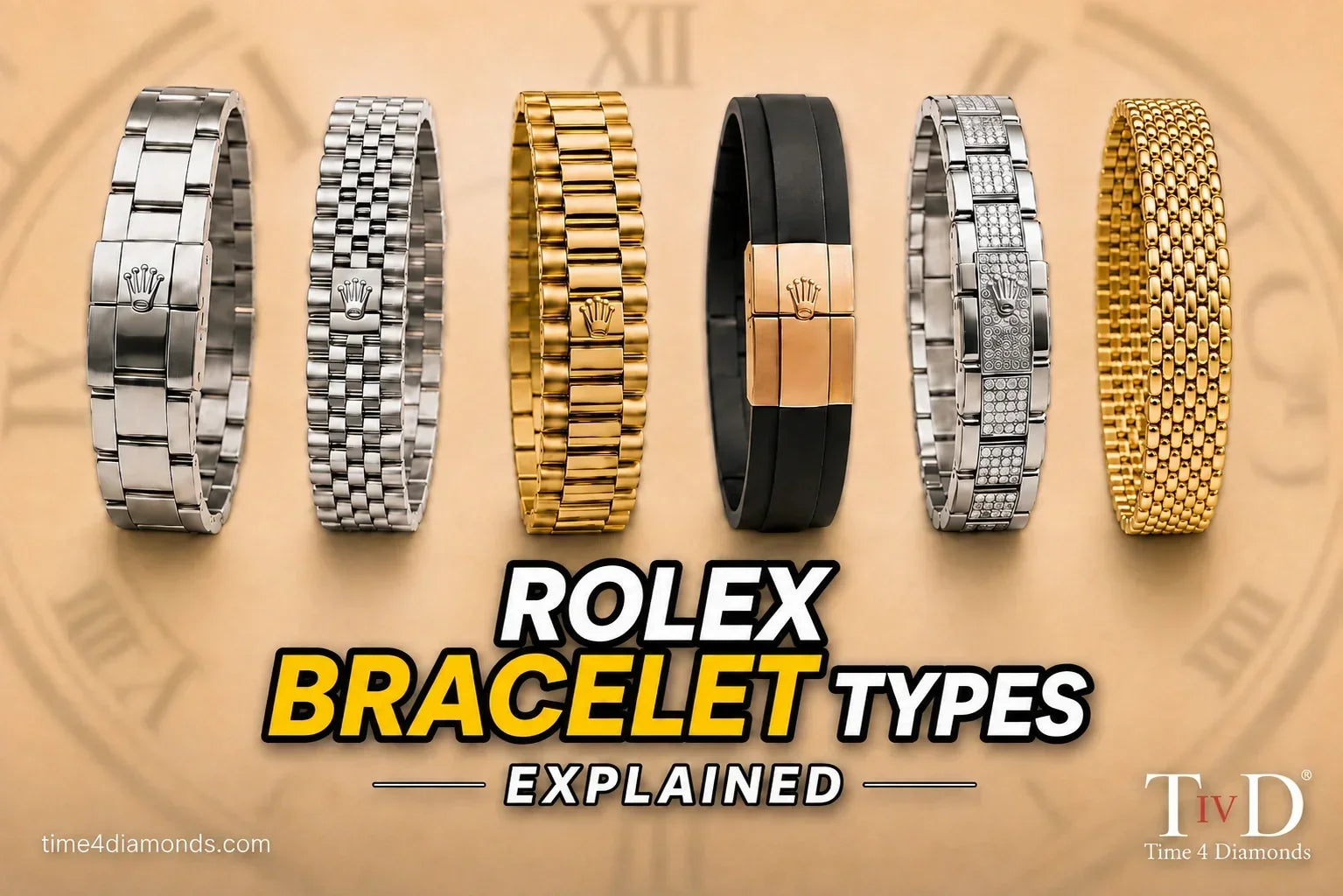
Article Summary: Rolex makes seven named bracelet types. The three-link Oyster (patented 1947), five-link Jubilee (1945), semi-circular President (1956), gem-ready Pearlmaster (1992), elastomer Oysterflex (2015), integrated Flat Jubilee (2025) and seven-link Settimo (2025). Each is tied to specific models and clasps, and the choice affects comfort, character and resale value.
- The Oyster bracelet was patented in 1947, reached wrists in 1948 and remains the standard fitting on the Submariner, GMT-Master II, Daytona and Explorer.
- The Jubilee bracelet launched in 1945 on the first Datejust, reference 4467, to mark the 40th anniversary of Rolex.
- The President bracelet debuted in 1956 with the Day-Date and has only ever been made in 18ct gold or 950 platinum.
- The Oysterflex, introduced in 2015 on the Everose Yacht-Master 116655, hides a titanium and nickel alloy blade inside its black elastomer coating.
- In 2025 Rolex added two new bracelets in a single year: the integrated Flat Jubilee on the Land-Dweller and the seven-link Settimo on the Perpetual 1908.
Ask most buyers to describe a Rolex and they will talk about the dial, the bezel or the reference number. The bracelet gets decided last, yet it is the part touching your skin all day and the part that most changes how the same watch reads on the wrist. A GMT-Master II on an Oyster is a tool watch. The identical reference on a Jubilee is something you can wear with a dinner jacket.
For eighty years Rolex ran on just three bracelet designs. Then 2025 arrived and the brand added two new ones in a single Watches and Wonders presentation, the first new bracelet architectures since the Oysterflex arrived in 2015. That makes this a good moment to lay out the full set: what each bracelet is, when it appeared, which models wear it and how the clasp systems differ. We handle these bracelets daily in our London workshop, so where relevant we have added what we see across pre-owned examples too.
The Seven Rolex Bracelets at a Glance
| # | Bracelet | Introduced | Link design | Found on |
|---|---|---|---|---|
| 1 | Oyster | Patented 1947, worn from 1948 | Three flat links | Submariner, GMT-Master II, Daytona, Explorer, Datejust and most of the range |
| 2 | Jubilee | 1945 | Five rounded links | Datejust, GMT-Master II, Sky-Dweller |
| 3 | President | 1956 | Three semi-circular links | Day-Date, select Lady-Datejust |
| 4 | Pearlmaster | 1992 | Five rounded links, gold only | Pearlmaster line |
| 5 | Oysterflex | 2015 | Metal blade in black elastomer | Yacht-Master, Daytona, Sky-Dweller in precious metals |
| 6 | Flat Jubilee | 2025 | Five flat links, integrated | Land-Dweller only |
| 7 | Settimo | 2025 | Seven small polished links | Perpetual 1908 in yellow gold |
1. The Oyster Bracelet: The Rolex Default Since 1948

The Oyster is the bracelet most people picture when they picture a Rolex. Three flat links across, a broad centre link flanked by two narrower outer links, built for strength first and everything else second. Rolex patented the design in 1947 and had it on watches by 1948, though its roots go back further: through the 1930s and 1940s the specialist bracelet maker Gay Freres produced early link bracelets for Rolex before the design was formalised in house.
Construction has evolved in three broad stages. Early Oyster bracelets used riveted links, later examples moved to folded links and modern production uses solid links machined from Oystersteel or precious metal. On pre-owned watches this matters. Older folded-link bracelets stretch with wear, which is one of the first things we check when a vintage piece comes through our workshop. A solid-link Oyster on a recent reference should show almost no stretch at all.
Clasps vary by model. Classic references use the Oysterclasp, sports models use the Oysterlock safety clasp with its flip-lock cover, and most current Oyster bracelets carry the Easylink comfort extension, a fold-out link that adds roughly 5mm without tools. Dive models go further with the Glidelock system, which allows around 20mm of tool-free adjustment in 2mm steps so a Submariner can fit over a wetsuit sleeve.
If you want the sportier face of the current GMT-Master II, the Batman on its Oyster bracelet is the configuration collectors default to, and we have it in stock in London.

Rolex GMT-Master II Batman Black Dial Oyster 126710BLNR
Ref 126710BLNR
- BraceletOyster, Oysterlock clasp
- Case40mm Oystersteel
- BezelBlue and black Cerachrom
- Price£13,995
2. The Jubilee Bracelet: Born With the Datejust in 1945

The Jubilee is the oldest named Rolex bracelet still in production. It arrived in 1945 on the very first Datejust, reference 4467, created to mark the 40th anniversary of the company, which is where the name comes from. Five links across, with three smaller rounded centre links between two flat outer links, it drapes around the wrist rather than sitting on it. That extra articulation is why so many owners find it the most comfortable metal bracelet Rolex makes.
Originally a dress bracelet in 18ct yellow gold, the Jubilee crossed into sports territory when it became an option on the GMT-Master line, and today it splits opinion in the best way. On a Datejust 36 it reads classic. On a steel GMT-Master II it reads deliberately retro, a nod to the Pan Am era references. Depending on the model, Jubilee bracelets close with either the concealed Crownclasp or the Oysterclasp and Oysterlock, and the sports fittings include the same Easylink 5mm extension as the Oyster.
The clearest way to see what the Jubilee does to a watch is to compare the same reference on both bracelets. We currently hold the GMT-Master II 126710BLNR in each configuration, and the Jubilee version below is the direct counterpart to the Oyster example above.

Rolex GMT-Master II Stainless Steel Black Dial Jubilee 126710BLNR
Ref 126710BLNR
- BraceletJubilee, Oysterlock clasp
- Case40mm Oystersteel
- BezelBlue and black Cerachrom
- Price£15,995
3. The President Bracelet: Precious Metal Only Since 1956

The President bracelet was created in 1956 for the launch of the Day-Date and the two have never been separated. Three semi-circular links across, always fully articulated, always closed by the concealed Crownclasp, and only ever produced in 18ct gold or 950 platinum. Rolex has never made a steel President, which is a large part of why the bracelet signals what it signals.
The name has its own history. Lyndon B. Johnson was photographed wearing a yellow gold Day-Date during his presidency, and the association between the watch, the bracelet and high office stuck permanently. It is the reason the Day-Date itself is nicknamed the Rolex President, a story we cover in more depth in our guide to Rolex nicknames. Beyond the Day-Date, versions of the President have appeared on precious metal Lady-Datejust references, but the core rule holds: President means gold or platinum, nothing less.
On the wrist the semi-circular links catch light differently to any other Rolex bracelet, closer to jewellery than to equipment. The platinum Day-Date 40 below is the reference that shows this best, and it is in our London showroom now.

Rolex Day-Date 40 Platinum Ice-Blue Dial 228206
Ref 228206
- BraceletPresident, Crownclasp
- Case40mm 950 platinum
- MovementCalibre 3255, 70 hour reserve
- Price£54,995
4. The Pearlmaster Bracelet: The Jewellery Piece From 1992

Launched in 1992 with the Lady-Datejust Pearlmaster, the Pearlmaster bracelet is the rarest of the traditional metal designs. Five links across like the Jubilee, but with larger rounded links, always in 18ct gold and frequently set with diamonds along the centre row. Rolex positioned it as the crown jewel of the bracelet range and it stayed exclusive to the Pearlmaster watch line rather than spreading across the catalogue.
Because Pearlmaster models appear far less often on the pre-owned market than Datejust or Day-Date references, the bracelet has become a collector detail in its own right. It is also the design that most clearly anticipates what many of our clients ask for today: a factory-look diamond-set bracelet. Our in-house workshop, staffed by watchmakers who previously worked at Rolex, sets Oyster and Jubilee bracelets with round brilliant or baguette stones as part of a full bespoke build, which achieves the Pearlmaster effect on the model you actually want to wear.
5. The Oysterflex: Rubber Outside, Metal Inside, Since 2015

The Oysterflex divides people until they handle one. Introduced in 2015 on the Everose gold Yacht-Master 116655, it looks like a rubber strap but Rolex classifies it as a bracelet for a reason. Inside the black elastomer coating sits a flexible blade of titanium and nickel alloy, which gives the band the structure and longevity of metal. On the underside, a patented cushion system lifts the band slightly off the skin for airflow, one of those details you only notice after a full day of wear.
The Oysterflex closes with the same Oysterlock safety clasp as the steel sports bracelets, and on the Yacht-Master 42 it gains Glidelock adjustment as well. Rolex fits it exclusively to precious metal cases, currently across the Yacht-Master, the Daytona and the Sky-Dweller, which creates a deliberate contrast: a gold watch that wears like a sports instrument.
One practical note from the workshop side. Unlike a metal bracelet, an Oysterflex is a wear item. The elastomer will eventually mark and age with heavy use, and replacement goes through Rolex, so factor that into long-term ownership. Our Everose Oysterflex pieces sell quickly and none are on the shelf as this guide goes live, but our team sources Yacht-Master and Daytona references on Oysterflex to order through our watch sourcing service, typically within 30 days.
6. The Flat Jubilee: The 2025 Integrated Bracelet

The Land-Dweller arrived at Watches and Wonders 2025 as the most significant new Rolex line in years, and it brought the first integrated Rolex bracelet with it. The Flat Jubilee keeps the five-link layout of the classic Jubilee but flattens and sharpens every surface, then flows directly into the case with no visible gap between lugs and links. It exists only on the Land-Dweller and cannot be ordered on any other model.
The result sits squarely in the integrated sports watch category, and the bracelet is doing as much of the work as the case or the high-frequency calibre 7135 inside. If the classic Jubilee is soft and rounded, the Flat Jubilee is architectural. For a fuller picture of where the Land-Dweller fits within the current range, our guide to every Rolex model explained covers the whole 2026 line-up.
7. The Settimo: Seven Links for the Perpetual 1908

The second new bracelet of 2025 went the other direction entirely. The Settimo, from the Italian for seventh, is built from rows of seven small fully polished links, closer in spirit to a 1950s jewellery bracelet than to anything else in the Rolex catalogue. It was created exclusively for the Perpetual 1908 dress watch and at launch comes only in 18ct yellow gold, attached to the case by a newly patented system with no fitted end links, and closed by the concealed Crownclasp.
Context makes the Settimo more interesting. The Perpetual 1908 launched in 2023 on leather straps only, fastened by the Dualclasp, so the Settimo is the first bracelet the model has ever had. Rolex clearly intends the 1908 to carry its dress watch ambitions, and giving it a bespoke bracelet architecture two years into its life signals a long-term commitment to the line. Expect white gold and platinum versions to be the obvious next step, though Rolex has announced nothing.
Oyster or Jubilee: How to Choose
This is the decision most buyers actually face, since the Datejust and the GMT-Master II offer both. The honest answer is that neither is better, they are tuned for different things. The Oyster is stiffer, more robust and visually quieter. The Jubilee is more flexible, lighter feeling on the wrist and more detailed to look at. If your wrist swells through the day or you sit at a keyboard, the drape of the Jubilee tends to win on comfort. If the watch will see hard use, the broad links of the Oyster take scratches and polishing better over decades.
Resale is close to neutral between them on current references, so buy the one you will enjoy. On the Datejust 41 the Jubilee with a fluted bezel is the definitive configuration, and the Wimbledon below is the version of that formula we sell more than any other.
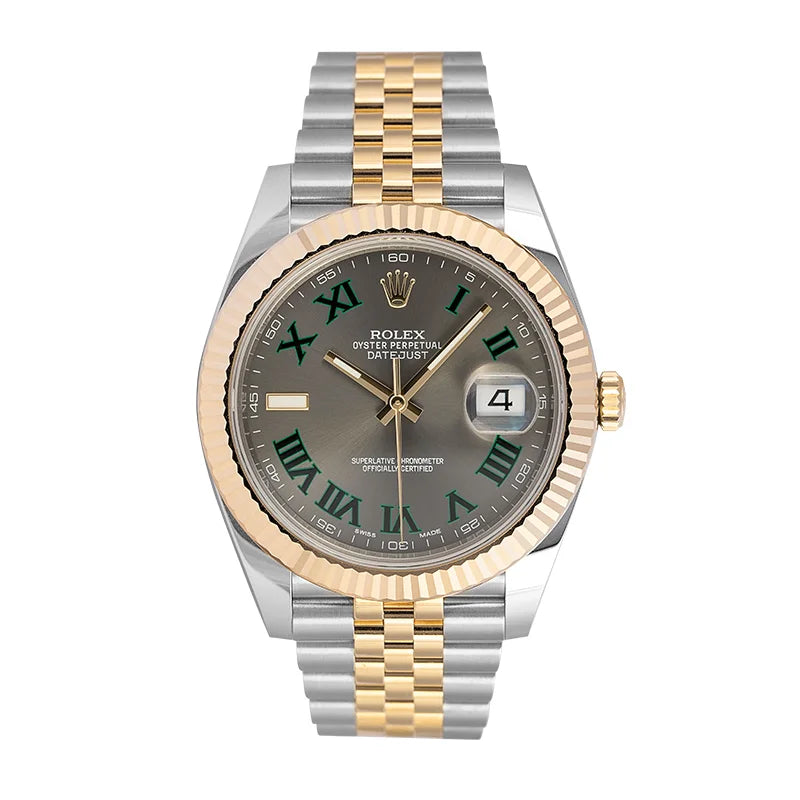
Rolex Datejust 41 Steel and Yellow Gold Wimbledon Dial 126333
Ref 126333
- Case41mm Oystersteel and yellow gold
- BezelFluted 18ct yellow gold
- MovementCalibre 3235, 70 hour reserve
- Price£13,495
Rolex Clasps and Extensions Compared
Half the engineering in a Rolex bracelet lives in the clasp. These are the systems you will encounter across the range and what each one does.
| System | What it does | Where you find it |
|---|---|---|
| Oysterclasp | Standard folding clasp | Classic models on Oyster and Jubilee |
| Oysterlock | Folding clasp with flip-lock safety cover | Professional models, Oysterflex |
| Crownclasp | Concealed clasp opened by a hinged coronet | President, Settimo, Pearlmaster, dressier Jubilee fittings |
| Easylink | Fold-out comfort extension of roughly 5mm, no tools | Most Oyster and sports Jubilee bracelets |
| Glidelock | Around 20mm of fine adjustment in 2mm steps | Dive models and Yacht-Master 42 |
| Dualclasp | Folding clasp for leather straps | Perpetual 1908 on leather |
If your clasp has gone loose, the bracelet has developed stretch or you simply want it refitted correctly, our guide on how to care for your Rolex covers the basics, and our workshop handles bracelet servicing alongside full movement work.
Aftermarket Straps and Bespoke Bracelet Work
Factory bracelets are only half the story. A growing share of owners rotate their watch onto aftermarket rubber for summer, travel or sport, then back onto metal, all without any permanent change to the watch. We stock Horus vulcanised rubber straps cut specifically for Rolex lug profiles in more than a dozen colours through our Rolex straps collection, and fitting takes minutes.
For a first strap the jet black remains the sensible pick, since it works on steel, two-tone and gold cases alike.

Horus Rubber Strap for Rolex Watches Jet Black
Ref 20mm lug width
- MaterialVulcanised rubber
- Fit20mm Rolex lug profile
- FittingNo modification to the watch
- Price£155
At the other end of the spectrum sits full bespoke bracelet work: diamond setting across Oyster or Jubilee links, two-tone conversions and finishing changes, all carried out in house. The bracelet is usually the largest surface on the watch, which is why it defines a full diamond-set build more than the case or bezel does. Our article on how to customise your Rolex walks through the options and what each involves.
Rolex Bracelet FAQs
Which Rolex bracelet is the most comfortable?
Most owners find the Jubilee the most comfortable metal bracelet because its five smaller links let it drape and flex around the wrist. For sport and hot weather the Oysterflex is the most comfortable overall, since the elastomer surface removes metal-on-skin contact entirely.
Can you swap an Oyster bracelet for a Jubilee?
On references where Rolex offers both, such as the GMT-Master II and Datejust, the correct bracelet for your reference can be fitted by a competent watchmaker. Rolex itself operates a strict exchange policy on replacement bracelets, so most owners buy the watch in their preferred configuration or fit a correct pre-owned bracelet through a specialist.
Why is it called the President bracelet?
The bracelet debuted in 1956 with the Day-Date, and after Lyndon B. Johnson was photographed wearing a yellow gold Day-Date the presidential association became permanent. The bracelet and the watch both carry the nickname to this day.
Is the Oysterflex a rubber strap?
Not quite. The exterior is black elastomer, but inside runs a flexible titanium and nickel alloy blade, which is why Rolex classifies the Oysterflex as a bracelet. It launched in 2015 on the Everose Yacht-Master 116655 and fits only precious metal models.
What is the Rolex Settimo bracelet?
The Settimo is a seven-link solid gold bracelet introduced at Watches and Wonders 2025 exclusively for the Perpetual 1908. The name comes from the Italian word for seventh, and the bracelet uses small fully polished links with a concealed Crownclasp and a patented case attachment without end links.
Do Rolex bracelets add value at resale?
The original bracelet matters more than the bracelet type. A watch with its factory bracelet, matching clasp code and minimal stretch will always outperform the same reference on a replacement band. On vintage pieces, an original riveted or folded-link bracelet in good order can add meaningfully to the price.



,%20five-link%20Jubilee%20(1945),%20semi-circular%20President%20(1956),%20gem-ready%20Pearlmaster%20(1992),%20elastomer%20Oy...)
Leave a comment
This site is protected by hCaptcha and the hCaptcha Privacy Policy and Terms of Service apply.