

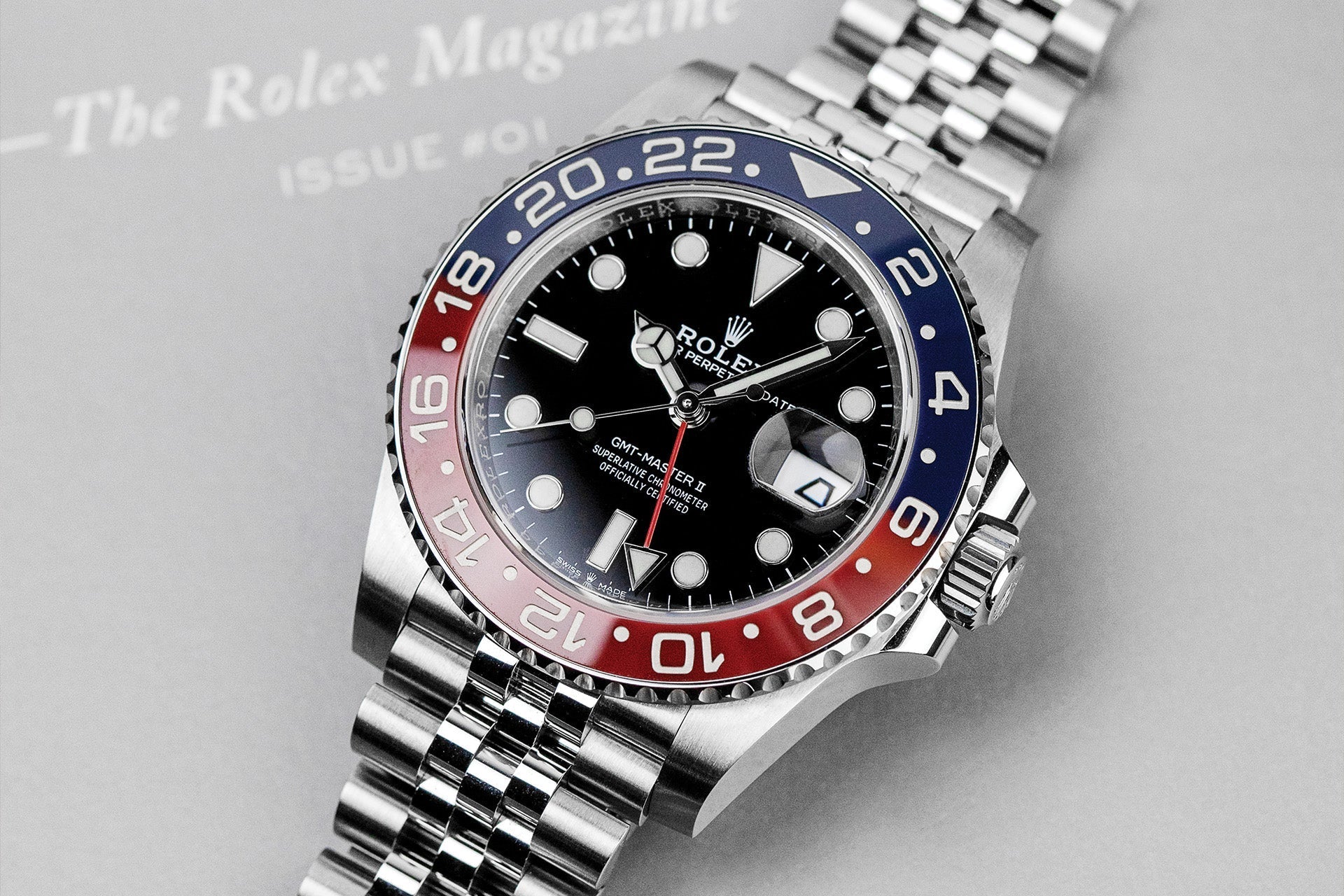
Rolex Pepsi Discontinued: The Full Story, The Market Reaction and What Collectors Should Do Next

On the opening day of Watches and Wonders 2026, Rolex removed the GMT-Master II Pepsi from its catalogue without a press release, without a farewell post and without naming a successor.
The steel reference 126710BLRO, the white gold reference 126719BLRO and the configurator option for a red and blue Cerachrom bezel all quietly vanished from rolex.com on 14 April 2026. The 126710BLRO product page returned the line "This page is not available" within hours of the fair opening, and authorised dealers had been told several weeks earlier that no further deliveries were coming.
The Pepsi is the most recognisable two-tone bezel in modern watchmaking and one of the most searched queries in the wider luxury watch market. The decision to end production of a steel sports Rolex that still commanded multi-year waiting lists at authorised retail is the most significant catalogue move the brand has made since the five-digit Submariner was retired in 2010.
The wider picture matters too, because the Submariner Date "Cookie Monster" blue dial was shelved in the same refresh, and that pattern tells us something about the direction Rolex wants the sports line to travel.
This is the detailed version of the story. What the reference actually was, why it ended, what the secondary market has done in the days since and which Pepsi is now the rational purchase for a collector with a real budget and a real plan.

A Short History of the Rolex Pepsi

The Pepsi nickname is older than most people assume. The GMT-Master arrived in 1955 as a tool watch for Pan Am pilots, and the reference 6542 launched with a red and blue Bakelite bezel designed to distinguish daylight and night-time hours on a 24-hour rotating scale.
There was an issue with Bakelite as it has weak properties, resulting in the bezel being cracked and faded. Therefore, in 1959, Rolex replaced the GMT-Master's Bakelite bezels with aluminium.
The history of the reference is worth understanding if you intend to buy one, because nearly every technical quirk of the modern Pepsi traces back to a specific decision in one of these earlier production runs. Our broader men's luxury watches inventory sits alongside the vintage references discussed here.
From that point, the Pepsi bezel appeared across five decades of GMT-Master and GMT-Master II references. A tight summary of the key production runs is below.
- Reference 6542, from 1955 to 1959. Bakelite blue and red bezel, no crown guards, Calibres 1030, 1036, 1065, and 1066.
- Reference 1675, from 1959 to 1980. Aluminium blue and red bezel, crown guards added (Pointed Crown Guards and Rounded Crown Guards), Calibres 1535, 1565 and 1575.
- Reference 16750, from 1980/81 to 1988. Aluminium blue and red bezel. Calibre 3075 with quick-set date function and higher beat rate.
- Reference 16700, from 1988 to 1999. Aluminium blue and red bezel. Calibre 3175 with fixed GMT-hour hand. Last of the GMT-Master line before the move to GMT-Master II exclusive production. Sapphire crystal.
- Reference 16710, from 1989 to 2007. Aluminium blue and red bi-directional bezel, which was interchangeable. Calibres 3185 and 3186, both allowing an independent hour hand, with the ability to show three time zones.
- Reference 116719BLRO, 2014 to 2018. Cerachrom blue and red bezel, cast in 18ct white gold only. This reference is what made the bicoloured ceramic bezel possible. Calibre 3186.
- Reference 126710BLRO, 2018 to 2026. Cerachrom blue and red bezel in Oystersteel. Launched on a Jubilee bracelet, then made available on the Oyster in 2021. Calibre 3285 with 70-hour power reserve.
- Reference 126719BLRO, 2018 to 2026. Cerachrom blue and red bezel, marking the second-generation white gold Pepsi, with a meteorite dial option. Calibre 3285 with 70-hour power reserve.
Seven decades, eight headline references, one bezel; the consistency of the Pepsi colourway explains why the 2026 discontinuation lands harder than the retirement of any other specific reference. For pilots, collectors and the broader public, the red and blue GMT was part of Rolex's identity.
Why did Rolex retire a watch that everyone wanted?

A steel sports Rolex that sells out at every authorised retailer, trades at a 100 per cent premium on the secondary market and has an eight-year continuous production track record is not obviously a candidate for the chopping block. The reasoning has to come from somewhere other than sales data. Four factors are likely in play, based on the pattern of recent Rolex catalogue moves:
The 1908 Strategy and the Quiet Repositioning of the Brand
Rolex has spent the last three years repositioning itself above the mid-five-figure steel sports bracket. The Perpetual 1908 line sits in white and yellow gold from launch, the Land-Dweller arrived in 2025 as a precious metal-only proposition at first, and the Daytona has tilted further towards platinum and gold configurations.
Removing the steel Pepsi eliminates one of the last remaining "entry-priced" sports icons in the catalogue, which supports the long-term migration of the sports lineup along the price curve. Is this us conspiring that more discontinuities for the Crown's steel sports watches are to come in the future? Potentially.
The Return of the Yacht-Master II and a Coming GMT Rework
The Watches and Wonders 2026 announcement package included a return of the Yacht-Master II and a reimagined Daytona; no new GMT-Master II references were shown.
When Rolex discontinues a flagship without presenting the replacement at the same fair, it usually means the successor is a year out and a larger architectural change is underway.
Referring to examples in the Pepsi's timeline that support this argument, the 1675 was replaced by the 16750 with a quick-set function, and the 16710 gave way to the 116710 with the ceramic insert and Calibre 3186.
Each of those transitions used a product vacuum to build anticipation. The difference this time is that Rolex named the successor in every prior case, which it has not done now.
Cerachrom Production Constraints
The blue and red Cerachrom bezel is one of the most difficult parts that Rolex produces. The colour split requires a two-stage firing process that was solved in 2014 for the 116719BLRO, then scaled for the steel 126710BLRO in 2018.
The failure rate on these inserts has been reported by industry analysts to be materially higher than single colour and other two-tone Cerachrom bezels.
A production reset, possibly involving a new manufacturing method or a new colour pairing, would explain why the bezel itself has been pulled from the configurator rather than just the metal variants.
Grey market management
Rolex has been public about wanting to reduce the gap between authorised retail and secondary market pricing. Discontinuation shrinks the perpetual waiting list problem by cutting the supply constraint off at the source.
The next reference can be launched into a hungry market without inheriting the queue. The retirement of the "Cookie Monster" Submariner Date on the same day fits the same pattern.
None of these reasons is mutually exclusive, as the most likely answer is that all four mattered, and the timing was set by the Cerachrom production cycle.
What the secondary market has actually done

The resale response has been sharp and measurable. The data points below are drawn from public trading platforms and are indicative rather than exhaustive, but the direction of travel is clear.
- Chrono24 reported a 500% surge in purchase requests for the 126710BLRO in the first week of March 2026 alone, after the first wave of dealer allocation cuts became public.
- WatchCharts showed the 126710BLRO market median rising roughly 19% over the preceding twelve months, from a base around £17,500 to the mid to high £20,000s in sterling.
- Median time to sell on Chrono24 for the 126710BLRO has compressed to 16 days, which puts it in the top 8% of watches by velocity.
- Post announcement asking prices on new unworn pieces have pushed through £28,000 in the UK, against a UK retail price of around £10,300 including VAT.
- The white gold 126719BLRO, with far lower production volumes, has seen asking prices move past £50,000 for clean pieces with a full set.
A 100% plus spread between the counter and the secondary market is not new for a hot Rolex. What is different this time is the lack of a stated replacement. Collectors who assumed a refresh would temper prices are now pricing in a full production gap of at least twelve to eighteen months, which rewards early buyers.
The comparable case is the reference 16710 after its 2007 discontinuation. Clean examples of that reference traded below retail for almost a decade, then began a steady climb from around 2016 onwards as the modern ceramic Pepsi drove attention back up the reference tree.
A top-tier 16710 with a full set now comfortably clears £16,000 in the UK, having spent years in the £6,000 to £8,000 bracket. The 126710BLRO could compress that cycle significantly, because the buyer profile at discontinuation is already engaged, and the reference is technically current.
For buyers who have been waiting on the Pepsi list for years, the practical answer is in the showroom rather than at retail. We currently hold a steel 126710BLRO with the original red and blue Cerachrom bezel and Oyster bracelet, ready to ship from London.
Rolex GMT-Master II Pepsi
Ref 126710BLRO
- Case40 mm Oystersteel
- BezelRed and blue Cerachrom Pepsi
- MovementCalibre 3285, 70-hour reserve
- BraceletOyster
Buyers chasing the white gold 126719BLRO, the meteorite dial variant or any of the earlier aluminium-bezel Pepsi references can brief our team directly. We source discontinued Rolex references on request through a global dealer network and can locate specific dial, bracelet and condition combinations.
Which Pepsi is the rational purchase now?

The collector question is which reference to target. The discontinuation has rearranged the relative value picture across the whole Pepsi family, so the answer depends on intent. A direct comparison of the three references most likely to interest a serious buyer is below.
| Reference | Production | Typical UK market (April 2026) | Best fit for |
|---|---|---|---|
| 1675 | 1959 to 1980 | £12,000 to £35,000 depending on dial, hands, condition | Vintage collectors, faded insert enthusiasts, long-term holders |
| 16710 | 1989 to 2007 | £9,500 to £18,000 depending on dial, hands, condition | Buyers who want a modern wear pattern without the ceramic era premium |
| 126710BLRO | 2018 to 2026 | £22,000 to £30,000 pre-owned, £28,000+ unworn | Collectors prioritising the reference that was just discontinued |
- The 1675 remains the most interesting long-horizon play because the top end of that market is driven by aesthetic attributes that cannot be replicated, specifically a fully faded pink or plum Pepsi insert paired with matched tritium lume.
- The 16710 is the most underrated because it was the last Pepsi you could fit with a non-ceramic bezel insert, which matters to anyone who cares about the purity of the aluminium era.
- The 126710BLRO is the purest news cycle trade, and the one where the buyer must accept that the current market is emotional rather than settled.
Our view on allocation is that a collector with one budget should choose based on wear pattern rather than theoretical appreciation. A 1675 is a weekend watch, a 16710 is a daily, and a 126710BLRO is a watch that needs to be worn hard enough to justify the price. Importantly, service costs on a discontinued Cerachrom bezel are a relevant factor if the collector plans to keep it for ten years. We can imagine a replacement Cerachrom insert on a 126710BLRO will become a dwindling stock item.
Buyers who want guidance on sourcing a clean example of any of the three references above can read our view on the pre-owned versus new Rolex question, which covers the core provenance, servicing and paperwork points in more detail.
The Counterfeit Problem will now accelerate
Every major Rolex discontinuation is followed by a rise in fake production, and the reason is simple. Fakes priced to flip against a live catalogue price have to undercut retail, but fakes priced against a rising secondary market have headroom.
The 126710BLRO is now the most targeted steel Rolex in the counterfeit market, and the 2026 generation of fake watches is materially better than anything that circulated five years ago.
The specific risk points on a 126710BLRO that counterfeiters tend to miss are the Cerachrom bezel colour split (the boundary between red and blue is almost always slightly soft on a fake), the date cyclops magnification at 2.5x, the movement bridge engraving on the Calibre 3285, which requires a dial open for verification, and the Jubilee or Oyster bracelet end link tolerance.
If you are buying privately, insist on an independent check from a watchmaker who handles the reference regularly. Our guide to spotting a fake Rolex covers the wider visual and mechanical tells.
Paperwork is now more valuable than it was six months ago. A 126710BLRO with full set, original warranty card stamped by an authorised dealer and service records to date will trade at a clear premium to a bare watch, because the chain of custody can be verified back to the point of sale. A bare watch in the current market carries a real authentication penalty on price.
Servicing also matters. A Calibre 3285 movement is a five-year service cycle, so a 2018 watch is now likely on its second trip to a watchmaker. Pepsi inserts damaged in handling are difficult and sometimes impossible to source, which makes access to a dealer with a stock of genuine factory parts more valuable than it was twelve months ago. Our watch service and repair team handles Cerachrom and bracelet work on the reference in-house.
What could replace the Pepsi?

Rolex has not announced a successor, so anything in this section is informed speculation rather than fact. The brand's current pattern suggests the next GMT-Master II will arrive at Watches and Wonders 2027, with a new calibre, a redesigned case profile and possibly a new bezel colourway to reset the Pepsi and Coke framing. The likely candidates are as follows.
- A revised Pepsi in Cerachrom with a different red and blue tonal balance, positioned as a next-generation model rather than a direct continuation.
- A fresh colour pairing, possibly green and black to align with the Sprite branding that has been trialled on the left-handed GMT-Master II reference 126720VTNR, or a cream and brown pairing in line with the Root Beer legacy.
- A move to a larger case diameter, potentially 41 mm, following the Submariner and Sea-Dweller case size shifts.
- A Calibre upgrade that replaces the 3285 with the newer architecture already used in the Land-Dweller, delivering better accuracy to minus two, plus two seconds per day and a longer service interval.
The Coke bezel, last produced on the aluminium 16710 in 2007, is the most requested absent colourway in the modern Rolex lineup. Its absence from Watches and Wonders 2026 was a surprise, because the Cerachrom black and red technology sits in the same family as the Pepsi Cerachrom. If the next GMT arrives without a Coke variant, the collector community will interpret that as a deliberate product planning decision rather than a manufacturing constraint.
Should you buy a Pepsi Reference 126710BLRO Pre-Owned Right Now?

The best advice we can give is to be patient. The discontinuation of the Pepsi 126710BLRO has produced a sudden and sharp price spike, similar to the valuations seen during the lockdown and Covid period. If there is one thing to learn from that period, it is not to nose-dive into a watch when the market is this unstable.
Our team sources discontinued Rolex references on request, including the 126710BLRO, the 126719BLRO and the earlier aluminium Pepsi references. If you have a specific dial, bracelet or condition requirement, a sourcing brief is faster than scanning the open market. The wider Rolex inventory and the new arrivals feed are both updated daily.
Owners considering the opposite trade, selling into the spike, should ask for an assessment before listing. The best offers for a discontinued Pepsi in the current market are being made privately rather than on open consignment. Our sell your watch desk handles direct purchase and part exchange for Pepsi references at current market values.
The Round-Up
The Pepsi was not retired because it failed; it was retired because Rolex is moving the sports line in a direction that the current reference cannot support. Collectors who have followed the crown for decades will recognise the pattern.
The 1675 ran for twenty-one years before being replaced, the 16710 ran for eighteen years, and the 126710BLRO ran for eight. Production cycles are shortening, discontinuities are arriving with less ceremony, and the secondary market is absorbing the shock faster than it used to.
The Pepsi will return in some form, our guess at Watches and Wonders 2027, but until then, a finite number of 126710BLRO and 126719BLRO pieces are in circulation, and the clock on production has stopped.
For buyers, the practical action is to decide what type of Pepsi you actually want, then buy the cleanest available example of that specific reference rather than chase the news cycle.
For sellers, the private market is moving faster than the public one. For everyone else, the Pepsi story is now a closed chapter of modern Rolex production, and the next chapter has not yet been written.
Disclaimer: Past performance is not indicative of future results. Watches should not be considered a substitute for traditional financial investments. Always seek independent financial advice before making investment decisions.


Leave a comment
This site is protected by hCaptcha and the hCaptcha Privacy Policy and Terms of Service apply.