

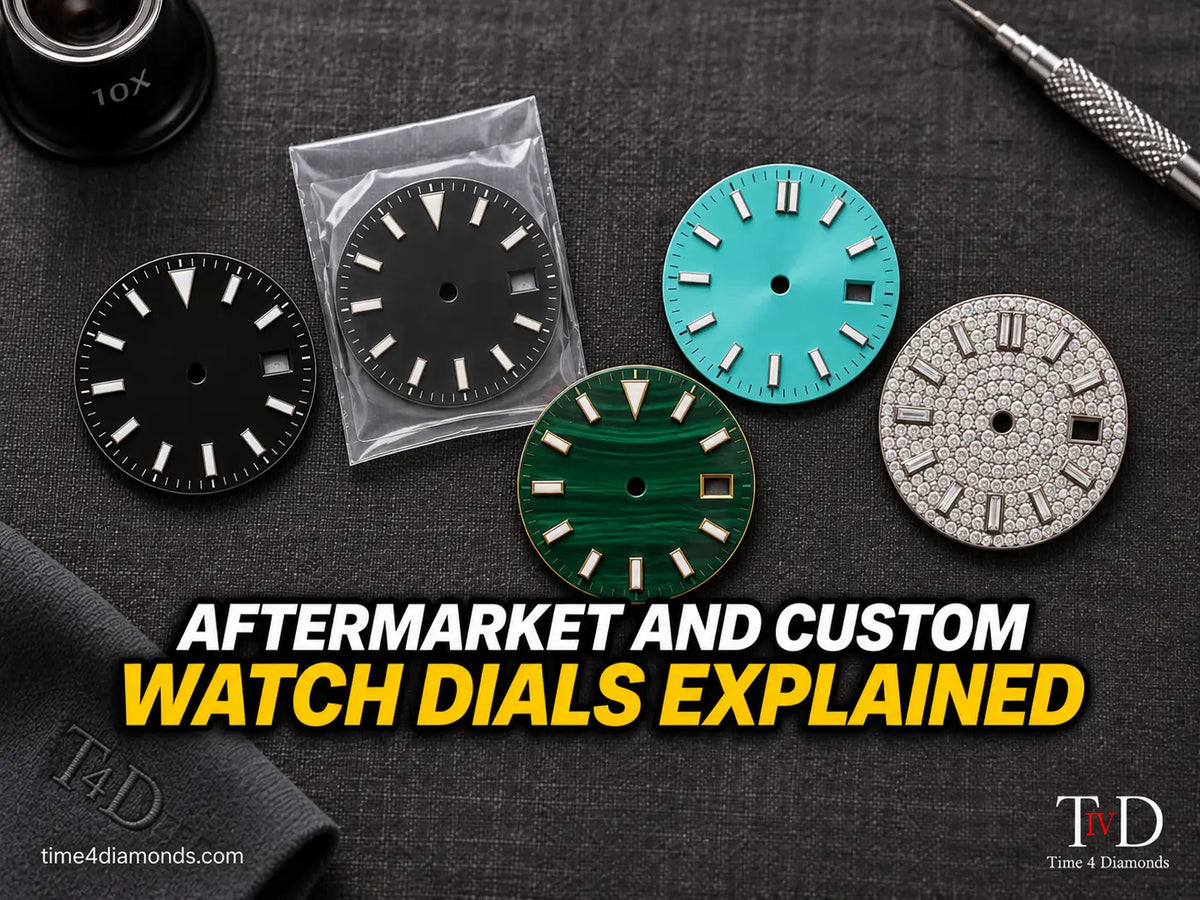
Aftermarket and Custom Watch Dials Explained: Warranty, Value and Legality

Summary: An aftermarket dial is any watch dial not manufactured by the brand whose name is on the case. "Custom dial" is a trade description rather than a category of origin: it covers both a factory dial modified after purchase and a third-party dial made to order. Both differ from a refinished dial (an original repainted) and a service dial (a later factory replacement). Fitting one voids a Rolex warranty, means Rolex may require non-genuine components to be replaced with genuine Rolex parts before or as part of servicing, and lowers resale value unless the original is kept.
- The Rolex guarantee excludes watches modified with non-genuine parts, and it names the dial specifically.
- The US Fifth Circuit's substituted opinion of 21 March 2024 in Rolex v BeckerTime extended the injunction against that reseller to all non-genuine dials in its Rolex-branded sales, including dials carrying original Rolex marks, and a 20 November 2024 ruling reinstated that scope.
- The Swiss Federal Supreme Court held on 19 January 2024 (case 4A_171/2023) that a workshop may personalise a client's own watch for that client's private use without infringing the brand's trademarks, and on 16 June 2025 sent the separate advertising question back to Geneva a second time.
- Most dials start as a brass disc with two soldered feet, then get electroplated, lacquered or PVD coated before markers are applied.
- Time 4 Diamonds returns every original part after a dial swap, so the watch can go back to factory specification at any time.
"Aftermarket dial" is one of the loosest phrases in the pre-owned watch trade. Sellers use it for a third-party dial, a repainted original, a factory dial with diamonds added later and sometimes a perfectly genuine service replacement. Buyers read it and picture a fake. Neither habit helps anyone, and the gap between the two is where money gets lost.
I have spent years on both sides of this: fitting custom dials for clients who want a colour the brand never offered, and assessing watches that arrived with a dial nobody could account for. This guide sets out the vocabulary, explains how a dial is built (which is why quality varies so much), and answers the three questions people actually ask us: what happens to the warranty, will the brand still service it, and what does it do to the value. The legal position shifted during 2024 and continued developing in Switzerland into 2025, so that gets its own section.
What is an aftermarket dial?
An aftermarket dial is a dial made by someone other than the watch manufacturer, designed to fit a specific reference and calibre. The base watch can be entirely genuine, but the dial is not. That single sentence covers the whole category, but it hides four neighbouring categories lumped in with it, and the differences matter for warranty, servicing and price.
| Term | What it actually is | Made by the brand? | Original to that watch? |
|---|---|---|---|
| Factory original | The dial fitted when the watch left the manufacturer | Yes | Yes |
| Service dial | A later genuine dial fitted by the brand during servicing | Yes | No |
| Refinished (redial) | An original dial stripped and repainted, logos reapplied | Base plate yes, finish no | Plate yes, finish no |
| Custom, modified genuine | A factory dial altered after purchase, typically by adding diamonds or a new colour | Base plate yes, finish no | Plate yes, finish no |
| Custom, aftermarket | A third-party dial made to a client's design; "custom" here describes the design, not the origin | No | No |
| Aftermarket | A third-party dial built to fit the reference, stock design | No | No |
The middle rows are where descriptions go wrong and cause some confusion. A service dial is genuine and correct, yet it is not the dial the watch was born with, and on a vintage reference that distinction can be worth a great deal.
A refinished dial is genuine metal with a non-genuine surface. "Custom" is the loosest word of all, because it describes what was done rather than where the dial came from: a custom dial might be a factory plate with stones set later, or a dial made from scratch by a third party to the client's design. When you see "custom" on a listing, ask which, because the two behave differently at resale.
The phrase I use with clients is "born with." A genuine part fitted later is authentic but not original; an aftermarket part is neither. Importantly, both facts need to be disclosed, and a seller who cannot tell you has not examined the watch closely enough.
How a watch dial is made (and why quality varies)

Many conventional metal watch dials start as a thin brass disc, with gold used for enamel or gem-set work and stone, meteorite and mother-of-pearl handled differently.
Two short pins called dial feet are soldered or welded to the underside; these locate the dial on the movement and are clamped or screwed in place from the side. The feet positions, hand hole, date aperture and outer diameter are specific to a calibre and case, so compatibility depends on the calibre, reference and case generation, not the model name alone. That is why a dial listing names the calibre or reference it fits, or both.
The blank is then stamped or milled for any relief (sunken sub-dials, a stepped rehaut, a guilloché pattern), brushed for a sunray or satin finish and electroplated. At Rolex, the brass blanks are first plated in gold and nickel baths for corrosion resistance, then finished by one of three routes: lacquer, PVD or a further electroplating for colour. Then, the printing is done by pad transfer from an engraved plate, and the applied markers and crown are separate pieces, in Rolex's case 18ct gold from its own foundry, pinned through the plate. Rolex has made its own dials at Chêne-Bourg in Geneva since it bought its dial supplier Beyeler in 2000.
Every one of those stages is somewhere an aftermarket dial can cut a corner: thinner plating, printed rather than applied markers, plated brass indices instead of gold, luminous paint applied by hand rather than deposited, and feet positioned by eye rather than jig. The best third-party dials get most of this right. The worst get none of it right and still carry a crown at 12 o'clock, which brings us to the legal problem later on.
Aftermarket vs custom vs genuine dials: what the difference means for you
Buyers rarely care about the vocabulary for its own sake. They care about four consequences: warranty, servicing, value and legality. The table sets out how each dial type scores, and the sections that follow go into the detail.
| Dial type | Manufacturer warranty | Brand servicing | Resale effect | Reversible? |
|---|---|---|---|---|
| Factory original | Unaffected | Yes | Baseline | Not applicable |
| Service dial | Unaffected | Yes | Neutral on modern, negative on vintage | Only if the original was kept |
| Refinished | Void | Replacement may be required first | Strongly negative on vintage | No, the finish is gone |
| Custom, modified genuine | Void | Replacement may be required first | Negative for collectors, neutral to positive for some buyers | Rarely, gem-setting cuts the plate |
| Custom or stock aftermarket | Void | Replacement may be required first | Negative unless the factory dial is included | Yes, if the original is retained |
Two points jump out of that table: the only modification with a clean route back is a straight dial swap where the factory dial is kept, and the refinish, which many owners see as a harmless tidy-up, is the one change that can never be undone. If you are weighing up a change to your own watch, our guide to the pros and cons of watch customisation covers the wider decision.
Do aftermarket dials void the warranty?

Yes, Rolex is the clearest example because its guarantee wording is public. The Rolex guarantee does not cover watches materially modified by the addition or substitution of non-genuine parts, and the list of examples names the bezel, case, case back, dial, essential movement parts and complete movements.
Rolex's own watch care FAQ adds that the guarantee also excludes repairs, opening or manipulation of the watch by anyone other than a Rolex retailer or Rolex Service Centre. Fit an aftermarket dial, or have an independent fit any dial, and the factory guarantee is gone.
Other manufacturers may impose similar restrictions, so check the specific brand’s current warranty terms before modifying the watch. This applies when considering customisation involving brands such as Audemars Piguet, Patek Philippe and Cartier. What replaces the manufacturer’s coverage depends on who carried out the work. At Time 4 Diamonds, every bespoke or customised piece carries our own 12 month warranty, and that warranty stands in place of the manufacturer’s warranty on any watch we have modified. Nobody can guarantee that a manufacturer will honour its warranty after third-party modification.
Will Rolex service a watch with an aftermarket dial?
Not on its own terms. Rolex's published position is that non-genuine parts invalidate the guarantee and that a Rolex service replaces any component failing its requirements with a genuine part. In practice, that means Rolex may require non-genuine components to be replaced with genuine Rolex parts, at the owner's cost, before or as part of a service.
Evidence at the BeckerTime trial in the United States described exactly that: Rolex would service a watch containing non-genuine parts only after restoring it to genuine components. The safe course is to refit the factory dial before the watch goes to Rolex, which is one more reason to keep it.
There is a second, less obvious risk that cuts the other way. Rolex's stated service process replaces any component that no longer meets its current functional and aesthetic specification with a genuine part. On a modern watch that is fine, but on a vintage reference it is how a faded original dial becomes a bright service dial, and the watch loses value while gaining a warranty.
Decline dial and hand replacement in writing before the estimate is approved, and confirm at the same time whether any replaced original parts can be returned to you. Our note on servicing a Rolex in the UK goes through the options, and independent servicing through our London workshop is the route for any watch that already carries custom parts.
Are custom dials legal? Rolex v BeckerTime and the Swiss Supreme Court
Having your own watch personalised, for your own use, has been upheld as lawful in Switzerland. Selling modified watches as the brand's own product has been found to infringe in the United States. Neither ruling is UK law, but both are the cases every reputable workshop now works around. The Swiss litigation continued into 2025, while BeckerTime produced further appellate clarification in November 2024.
In the United States, Rolex sued Texas reseller BeckerTime in September 2020. BeckerTime refinished dials by stripping them to bare metal, drilling holes, setting aftermarket diamonds as hour markers and reapplying the Rolex crown and text, then sold the watches described as "Genuine Rolex".
The district court found infringement in January 2022. The Fifth Circuit issued an opinion on 26 January 2024, then withdrew it on rehearing and substituted a revised opinion on 21 March 2024 that widened the injunction against BeckerTime to cover all non-genuine dials in its Rolex-branded sales, including dials carrying original Rolex marks.
When the district court's amended judgment tried to let BeckerTime keep selling customised dials with a "CUSTOMIZED BY BECKERTIME" caseback inscription, the Fifth Circuit vacated it on 20 November 2024 and reinstated that scope.
The order binds BeckerTime's business rather than every US seller, but it is the clearest statement yet of how a US court treats a Rolex-marked watch with a non-Rolex dial. The Fashion Law's analysis tracks the sequence. Rolex won the injunction but no share of profits, because it had known about BeckerTime for a decade before suing.
In Switzerland, the Federal Supreme Court decided case 4A_171/2023 on 19 January 2024 between Rolex and the popular Geneva workshop, Artisans de Genève. The court held that a workshop may personalise a legitimately owned branded watch at its owner's request, for that owner's private use, without infringing the brand's trademark rights merely by carrying out that customisation.
Holding stock of modified Rolex watches and selling them, which the workshop had done at least once to a mystery shopper, was not. WatchPro's report covers that first decision, but it did not end the case. The court sent the separate question of how the workshop used Rolex's name and imagery on its website back to Geneva, and on 16 June 2025 the Federal Supreme Court remanded the advertising and website-use questions to the Geneva court again, because the required analysis had not been carried out. The business model survived; the advertising questions went back for a second look.
For a client in the United Kingdom those two cases are examples, not the rulebook. UK trademark law has its own exhaustion rule in section 12 of the Trade Marks Act 1994, and its own exception: a brand can still object to further dealings in goods where their condition has been changed or impaired after sale.
How that applies to a customised watch offered for resale has not been tested in a reported UK case that I am aware of, and nothing here is legal advice. What the US and Swiss decisions do show is the shape of the safe zone that careful workshops already stay inside: the client owns the watch before work begins, the work is described as a modification and never as factory, and the workshop's own name is attached to it.
That is how our customisation service is structured, and it is why every project starts from a watch the client either brings in or buys from us first.
How an aftermarket dial affects resale value
An aftermarket dial reduces the value of a watch to a collector, and whether the original dial survives is one of the biggest factors in how much. With the factory dial in the box, a modern Datejust or Daytona wearing a custom dial is a watch the buyer can return to standard in an afternoon, and dealers price it with that in mind. Without it, the watch becomes a sourcing exercise: a genuine replacement dial has to be found, bought and fitted before the watch is whole again, and offers reflect that cost and uncertainty.
Vintage is a different market. Originality drives the price of a 1960s Submariner or Daytona, and refinished or service dials can substantially reduce what buyers will pay for collectable vintage references compared with an untouched original. No one can give you a universal percentage, because the reference, the extent of the change, and current demand all move the number, but the direction is consistent. One exception worth knowing is documented retailer co-signing, a factory dial with a retailer's name printed at the manufacture; our piece on Rolex Tiffany dials explains why those command a premium rather than a reduction.
Custom pieces also have their own buyers. A diamond-set or Arabic dial on a modern reference sells well in London and Dubai to people who want that look and understand what they are buying. The celebrity market shows this at the top end; our analysis of Drake's Asprey Daytona is a good case study in how hard it can be to tell factory from custom even at that level. The value rule is simple: keep every original part and all the paperwork, and describe the watch accurately when you sell.
What a custom dial fitting involves

A dial swap sounds trivial, but it is not. The case back comes off, the crown and stem are released, the movement is lifted out, the hands are pulled, the old dial is unclamped and the new one seated on its feet, then the hands are refitted at exactly 12 with the date change checked, the movement is re-cased, and the watch is pressure tested.
Any step done carelessly leaves a scratched dial, a bent hand, a date that flips at 11:40 or a case that no longer seals. Our watchmakers include engineers who previously worked at Rolex, and every dial we sell is priced to include dismantling, fitting, assembly and testing in-house rather than handing you a part in a bag.
Compatibility is the first check. Our custom blue Daytona dial, for example, is made for the 1165xx generation powered by the calibre 4130, so it wouldn't fit the 126500 generation powered by the calibre 4131 that replaced it in 2023. We return all original parts after fitting, so the factory dial goes home with you, and every custom part carries the 12-month warranty described above. If the colour you want does not exist, we make it: the custom Arabic Day-Date 40 build we documented shows how a bespoke dial goes from reference photos to a finished piece.
The made-to-order Daytona dial below is the most requested colour change on the 1165xx series, and it is delivered fitted within 30 days.

Custom Blue Dial for Rolex Daytona
Fits Daytona Ref 1165xx
- Fitment: Calibre 4130, Daytona 1165xx
- Dial: Custom blue, applied markers
- Fitting: Included, in-house watchmakers
- Delivery: Fitted within 30 days
Genuine replacement dials: the other half of the market
Not every dial swap is a custom job. Damaged and faded factory dials are replaced with factory dials all the time, and a genuine service-grade dial is the right answer whenever the aim is to keep the watch inside the brand's service network.
The catch is supply: Rolex does not generally retail genuine dials to consumers, and access to factory replacement parts is tightly controlled through its servicing and parts network, so genuine dials on the open market tend to come from watches broken for parts, from surplus service stock or from previous swaps. Buy from a dealer who states the dial is factory, names the calibre it fits and gives a warranty on it, and check the dial listing describes the part as original rather than "original style".
The GMT-Master II dial below is a factory black dial for the 116710LN on calibre 3186, held in London stock and fitted in-house.

Rolex GMT-Master II 40mm Black Original Factory Dial
Fits Ref 116710LN
- Fitment: Calibre 3186, GMT-Master II 40mm
- Dial: Genuine Rolex, black, pre-owned
- Fitting: Included, in-house watchmakers
- Delivery: Next day UK, insured
How to tell if a dial is aftermarket

Start with the crown and text at 12 o'clock. On a genuine Rolex dial, the crown is an applied gold piece with crisp, slightly domed relief and no flash around its base; on most aftermarket dials, it is either printed flat or a plated casting with soft edges. Read the text under a 10x loupe: factory printing has sharp, even edges and consistent stroke weight, while pad-printed aftermarket text often shows fuzzy borders, uneven ink density or a nearly right font. Serifs on the "ROLEX" lettering and the spacing of the two chronometer lines beneath it are the usual giveaways.
Then the markers. Genuine applied markers sit flat, with luminous material filled cleanly to the metal surround and glowing evenly in the dark. Aftermarket lume tends to be domed, bubbled or uneven from one marker to the next, and it charges and fades differently.
Look at the date aperture: the frame should be perfectly centred on the disc, and the disc font should match the dial font. Finally, ask for the dial feet. If the seller or watchmaker can show you the underside, factory feet are clean, machine-positioned and unmarked, whereas moved or re-soldered feet are the signature of a dial adapted to fit. The same disciplines apply to spotting a whole counterfeit watch, which we cover in how to spot a fake Rolex.
Diamond dials deserve their own test. A factory-set Rolex diamond dial uses stones sized and graded in-house, with the settings cut into the plate at the manufacturer. Later gem-setting on a genuine plate is a modification and should be disclosed as such. Our own bespoke pieces use natural diamonds of VS1 clarity and G to H colour or better, and every listing says custom in the title.
Should you buy a watch with an aftermarket dial?
Buy it if you want the look, the price reflects the modification, and the seller is transparent about what was done and by whom. Walk away if the dial is described as factory and your loupe says otherwise, if the original dial is missing and the price does not reflect that, or if the seller cannot say who did the work. Five checks before you commit:
- Get the modification in writing on the invoice, naming the dial as aftermarket, custom or refinished.
- Confirm the original dial is included, or price the watch as though you will need to source one.
- Ask which calibre the dial was made for and whether the feet were moved.
- Check who carries the warranty, since the manufacturer's no longer applies.
- Have an independent watchmaker open the case before money changes hands.
For a watch you already own, the same logic runs in reverse. A custom dial from a workshop that fits it properly, returns the original and warrants the work gives you a watch nobody else has and a route back to standard whenever you want it. Our most requested custom dials and the broader guide to customising a Rolex are the two places to start, and if the model you want to modify is not in your collection yet, our sourcing team can find the base watch first.
Frequently asked questions
What does aftermarket dial mean?
An aftermarket dial is a dial made by a third party rather than the watch brand, built to fit a specific reference and calibre. The watch itself can be genuine; the dial is not a factory part.
Is an aftermarket dial the same as a fake?
Not automatically. An aftermarket dial is a non-factory part, and fitted to a genuine watch with full disclosure it is a modification rather than a fake. A third-party dial that carries the brand's trademarks without authorisation can raise trademark and counterfeiting issues in its own right, whatever the rest of the watch is.
Does a custom dial void a Rolex warranty?
Yes. The Rolex guarantee excludes watches modified with non-genuine parts, naming the dial specifically, and excludes work done by anyone other than a Rolex retailer or Rolex Service Centre. A workshop warranty replaces it on a customised watch.
Will Rolex replace an aftermarket dial with a genuine one?
Rolex may require non-genuine components to be replaced with genuine Rolex parts, at the owner's cost, before or as part of a service, and any component failing its standards is replaced with a genuine one. Refit the factory dial before sending the watch in.
How much does a Rolex dial replacement cost?
Genuine pre-owned Rolex dials can range from a few hundred pounds to well over £1,000 depending on the reference and dial, with fitting sometimes included, while custom dials are priced on request and depend on the design, stones and reference. Prices vary by model and availability.
Can an aftermarket dial damage the watch?
A badly made or badly fitted one can. Incorrect feet, wrong thickness or a poorly centred hand hole can foul the hands, jam the date or scratch the dial, and a careless refit can compromise water resistance. Have it fitted by a watchmaker who pressure tests afterwards.
Are custom Rolex watches illegal to sell?
It depends on the jurisdiction and on how the watch is described and marked. In the United States, the Fifth Circuit's 2024 rulings in Rolex v BeckerTime enjoined that reseller from selling Rolex-branded watches with non-genuine dials, even with disclosure. UK law has not been tested on the point in a reported case, and section 12 of the Trade Marks Act 1994 lets a brand object to resale of goods whose condition has been changed. Personalising your own watch for your own use is a different matter.
Do Arabic dial Rolex watches come from the factory?
Some do. Rolex has produced Eastern Arabic numeral dials on Day-Date models including the platinum 228206, and it has also built Arabic dials for specific markets. Many others on the market are custom, so ask which before you buy; our Arabic dial watches are labelled either way.

Leave a comment
This site is protected by hCaptcha and the hCaptcha Privacy Policy and Terms of Service apply.