

Rolex Tiffany Dials: The Complete Guide to Vintage Co-Branded and Modern Turquoise Dials

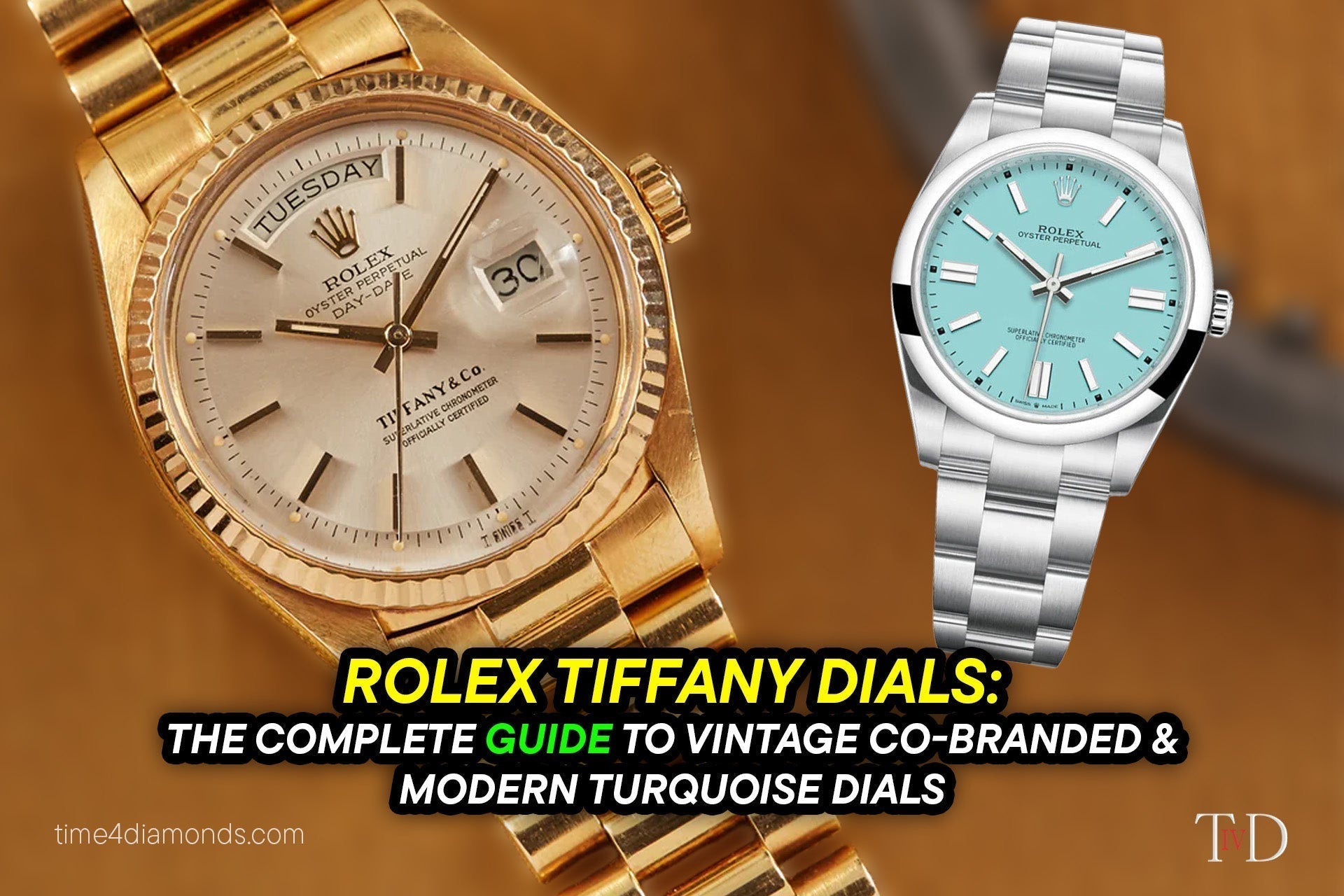
Ask ten people what a Rolex Tiffany dial is, and you will get two completely different answers. Some picture a rare vintage watch with the words "Tiffany & Co." printed under the Rolex crown; others picture the bright turquoise Oyster Perpetual that flooded social media after 2020. Both get called the "Tiffany dial", and only one of them has anything to do with the jeweller.
This confusion costs buyers real money. I have watched people pay a premium for a modern turquoise Rolex, believing it is a Tiffany collaboration, and I have seen genuine co-signed vintage pieces sold for a fraction of their worth because the seller did not know what they had. So before we go any further, here is the plain version.
A vintage co-signed Tiffany dial is real; it is a Rolex dial that was stamped with the Tiffany & Co. name when the watch was sold through Tiffany decades ago. A modern turquoise dial is a Rolex-only creation, where the nickname stuck because the colour looks like the Tiffany shade of blue, not because the two brands worked together on it. Everything else in this guide builds on that single distinction.
What is a Rolex Tiffany dial?
The term covers three separate things, and keeping them apart is the whole game. The first is a factory Rolex dial from the mid-20th century that carries a Tiffany & Co. retailer signature. The second is a modern lacquer dial in turquoise blue, nicknamed after Tiffany because of the shade. The third is a bespoke turquoise dial commissioned today and fitted to a Rolex watch by a specialist workshop, which is where most buyers who want "the look" actually end up.
Here is how the three compare at a glance.
Type |
Tiffany connection |
Era |
Colour |
Rarity and value |
Vintage co-signed |
Genuine. Sold through Tiffany, signed on the dial |
Mid 1950s to early 1990s |
Standard Rolex dial colours (black, silver, champagne) |
Very rare. Often two to three times a standard example |
Modern turquoise |
None. Rolex-only, nicknamed by colour |
2020 onward |
Turquoise blue lacquer |
Discontinued 41mm commands strong premiums |
Bespoke turquoise |
None. Aftermarket custom dial |
Made to order today |
Turquoise blue, matched to Tiffany Blue |
Priced by commission, any Rolex model |
The vast majority of searches for "Rolex Tiffany dial" are really after one of the last two. That is fine, and there is a clean way to get exactly that look. The vintage co-signed pieces are a different conversation, closer to serious collecting than to everyday buying, so let us start there and give them their due.
Vintage Tiffany & Co co-signed Rolex dials

For most of its history, Rolex has kept an iron grip on its dials, but that has not always been the case. From the mid-1950s into the early 1990s, a small number of prestige retailers were allowed to add their own name to a Rolex dial, and Tiffany & Co. was the most celebrated of them. Watches sold through Tiffany's Fifth Avenue store left with the jeweller's name printed on the face, usually in a single discreet line.
The placement was thought through: on dress models, the Tiffany signature sat below the Rolex text but above the hands, so it did not upset the dial's balance, whereas on sports models it dropped lower, above the block of text near six o'clock.
Early on, the stamping was done on-site in New York; later, Rolex instructed its own dial makers to print the retailer's name before the dials ever left the factory in Geneva, using a transfer printing method known as decalque. The Rolex office in New York held separate printing plates for its different retailers, including Tiffany and Cartier.
These are the models collectors chase, and it is a good moment to appreciate how much variety lies within the broader Rolex dial story.
Model |
Notable references |
Why it matters |
Air-King |
5500, 5501 |
Among the earliest co-signed pieces, from when the partnership began in the 1950s |
Datejust |
1601, 1603, 16013, 16018, 16030, 16220 |
The most commonly encountered co-signed models are the natural fit for a jeweller |
Day-Date |
1803, 18038, 18238 |
A partnership that makes the most sense |
GMT-Master |
1675 |
A sought-after sports reference made rarer still by the Tiffany stamp |
Submariner |
5512, 5513 |
Tool-watch appeal plus retailer signature, a prized combination |
Sea-Dweller |
1665 "Double Red", 1971 to 1977 |
A Double Red with a Tiffany signature is a genuine rarity within a rarity, considered a holy grail in Rolex watch collecting |
Cosmograph Daytona |
6239, 16520, 16523 |
Rare, since early Daytona models sold in small numbers to begin with |
What do these demand from a buyer? A co-signed watch routinely sells for two to three times the price of the same reference with a plain dial, and that gap widens when the original Tiffany paperwork survives with the watch. Double-signed Rolex pieces are a regular fixture at Phillips, Christie's and Sotheby's, and a Tiffany-signed Daytona or "Double Red" Sea-Dweller can move well into six figures when condition and provenance align. The signature does not change how the watch runs, but it changes the story, and in vintage collecting, the story is most of the value.
One important footnote, the Rolex and Tiffany retail arrangement wound down and ended by the early 1990s. This was due to branding disputes and Rolex wanting to exert tighter control over its production and servicing. Since then, the Crown has not run a comparable programme, which is exactly why no modern Rolex leaves the factory with a Tiffany name on it. Hold that thought, because it is the fact that clears up most of the confusion later on.
Genuine co-signed examples rarely sit in a shop window. They surface at auction and through specialist dealers, and finding the right one takes patience and a trusted eye. If a period-correct co-signed Rolex is what you are after, our watch sourcing service can track a specific reference to your brief rather than leaving you to gamble on an open listing.
How to spot a fake Tiffany & Co dial
Here is the uncomfortable part. Tiffany dials are among the most faked dials in the entire vintage market, and the reason is baked into how they were made. Stamping was done locally by Tiffany, not at Rolex's factory in Switzerland. The stamping of the retailer name was added as a separate step; the font, spacing, ink colour and even the exact position vary from one genuine dial to the next. Therefore, there was a lack of standardisation and method, meaning, technically, there is no single "correct" Tiffany stamp to check against, which gives forgers cover and makes casual authentication almost worthless.
Adding a Tiffany line to an ordinary vintage Rolex dial is a quick way to inflate its apparent value, so the incentive to fake is enormous. That means the dial signature can never be assessed on its own. It has to be judged alongside the case, the movement, the serial and reference numbers, the lume, the hands and most importantly, the paperwork.
A period-correct signature on the wrong reference, or with the wrong service history, tells you more than the signature ever could on its own. Our full walkthrough on how to spot a fake Rolex covers the wider authentication process, and every point in it applies doubly to a co-signed dial. When in doubt, buy the watch from someone who stakes their reputation on getting this right, and get it independently verified.
The modern turquoise Tiffany dial: what it really is

Now, on to the watch most people actually refer to. In September 2020, Rolex refreshed the Oyster Perpetual, with a set of loud lacquer dials in candy pink, coral red, yellow, green and turquoise blue, colours that nodded to the vintage Stella dials of the 1970s. The turquoise version, in particular, went off like a rocket.
Let me be blunt about the central myth. No, the modern turquoise Oyster Perpetual is not a collaboration with Tiffany & Co. There is no Tiffany logo on the dial, no shared branding, no partnership behind it. It is a standard Rolex product that happens to wear a colour close to Tiffany Blue.
Collectors nicknamed it the "Tiffany dial", dealers repeated the nickname, and a marketing accident turned into received wisdom. Reputable sellers now flag this openly, describing the colour as "Tiffany" only in inverted commas and noting that it is not affiliated with the jeweller.
The turquoise dial arrived in three case sizes, and the references are worth knowing because they drive the whole market.
Model |
Reference |
Case size |
Movement |
Status |
Oyster Perpetual 41 |
124300 |
41mm |
Calibre 3230 |
Turquoise dial discontinued in 2022 |
Oyster Perpetual 36 |
126000 |
36mm |
Calibre 3230 |
Remains in production |
Oyster Perpetual 31 |
277200 |
31mm |
Calibre 2232 |
Remains in production |
From a collector's point of view, the 41mm reference 124300 is the one that matters most, as the turquoise dial's production window on the 41mm ran only from 2020 to 2022, when Rolex pulled the colour from that case size. The reference 124300 itself was later replaced in 2025 by the reference 134300, which carries softer matte pastel dials. This short, compressed run is what makes the model desirable.
That scarcity, plus the timing, sent secondary prices soaring. At the peak, the turquoise Oyster Perpetual traded at several times its recommended retail price of roughly $6,000, with some examples pushing past £30,000 on the secondary market before the frenzy cooled. Prices have since come down from that high, but the discontinued 41mm still carries a clear premium over its original ticket, sitting at around £20,000.
Rolex leaned into the colour again at Watches and Wonders 2023 with the Oyster Perpetual "Celebration" dial, a turquoise ground scattered with coloured bubbles, offered in 31mm, 36mm and 41mm. Love it or loathe it, it cemented turquoise as part of the modern Oyster Perpetual identity rather than a one-off.
The rest of the modern Rolex Oyster Perpetual range sits alongside these turquoise pieces, and it is worth seeing the standard dials next to the loud ones to understand what the hype premium is actually paying for.
If you want the turquoise look on an Oyster Perpetual without hunting for a discontinued reference at a premium, a workshop-fitted custom dial is the direct route. We build turquoise lacquer dials to order and fit them to the Oyster Perpetual 41, matched closely to Tiffany Blue.
Rolex Tiffany dial price guide
Values in this space swing widely depending on which "Tiffany dial" you mean, so treat the ranges below as orientation rather than fixed quotes. Condition, provenance, reference and the market on the day all move the number.
Type |
What drives the price |
Indicative level |
Vintage co-signed Rolex watches |
Rarity of the reference, condition, original Tiffany paperwork |
Two to three times the same reference with a plain dial, into six figures for rare sports models |
Modern Oyster Perpetual 41 (ref. 124300) |
Discontinued status, short production run, demand |
Currently sitting at around £20,000, a clear premium over its original retail price, well down from its speculative peak |
Modern Oyster Perpetual 36 ref. 126000 & 31 ref. 277200 |
Still produced, so closer to retail (36mm is £5,600 & 31mm is £5,250) |
Around or modestly above the retail price |
Bespoke turquoise or Arabic dial |
Base watch, dial complexity, diamond setting |
Priced by commission, enquire for a quote |
The honest takeaway is that a genuine co-signed vintage Rolex is a collecting decision requiring proper research. A modern turquoise Oyster Perpetual is a supply-and-demand play on a discontinued colour, and a bespoke dial is the flexible route to the exact look you want on the exact watch you want. None of them is wrong; they are simply different purchases wearing the same nickname.
Disclaimer: Past performance is not indicative of future results. Watches should not be considered a substitute for traditional financial investments. Always seek independent financial advice before making investment decisions.
Custom Bespoke Turquoise Rolex Dials

The third and final avenue for Rolex "Tiffany" dials is the customisation route. Yes, this can be under the modern turquoise dials section above; however, when manufactured by Time 4 Diamonds, I think it deserves its own part.
Since 2005, Time 4 Diamonds has been producing some of the most beautiful custom pieces, but sometimes the simplest of changes to a watch can make a huge difference. In this instance, a dial swap for one of our custom turquoise dials on an Oyster Perpetual has always been a popular choice.
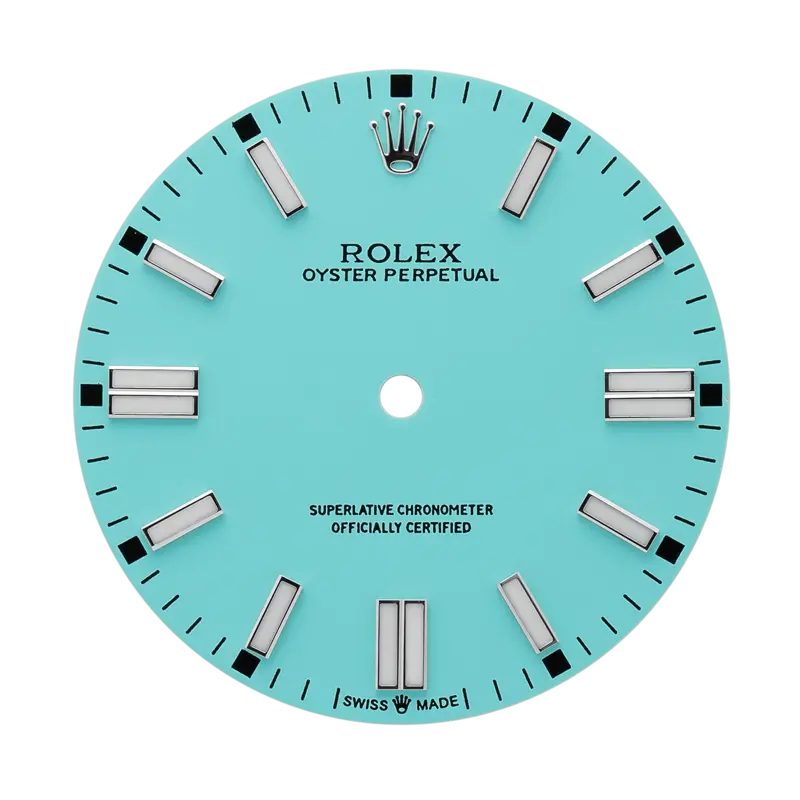
Custom Tiffany Blue Dial for Oyster Perpetual 41
Fits Ref 124300
- FitmentOyster Perpetual 41
- DialCustom turquoise blue, applied hour markers
- FittingIn-house by our watchmakers
- DeliveryWithin 30 days
As highlighted, the only model to have utilised the turquoise blue dial in recent times is the Oyster Perpetual. But the beauty of customisation allows the chance for elements to be applied to other models, which Rolex simply won't do. An example of this would be our custom Daytona 116509, which features bespoke parts such as diamond hour markers, a baguette-set diamond bezel and a diamond-set case.

Rolex Daytona 116509 with Custom Tiffany Blue Dial
Ref 116509
- Case40mm 18ct White Gold
- MovementCalibre 4130 chronograph
- DialCustom Tiffany blue, diamond hour markers
- BezelBaguette-cut diamonds, VS1
Tiffany blue Arabic dials
There is one more branch of this story that gets little coverage elsewhere, and it is a favourite in the Gulf. The turquoise blue Arabic dial takes the colour and pairs it with Eastern Arabic numerals, the script used across much of the Middle East, in place of the usual batons or Roman markers. The result reads as both contemporary and regional, and it has become a signature look on the Datejust in particular.
Again, this is a custom dial, not a factory Rolex option. There is no catalogue Rolex with a turquoise Arabic dial, so the colour and the numerals are both applied by a workshop. Done well, on a solid Datejust reference such as the 126300, it is one of the most distinctive things you can wear.

Rolex Datejust 41 126300 with Tiffany Blue Arabic Dial
Ref 126300
- Case41mm Oystersteel
- MovementCalibre 3235
- DialCustom Tiffany blue, Arabic numerals
- BraceletOyster, fold-over clasp
The same treatment works across the Rolex Datejust 41 range, and dial size, numeral finish and date window colour can all be specified as part of the build.
Rolex Daytona Tiffany dials

The Daytona deserves its own section, because "rolex daytona tiffany blue" is one of the most searched terms in this whole space, and it sits right on the fault line between the two meanings.
On the vintage side, a Cosmograph Daytona with a Tiffany & Co. signature is a serious rarity. Early Daytona models were sold in modest numbers, so relatively few passed through Tiffany to be signed at all. A co-signed reference 6239 from the Paul Newman era, or a later 16520 or 16523 from around 1988 with the Tiffany stamp, is a headline lot when it appears. These are collector-grade watches with collector-grade prices.
On the modern side, there is a catch that trips up a lot of buyers. Rolex has never made a factory Daytona with a turquoise "Tiffany" dial. The lacquer turquoise colour lives on the Oyster Perpetual, not the Daytona. The closest thing to a Daytona turquoise dial is the "Beach Blue" reference 116519, but that has its own entirely different nickname and collector value.
If a vintage co-signed Daytona is the goal instead, that is a sourcing job, not an off-the-shelf purchase, and the wider Rolex Daytona selection is the place to start narrowing down the reference and configuration you actually want.
Patek Philippe and the real Tiffany Blue dial
You might be thinking, "What is Patek Philippe doing in a Rolex dial tailored article?" Well, to understand why turquoise and "Tiffany" became glued together in buyers' minds, you have to look at what Patek did with Tiffany.
In December 2021, Patek Philippe released the Nautilus reference 5711/1A-018, a stainless steel piece with a genuine Tiffany Blue dial, double signed with the Patek logo at twelve o'clock and the Tiffany & Co. name at six. The model was unveiled to mark 170 years of the Patek and Tiffany relationship, which is why the run was capped at exactly 170 pieces, sold only through Tiffany's New York, Beverly Hills and San Francisco stores.
This was the real thing, and the numbers were extraordinary. The watch retailed at around $52,000, but the very first example was consigned to Phillips in New York and hammered at $6,503,500, with the proceeds going to charity. The caseback carried an anniversary inscription reading 1851 to 2021, and eagle-eyed collectors even found an LVMH initial hidden in the engraving, a nod to Tiffany's owner following its acquisition by the group in January 2021.
Two facts from this story explain the whole nickname: First, the Patek and Tiffany partnership dates back to 1851, when Tiffany became the brand's first retailer in the United States. In fact, Tiffany & Co. remains the only retailer whose name Patek allows on its dials. Second, "Tiffany Blue" is a registered colour trademark, standardised by Pantone as a custom shade called "1837 Blue", the number marking the year Tiffany was founded. So when the Patek Tiffany Nautilus landed in the same window as Rolex's turquoise Oyster Perpetual, the public simply merged the two in their heads. One was an actual double-signed Tiffany watch, whilst the other was a Rolex in a similar colour. The confusion has never fully cleared since.
Can you get a Tiffany dial for your own Rolex?
Yes, and for most people, this is the answer they were actually looking for. If you own a Rolex, or buy one, a turquoise dial matched to Tiffany Blue can be produced and fitted to it. This is dial work, not a factory option, so it sits under bespoke customisation rather than standard retail. Also, you can keep your factory part in case you ever want to revert to its original look.
The quality of that work is everything, and it is not a job for a general jeweller. Our workshop includes watchmakers who previously trained and worked at Rolex, which matters when you are removing a factory dial, colour-matching a lacquer to a trademarked shade, refitting hands and markers and closing the watch back up to the tolerances the movement expects. A rushed dial swap shows immediately in the finish and in the way the piece runs. A properly executed one is close to indistinguishable from a factory dial, save that no factory ever offered this combination.
Beyond turquoise, the same bespoke approach applies to diamond setting, coloured lacquer dials, Arabic numeral conversions and full custom builds. If you are weighing up what can and cannot be done to a specific reference, our guide on how to customise your Rolex runs through the options, and the customise your watch page is the place to start a commission.
Time 4 Diamonds has been doing this from its London base since 2005, and for Middle Eastern clients, a WhatsApp message is often the quickest way to talk through a build.
Frequently asked questions
Are Rolex Tiffany dials real?
Yes, but only the vintage ones. From the mid-1950s to the early 1990s, Rolex allowed Tiffany & Co. to stamp its name on watches sold through the jeweller, creating genuine co-signed dials that are highly collectable today.
Is the Rolex Oyster Perpetual "Tiffany" a collaboration?
No. The Oyster Perpetual "Tiffany", launched in 2020, is a Rolex-only creation. It picked up the "Tiffany" nickname because the colour closely resembles Tiffany Blue, not because the two companies worked together. There is no Tiffany logo on the dial and no partnership behind it.
Why is it called a Tiffany dial?
Two reasons overlapped. The turquoise lacquer colour is a similar shade to the trademarked Tiffany Blue, and Rolex released it in the same window as Patek Philippe launched its genuine double-signed Tiffany Blue Nautilus. The public merged the two, and the nickname stuck.
How much is a Rolex Tiffany dial worth?
A vintage co-signed Rolex typically sells for two to three times as much as a standard example of the same reference, and rare sports models reach six figures at auction. A discontinued turquoise Oyster Perpetual 41 trades at a premium over its original retail price, sitting at around £20,000 on the secondary market. A bespoke turquoise dial is priced by commission based on the base watch and the work involved.
What is the reference number for the turquoise Rolex Tiffany dial?
The turquoise lacquer dial appeared on the Oyster Perpetual 41 reference 124300, which lost the colour in 2022. The dial remains part of the Oyster Perpetual collection on both the 36mm reference 126000 and the 31mm reference 277200.
Did Rolex and Tiffany ever work together?
Historically, yes, as a retailer and manufacturer. Tiffany sold Rolex watches and was permitted to sign the dials until the arrangement ended in the early 1990s. Rolex has not run a comparable programme since, so there is no modern Rolex Tiffany collaboration.
Can I put a Tiffany blue dial on my Rolex?
Yes. A turquoise dial matched to Tiffany Blue can be produced and fitted to a Rolex as a bespoke commission. It is aftermarket dial work rather than a factory option, so the standard of the workshop matters. Time 4 Diamonds builds these to order in London.
What is Tiffany Blue?
Tiffany Blue is a registered colour trademark owned by Tiffany & Co., standardised by Pantone as a private custom shade named "1837 Blue" after the year the company was founded. It is the robin's-egg turquoise used across Tiffany packaging and branding.

Written by
Adam Dedman
Adam is a watch specialist at Time 4 Diamonds and a collector in his own right. He works with the pieces passing through the London showroom daily, covering condition, references and what separates a strong example from an average one.


Leave a comment
This site is protected by hCaptcha and the hCaptcha Privacy Policy and Terms of Service apply.