

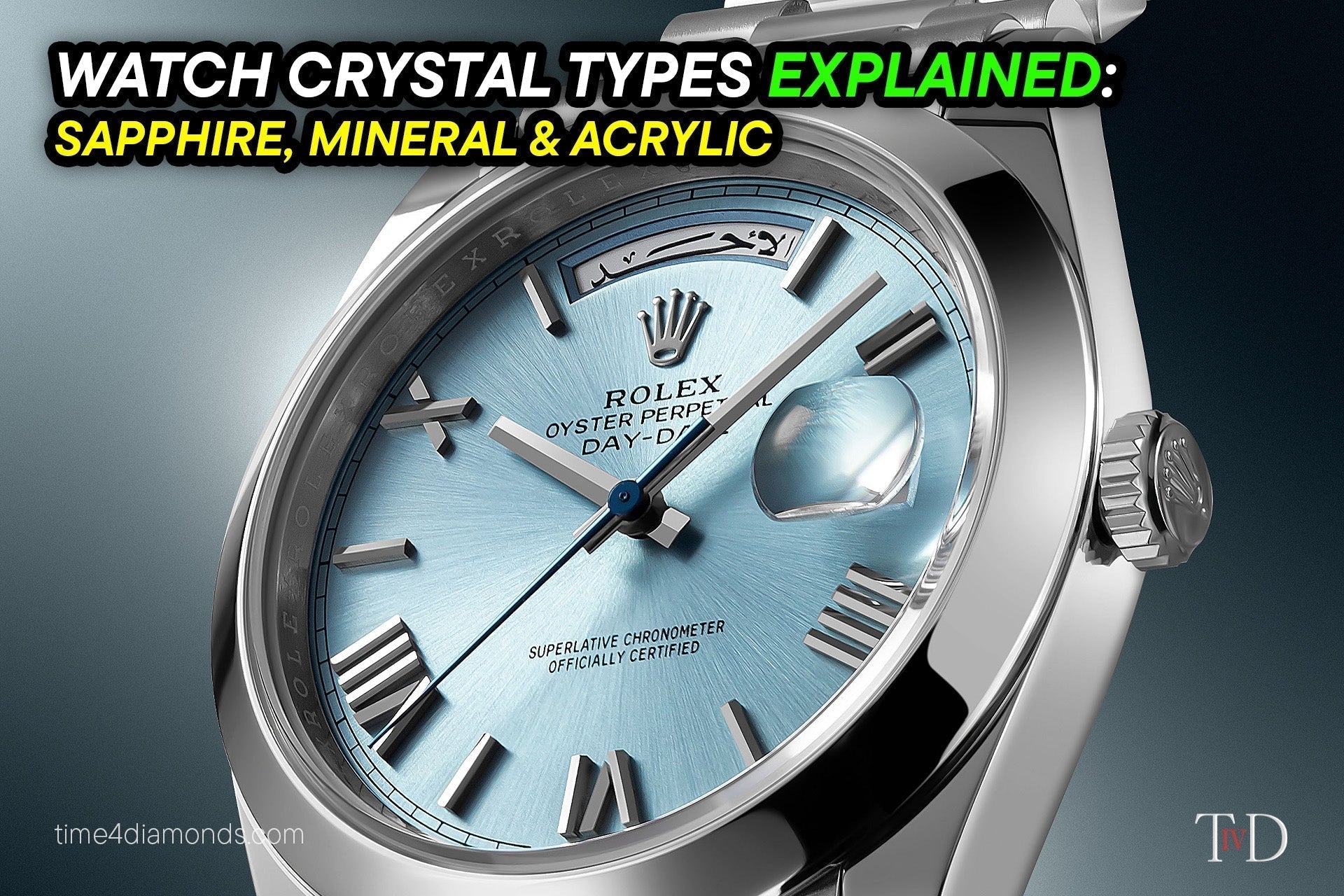
Watch Crystal Types Explained: Sapphire, Mineral and Acrylic
The crystal is the piece of a watch most people look straight through and rarely think about, yet it is constantly working without you knowing. It shields the dial from dust, water and knocks while staying clear enough to read at a glance, and on many modern pieces, it does the same job a second time over the movement at the back.
Three materials dominate the market: acrylic, mineral glass and sapphire. They behave very differently, and the differences matter whether you are buying, selling or simply trying to keep a watch looking right.
This guide sets out what each crystal is made of, how the three compare in hardness, scratch resistance, clarity, and cost, and which one is suitable for, or a part of, a watch you already own. The single idea worth holding onto before we start: the hardest crystal is not automatically the toughest. That trade-off explains almost every choice a watchmaker makes here.
What is a Watch Crystal?

A watch crystal is the transparent cover sitting above the dial; the term “watch crystal” is a historical leftover rather than a description of the material. Its main purpose is to protect the dial and hands, but it also safeguards the movement from dust and moisture. Also, thanks to its clarity and transparency, it allows the wearer to view the time, and it structurally helps ensure a watch’s water resistance.
The History of a Watch Crystal
To begin with, during the 16th and 17th centuries, timepieces did not use a clear crystal, as early pocket watches used thin discs of natural quartz, known to the trade as "rock crystal”.
By the 18th century, watchmakers utilised standard glass sheets, but they were very brittle and would shatter upon minor impacts, dropping small shards into the watch and damaging the dial and movement.
After World War I, wristwatches became popular, driving demand for a more durable, shatter-resistant watch crystal because they were more wearable daily and suitable for rigorous environments than pocketwatches. This led to the creation of acrylic crystals, made from polymethyl methacrylate (PMMA). This was a significant upgrade from glass sheets, as acrylic was highly flexible, lightweight, affordable and shatter-resistant. Whilst acrylic was an improvement over the previous glass crystals, they were soft and prone to scratches.
As manufacturing techniques improved, horologists sought to enhance the watch crystal, and this transition came in the 1960s when Seiko utilised mineral glass crystals. Made from tempered silica, mineral crystals became a standard for mid-tier watches, and these were significantly more scratch-resistant than acrylic. Yet, it wasn’t a breakthrough because it was more prone to shattering than acrylic.
The modern watch crystal is the sapphire crystal, also known as synthetic sapphire, which is the current industry standard benchmark, but it first appeared on the Jaeger-LeCoultre Duoplan in 1929. Whilst the technology was pioneered almost a century ago, sapphire crystals were exceptionally rare and very expensive to produce. It wasn’t until the 1960s and 70s that sapphire crystals were being commercially used in mass-market and luxury timepieces. Made from crystallised aluminium oxide, sapphire crystals score a 9/10 on the Mohs hardness scale, where only a diamond can scratch them. Jaeger-LeCoultre were the first, but other notable early adopters of the sapphire crystal were Rado and Rolex.
The Watch crystal’s job is simple to state but hard to do well: it has to resist scratches and impacts, stay optically clear, fit the case precisely enough to hold a water-resistant seal, and survive years of daily contact with keys, cuffs, doorframes and desks. Different materials prioritise different parts of that brief, which is why three of them coexist rather than one winning outright.
The 3 Main Types of Watch Crystal
Almost every wristwatch made in the last century uses one of three crystal materials. The table below is the quickest way to see how they stack up. Hardness here is measured on the Mohs scale, the standard 1-10 ranking of scratch resistance, where talc is 1 and diamond is 10.
|
Crystal type |
Material |
Mohs hardness |
Scratch resistance |
Impact resistance |
Optical clarity |
Typical use |
|
Acrylic |
Polymethyl Methacrylate (PMMA) |
About 3 |
Low, but scratches polish out |
High, flexes rather than shattering |
Warm, slight distortion when domed |
Tool watches |
|
Mineral |
Tempered silica |
About 5 to 6 |
Moderate, prone to fine scratching |
Moderate, can chip |
Good, clear and flat |
Fashion & entry-level watches |
|
Synthetic Sapphire |
Crystallised, aluminium oxide |
9 |
Very high, near scratch-proof in daily wear |
Lower, hard but brittle and can crack |
Excellent, does not yellow or cloud |
Most modern luxury, current watchmaking standard & benchmark |
Read across those rows, and the pattern is clear. As you climb the hardness scale from acrylic to sapphire, you gain scratch resistance and clarity but give up a little impact resistance. None of the three is the right answer for every watch, which is the whole point of the sections that follow.
Acrylic Crystal: The Plastic Era
Acrylic is a clear plastic, formerly known as polymethyl methacrylate (PMMA), and you will see it sold under several trade names called Plexiglass and Hesalite. It is lightweight, flexible, and, crucially, it flexes under impact instead of shattering. That property is why acrylic dominated watchmaking from the 1930s up to the 1970s and why it was the material of choice in military and dive watches.
The weakness is hardness, sitting at roughly 3 on the Mohs scale; acrylic picks up scratches from ordinary daily wear, sometimes just from a shirt cuff. It seems paradoxical to think it was the material of choice in military and dive watches, but the saving grace is that any marks are shallow and easy to remove. A mild abrasive paste such as PolyWatch buffs light scratches out at home in minutes, restoring clarity, which is something no other crystal type allows as readily.
The most famous acrylic crystal in horology sits on the chronograph that went to the Moon, the Omega Speedmaster Professional, in 1965, which NASA flight-qualified. In a pressurised capsule, a glass or sapphire crystal that cracked could throw sharp shards into the cabin in zero gravity, whereas acrylic cracks won’t break apart but will hold together. Omega still sells the Moonwatch with a Hesalite crystal alongside a sapphire version, and you can spot the Hesalite one by the small Omega logo printed in the centre of the dome. For collectors, that warm domed acrylic is a feature, not a compromise.
Mineral Crystal: The Middle-ground
Mineral glass, sometimes called mineral crystal, is silica-based glass that has been heat-treated or chemically hardened to toughen its surface. On the Mohs scale, it sits between acrylic and sapphire at roughly 5 to 6, which makes it noticeably more scratch-resistant than acrylic while costing far less to produce than sapphire.
Yes, mineral crystals are more scratch-resistant than acrylic; however, once scratched, the damage cannot be easily polished out. In worst cases, such as a deep scratch or chip, a full replacement is required. The types of timepieces that use mineral crystals include fashion watches and entry-level pieces
You will also see branded and hybrid versions, like Seiko's Hardlex, which is a well-known proprietary hardened mineral glass. Alternatively, some other brands advertise a "sapphire-coated" mineral crystal, a thin layer of hardness over a glass core. The coating helps at first but wears through, so it is worth reading a specification carefully rather than treating "sapphire-coated" as the same thing as a solid sapphire crystal.
Sapphire Crystal: The Modern Standard & Benchmark
Sapphire crystal is the material on almost every modern luxury watch, and despite the name, it is not the gemstone you would set in a ring. It is synthetic sapphire, crafted from the same aluminium oxide as natural sapphire but grown in a furnace, classically by the Verneuil flame-fusion process developed in the late 19th century. The result is one of the hardest materials in everyday use, a clean 9 on the Mohs scale, second only to diamond at 10.
In practical terms, that means a sapphire crystal shrugs off the things that scratch other watches. Keys, coins, door handles, and most metals leave no mark, and the surface stays clear for decades without yellowing or clouding. Sapphire also takes an anti-reflective coating well, which is why high-end dials read so cleanly in bright light.
The only proper downside is the cost. Growing and machining a material this hard is expensive, but for a watch meant to be worn hard and kept for years, it is the obvious choice. Notably, whilst sapphire crystals are hard, they are brittle, meaning a hard strike to them can result in a chip or shatter.
Rolex is the clearest case study in the switch from acrylic to sapphire. The first Rolex to use a sapphire crystal was the quartz reference 5100 in 1970, and the first Rolex sports watch to get one was the Sea-Dweller reference 16660 in 1978. The rest of the catalogue followed through the 1980s, and by 1991, Rolex had left acrylic behind entirely. Today, sapphire is the industry standard at the top of the market, with Audemars Piguet and Patek Philippe routinely fitting a second sapphire crystal in the caseback to display the movement, and Cartier uses it across its dress range.
Sapphire is hard enough that some brands now machine entire cases from it rather than just the crystal. Hublot and Richard Mille have both produced fully transparent sapphire-cased pieces, a serious feat of engineering given how difficult the material is to cut. Those watches sit at the extreme end of what sapphire allows, well beyond the flat disc over the dial.
Hardness vs Toughness: Why the Hardest Crystal is not always the Strongest

This is the point most buying guides skate over, and it is the one that actually decides which crystal suits you. Hardness and toughness are not the same measurement. Hardness is resistance to scratching, which is what the Mohs scale records, whilst toughness is resistance to cracking or shattering under a sharp blow.
As highlighted in our table above, a material can score high on one and low on the other, with Sapphire being the textbook example. It is brilliant on hardness, scoring a 9 on the Mohs scale, but it is weak on toughness because its rigid crystal structure does not flex, so a hard knock on a corner can crack or shatter it outright. Acrylic is the mirror image: soft and easily scratched, but flexible enough to absorb an impact and survive. Mineral glass sits in the middle on both counts. This is exactly why NASA kept acrylic on the Moonwatch and why a vintage tool watch on acrylic can take a beating that would chip a modern sapphire. There is no single "strongest" crystal, only the right trade-off for how a watch is worn.
Crystal Shape & Anti-reflective Coating
Crystal material is only half the story, as shape and finish change both the look and the legibility of a watch: flat crystals are the modern default and the easiest to read straight on, single or double domed crystals curve outward and give vintage pieces their character but may be steep which can distort the dial at an angle, and box or top-hat domes rise in a sharp-edged step above the bezel and are a deliberate retro signature on many reissues.
Anti-reflective (AR) coating is the other variable, which is a microscopically thin layer that cuts glare and lets more light through to the dial. There are two main types of AR coatings: inside-only AR and double-sided AR.
Inside-only AR means the coating is applied to the underside of the crystal, eliminating the internal glare bouncing off the watch dial while keeping the exterior scratch-proof. Double-sided AR is a coating which is applied to both the top and underside of the crystal, offering the best possible optical clarity, creating an illusion where the crystal looks non-existent. Importantly, the coating on the inner surface lasts because it is protected, while the coating on the outer surface gives the best clarity but wears off over time. Sapphire takes these coatings particularly well, which is part of why luxury dials look so clear.
One coating detail is worth singling out because it doubles as an authenticity check. The Rolex Cyclops, the magnifying bubble over the date, was introduced on the Datejust in the early 1950s, and Rolex long described it as magnifying the date around two and a half times. On vintage acrylic Rolexes, the Cyclops was moulded into the crystal as a single piece. On modern sapphire models, it is a separate lens of sapphire glued on top, and since 2005, it carries a double anti-reflective coating that produces the near-invisible "black hole" effect collectors look for. Counterfeits routinely get the magnification and the alignment wrong, which is one of several reasons it features in our guide on how to spot a fake Rolex.
How to identify which Crystal your Watch features
If you are not sure what is on your wrist, start with the specification. The manufacturer's listing, the original paperwork or a reputable dealer's description will state the crystal, and that is the most reliable answer. Where you have no paperwork, a few quick physical checks narrow it down without any risk to the watch.
-
The Tap Test: Tap the crystal gently with a fingernail. Sapphire gives a sharper, higher-pitched ring, mineral glass will sound like solid glass, while acrylic sounds dull and plasticky.
-
The Water-drop Test. Place a small drop of water on the crystal and tilt it. On sapphire, the drop tends to hold its bead shape rather than spreading flat and then sliding off once tilted. While on mineral crystals, a drop of water will struggle to hold its shape and spread out slightly. Lastly, a water droplet on acrylic crystals will smear and stick to the glass.
None of these is conclusive on its own, but together they will usually tell you whether you are looking at plastic, glass or sapphire. For valuable or vintage watches, a specialist can confirm it in seconds with a thermal tester rather than guesswork.
How to Care for Your Watch Crystal
Maintenance depends entirely on the material, which may also impact your buying guide.
An acrylic crystal benefits from the occasional light polish to lift surface marks, and you should keep solvents and harsh cleaners away from it because they can cloud the plastic. As highlighted earlier, PolyWatch buffs light scratches out at home in minutes, and a microfibre cloth and a little water handle day-to-day cleaning.
Mineral glass needs less polishing and more care around hard surfaces, since its scratches are permanent and chips are common at the edges.
Sapphire is the lowest-maintenance of the three for scratches, but its brittleness means the sensible precaution is the opposite one: treat the watch gently around stone worktops, tiled floors and anything that delivers a sharp-edged impact.
For every type, a soft cloth and lukewarm water are enough for routine cleaning, and you should avoid wiping grit across the surface, which is what causes most fine scratching in the first place.
Watch Crystal Scratches, Polishing and Replacement

What you can do about a damaged crystal depends, again, on the material.
Acrylic scratches polish out at home with a PMMA paste. Light marks on mineral glass can sometimes be reduced with a glass polish, but any chip or anything deep calls for a replacement. Sapphire is the surprising one: because almost nothing in daily life is hard enough to scratch it, sapphire scratches are rare, but when they do happen, they cannot be polished out at all. A scratched or cracked sapphire crystal has to be replaced.
Crystal replacement is a job for a watchmaker rather than a DIY task, and not only because of the part itself. The crystal forms part of the water-resistant seal, so it has to be fitted with the correct gasket and the case pressure-tested afterwards. On a Rolex, the Cyclops lens and its anti-reflective coating have to be matched correctly, and on a domed vintage piece, the exact profile matters to the look. Get any of this wrong, and you compromise both the watch's water resistance and its value.
This is where Time 4 Diamonds works on the watches themselves. Established in 2005, the business runs an in-house London workshop staffed by watchmakers with decades of experience on Swiss calibres, including watchmakers trained at Rolex, handling crystal replacement, polishing, parts replacement and full servicing across brands. If you have a scratched, hazed or cracked crystal, our watch servicing and repair team can assess it and quote the work properly.
Crystal condition also matters at the point of sale. A clouded acrylic dome or a scratched mineral crystal drags down the impression a watch makes, and a cracked crystal will pull down what a buyer is willing to pay. If you are weighing up a sale, it is worth understanding how condition feeds into value before you list, and you can start a valuation through our sell your watch page.
Scratch resistance is not only a crystal question, either. The case takes just as much daily abuse, which is why some owners specify a hard DLC or PVD coating when they have a watch reworked. Our in-house artisans handle that alongside custom dials, diamond-set bezels and other bespoke work, so if you are reshaping a piece rather than repairing it, the bespoke collection and the customise your watch service are the places to start.
Which Watch Crystal is Best?
There is no universal winner, only the crystal that fits how you wear a watch. For a modern piece you intend to wear daily and keep for years, sapphire is the sensible default: it stays clear, resists the scratches of ordinary life and holds its appearance over decades, which is why almost every current luxury watch uses it.
For a vintage watch or a true tool watch, acrylic is often the right answer, both for period authenticity and for its ability to survive a knock and be polished back to life.
Mineral glass earns its place in the middle of the market where cost matters and the watch is not expected to last a lifetime.
The mistake to avoid is assuming hardest means best. The right question relies on how the watch will be used, and the crystal that answers that question is the best one for you. The same logic explains why buyers in the pre-owned market care about the original specification, which we cover in our guide to choosing a pre-owned Rolex, and why the crystal sits alongside the watch bezel as one of the exterior parts worth understanding before you buy.
Watch crystal FAQs
What is a sapphire crystal on a watch?
A sapphire crystal is the clear cover over the dial made from synthetic corundum, the same aluminium oxide as a natural sapphire but grown in a furnace. It rates 9 on the Mohs hardness scale, second only to diamond, which is why it resists scratches so well and is used on most luxury watches.
Is sapphire crystal better than mineral crystal?
For scratch resistance and long-term clarity, yes. Sapphire is far harder than mineral glass and will stay clear for decades, whereas mineral glass hazes and scratches over time. The one area where mineral glass has an edge is impact, because it flexes slightly, while sapphire is more brittle and can crack on a sharp knock.
Can a sapphire crystal be scratched?
It can, but only by something of similar or greater hardness, such as diamond, certain ceramics, tungsten carbide or another sapphire. The everyday objects that scratch other watches, keys, coins and most metals leave sapphire unmarked, so in normal wear it is effectively scratch-proof.
Can you polish scratches out of a sapphire crystal?
No. Because sapphire is so hard, scratches cannot be polished out the way they can on acrylic, and a scratched or cracked sapphire crystal has to be replaced. The good news is that genuine scratches on sapphire are rare, since so little in daily life is hard enough to cause them.
How is sapphire crystal made?
Watch sapphire is synthetic. Aluminium oxide powder is melted at a very high temperature and crystallised into a solid block, classically using the Verneuil flame-fusion method, then sliced, ground into crystals and polished. The process is slow, and the material is extremely hard to machine, which is why sapphire crystals cost more than glass or plastic.
Can you replace a mineral crystal with a sapphire one?
Often, yes, if a correctly sized sapphire crystal is available for the case. A watchmaker can fit one and pressure-test the seal afterwards. It is a popular upgrade on watches that are otherwise worth keeping, though it is not always cost-effective on inexpensive pieces, and any change should preserve the water resistance.
When did Rolex start using sapphire crystals?
Rolex first used a sapphire crystal on the quartz reference 5100 in 1970. The Sea-Dweller 16660 became the first Rolex sports watch with sapphire in 1978, and the rest of the range adopted it through the 1980s. By the early 1990s, all new Rolex watches used sapphire, and acrylic was gone from current production.
How much does it cost to replace a watch crystal?
It varies with the material, the brand and the complexity. An acrylic replacement is the simplest, while a branded sapphire crystal with a Cyclops, anti-reflective coating or a domed profile costs more because the part is specific and the case has to be resealed and pressure-tested. The reliable way to get a figure is to have a watchmaker assess the exact reference.
How do you clean a sapphire crystal watch face?
A soft microfibre cloth and a little lukewarm water are enough for routine cleaning. Wipe gently rather than rubbing grit across the surface, and dry it with a clean cloth. Sapphire does not cloud or yellow, so it rarely needs more than this to look its best.
Does PolyWatch work on sapphire crystal?
No. PolyWatch is a mild abrasive designed for acrylic, and it will not remove scratches from sapphire because sapphire is far harder than the polishing compound. It is excellent on acrylic and Hesalite crystals, but a damaged sapphire crystal needs replacing rather than polishing.


Written by
Adam Dedman
Adam is a watch specialist at Time 4 Diamonds and a collector in his own right. He works with the pieces passing through the London showroom daily, covering condition, references and what separates a strong example from an average one.


Leave a comment
This site is protected by hCaptcha and the hCaptcha Privacy Policy and Terms of Service apply.