

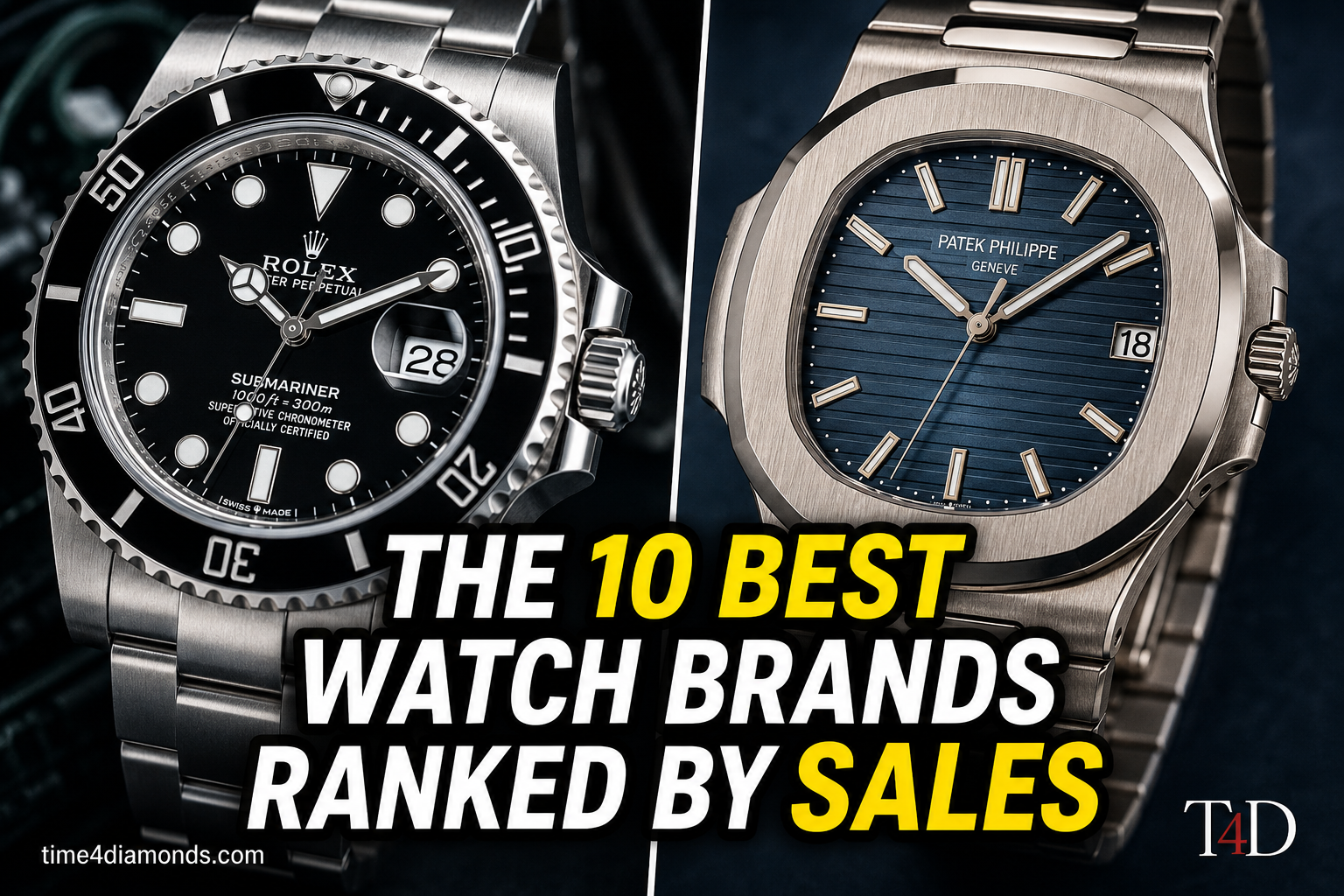
The 10 Best Watch Brands in the World, Ranked by Sales

Most lists of the best watch brands are opinion dressed up as fact. This one is not. The ranking below follows the Morgan Stanley and LuxeConsult Ninth Annual Swiss Watcher report, published in February 2026, which estimates the wholesale turnover of every major Swiss watch brand for the 2025 calendar year. It is the closest thing the industry has to audited accounts, because almost none of these companies publish their own figures.
The top 10 watch brands in the world by 2025 sales are Rolex, Cartier, Audemars Piguet, Patek Philippe, Omega, Richard Mille, Longines, Vacheron Constantin, Breitling and Tissot. Only six of them passed CHF 1 billion in wholesale turnover, and Rolex alone sold more than the next six brands combined. Here is the full table, followed by what each brand actually does to earn its place.
The Top 10 Watch Brands Ranked by 2025 Sales
| Rank | Brand | Est. 2025 wholesale turnover | Founded | Defining models |
|---|---|---|---|---|
| 1 | Rolex | CHF 11.0 billion | 1905 | Submariner, Daytona, GMT-Master II, Datejust |
| 2 | Cartier | CHF 3.5 billion | 1847 | Santos, Tank, Ballon Bleu |
| 3 | Audemars Piguet | CHF 2.6 billion | 1875 | Royal Oak, Royal Oak Offshore |
| 4 | Patek Philippe | CHF 2.5 billion | 1839 | Nautilus, Aquanaut, Calatrava |
| 5 | Omega | CHF 2.2 billion | 1848 | Speedmaster, Seamaster |
| 6 | Richard Mille | CHF 1.75 billion | 2001 | RM 011, RM 035, RM 72-01 |
| 7 | Longines | CHF 920 million | 1832 | Spirit, Master Collection |
| 8 | Vacheron Constantin | CHF 914 million | 1755 | Overseas, Patrimony, 222 |
| 9 | Breitling | CHF 820 million | 1884 | Navitimer, Chronomat |
| 10 | Tissot | CHF 720 million | 1853 | PRX, Seastar |
Source: Morgan Stanley and LuxeConsult, Ninth Annual Swiss Watcher, February 2026. All turnover figures are analyst estimates at wholesale level, in Swiss francs.
1. Rolex: The Biggest Watch Brand in the World
 Rolex is not just first on this list. It is first by a margin that makes the rest of the industry look like a different sport. The brand booked an estimated CHF 11 billion in wholesale sales in 2025, roughly a third of the entire Swiss watch industry, from around 1.1 million watches. That is more than triple the turnover of second-placed Cartier. At retail value, Morgan Stanley estimates Rolex at around CHF 16 billion, which now exceeds the Apple Watch.
Hans Wilsdorf founded the company in London in 1905 before moving it to Geneva, and the formula he built still holds: robust in-house movements, instantly recognisable designs and supply that never quite meets demand. The Submariner (1953), Daytona (1963), GMT-Master (1955) and Datejust (1945) are the most copied watch designs ever made, and steel sports references such as the Daytona 116500LN routinely trade above retail on the secondary market. Notably, Rolex trimmed production by around 2 per cent in 2025, the second consecutive annual cut, a deliberate exercise in protecting scarcity while every rival chases volume.
For buyers in the UK, the practical consequence is familiar: multi-year waits for steel sports models through retail channels. The pre-owned market is the realistic route to a Submariner or Daytona this year rather than in 2029, and it is where most of the real-world price discovery for Rolex now happens. Our guide to the best Rolex watches for investment ranks the references that data says to buy first. And at the top of the range, this is what the modern brand looks like: a GMT-Master II in 18ct white gold with a dial cut from genuine meteorite, in our London showroom now.
 In stock · UK
Rolex GMT-Master II White Gold Meteorite Dial
Ref 126719BLRO
- Case40mm 18ct white gold
- DialGenuine meteorite
- BezelPepsi Cerachrom
- Price£49,995
2. Cartier: The Watch and Jewellery

Cartier grew sales by around 10 per cent in 2025 to roughly CHF 3.5 billion, cementing a second place it has held since 2020. The Paris house, founded in 1847, effectively invented the men's wristwatch as a commercial product: the Santos, created in 1904 for the aviator Alberto Santos-Dumont, predates almost everything else on this list.
Cartier's strength is breadth. The Tank (1917), Santos and Ballon Bleu span entry-level quartz pieces to high-complication haute horlogerie, so the brand captures buyers at almost every price point without diluting the design language. Shaped cases, Roman numerals and sapphire cabochon crowns make a Cartier identifiable across a room, which is precisely why demand has proved so resilient while much of the mid-market contracts. Vintage and neo-vintage Cartier, particularly the Crash and early Tank references, has also become one of the strongest growth areas in collecting.
3. Audemars Piguet: The Royal Oak

Audemars Piguet overtook Omega in 2025 to claim third place with an estimated CHF 2.6 billion in turnover. Founded in Le Brassus in 1875 and still family controlled, AP is the smallest of the giants by volume yet one of the most profitable per watch.
One design carries the house. Gérald Genta sketched the Royal Oak overnight in 1971, and when it launched in 1972 as the first luxury sports watch in stainless steel, priced at 3,650 Swiss francs, it cost more than many gold dress watches of the day. The octagonal bezel, exposed screws and Tapisserie dial went on to define an entire category, with the Royal Oak Offshore (1993) extending the formula. Demand for references such as the 15500ST and the Jumbo 16202 remains far ahead of supply, and pre-owned prices reflect it. If you are weighing up which reference to chase, our guide to the best Audemars Piguet watches breaks the current line-up down model by model.
The Royal Oak is also the piece our workshop is asked to customise more than almost any other. The example below is a 15400ST with a full diamond setting completed by our in-house team, ready to wear today.
 In stock · UK
Audemars Piguet Royal Oak Custom Diamond Set
Ref 15400ST
- Case41mm stainless steel
- SettingCustom diamond set
- BraceletIntegrated steel
- Price£32,995
4. Patek Philippe: The Collector's Benchmark

Patek Philippe grew around 9 per cent in 2025 to an estimated CHF 2.5 billion, moving up to fourth. By reputation, though, many collectors would put the Geneva house first. Founded in 1839 and family owned since 1932, Patek Philippe holds most of the meaningful auction records, including the Grandmaster Chime reference 6300A-010, which sold for CHF 31 million at Only Watch in 2019, still the most expensive wristwatch ever sold at auction.
The Nautilus, another Genta design launched in 1976 as the reference 3700, became the single most hyped watch of the modern era, and its 2021 discontinuation in the 5711/1A only intensified demand. The Aquanaut (1997), Calatrava and the Grand Complications line round out a catalogue that is deliberately small, at around 70,000 watches a year. Production discipline is the point: Patek Philippe sells fewer watches than Longines makes in a quarter, at many multiples of the price. Our separate guide covers the best Patek Philippe watches to invest in if you want the model-level detail.
Complicated Pateks rarely surface for immediate sale, which is exactly why this one deserves attention: a world time display and a flyback chronograph in a single white gold case, available to buy today.
 In stock · UK
Patek Philippe World Time Chronograph White Gold
Ref 5930G-001
- Case39.5mm 18ct white gold
- ComplicationWorld time chronograph
- StrapBlue leather
- Price£45,995
5. Omega: The Volume Luxury Leader Under Pressure
 Omega had the hardest year of any brand in the top five. Revenue fell around 8 per cent to an estimated CHF 2.2 billion and volumes dropped 9 per cent, pushing the Biel house from third to fifth as both Audemars Piguet and Patek Philippe went past it. Founded in 1848, Omega remains the flagship of the Swatch Group and a technical heavyweight: the Co-Axial escapement introduced in 1999 and the METAS Master Chronometer certification, which tests resistance to magnetic fields of 15,000 gauss, are real engineering advantages rather than marketing.
The Speedmaster Professional, launched in 1957 and worn on the Moon in 1969, and the Seamaster of James Bond fame are two of the most recognisable watches in existence. Omega's problem is positional, not horological. It sits between Rolex above and resurgent mid-tier brands below, in the exact segment of the market that contracted hardest in 2025.
6. Richard Mille: The Youngest Brand in the Billionaires' Club
 Richard Mille is the outlier in every sense. Founded only in 2001, it reached an estimated CHF 1.75 billion in 2025 turnover from a few thousand watches a year, which gives it by far the highest average selling price of any brand on this list. Tonneau-shaped cases in carbon composites, sapphire and titanium, skeletonised movements and prices that start in the six figures have created a category of one.
The report's most striking structural finding involves this brand directly. The four largest privately owned houses, Rolex, Patek Philippe, Audemars Piguet and Richard Mille, now control 49.1 per cent of the entire Swiss watch market by value, up 2.2 percentage points in a single year. Richard Mille's partnerships across Formula 1, tennis and athletics have made the RM 011 and RM 72-01 shorthand for a certain kind of wealth, and waiting lists at retail are among the longest in the industry.
7. Longines: Heritage at Scale
 Longines is the cautionary tale of the 2026 report. Sales fell 18 per cent to CHF 920 million, dropping the Saint-Imier brand, founded in 1832, out of the CHF 1 billion club for the first time in over a decade. Exposure to the Chinese market and a run of aggressive price rises did the damage.
None of that changes what Longines is good at. The Spirit collection channels the brand's aviation and exploration record, the Master Collection offers complications at a fraction of what the houses above charge for them, and build quality at the price remains hard to fault. Longines sells around three quarters of a million watches a year, more than every brand above it on this list except Rolex.
8. Vacheron Constantin: The Oldest Watchmaker in the World

Vacheron Constantin has been building watches continuously since 1755, longer than any other manufacturer, and holds eighth place for the fourth consecutive year with an estimated CHF 914 million in sales from only around 31,000 watches. As one third of the so-called Holy Trinity alongside Patek Philippe and Audemars Piguet, it represents haute horlogerie in its purest commercial form: small volumes, extreme finishing and complications stacked into pieces made in single-digit quantities.
The Overseas has become its answer to the Royal Oak and Nautilus, while the Patrimony carries the dress watch tradition and the revived 222 has become one of the most sought-after modern releases. Within the Richemont group, Vacheron Constantin has quietly outperformed sister brands such as IWC and Jaeger-LeCoultre through the downturn. Because allocations are tiny, most Vacherons change hands privately: if a specific reference is proving hard to find, our watch sourcing service locates individual pieces through our dealer and collector network.
9. Breitling: The Independent Aviation Specialist

Breitling, founded in 1884, posted an estimated CHF 820 million in 2025, sitting just below the billionaires' club. The Navitimer, launched in 1952 with its circular slide rule bezel, remains one of the great tool watch designs, and the Chronomat and Superocean give the brand credible sports and dive offerings.
Under private equity ownership since 2017, Breitling has repositioned itself sharply upmarket with in-house movements and a tighter catalogue. It is the largest Swiss brand outside the big luxury groups and the Rolex or Patek Philippe orbit, which makes its independence rare at this scale.
10. Tissot: The Volume King of the Top 10
 Tissot closes the list at an estimated CHF 720 million, and it gets there in the opposite way to everyone above it. The Le Locle brand, founded in 1853, sold roughly 2.48 million watches in 2025, more than double Rolex's volume, at accessible price points. One model explains its resilience: the PRX, an integrated bracelet sports watch that gives buyers the Royal Oak silhouette for a few hundred pounds and has become the default first mechanical watch for a generation.
Tissot is the only brand in this top 10 that is not a luxury house in the traditional sense, and its presence is a useful reminder that the ranking measures money, not prestige.
The Best Watches in the World, One Per Brand
A ranking of brands only takes you so far, because nobody wears a brand. They wear a reference. If the question is which are the best watches in the world today, one model per house from this top 10, this is how we would answer it based on what holds value, what collectors chase and what still feels right ten years after purchase.
| Brand | The watch to own | Reference | Why this one |
|---|---|---|---|
| Rolex | Submariner Date | 126610LN | The default luxury sports watch, strongest liquidity of any reference |
| Cartier | Santos de Cartier | Large, steel | The 1904 original that started the men's wristwatch, still the range's centre |
| Audemars Piguet | Royal Oak Jumbo Extra-Thin | 16202ST | The direct descendant of the 1972 original, calibre 7121 |
| Patek Philippe | Nautilus | 5811/1G | The current flagship of the most collected brand at auction |
| Omega | Speedmaster Moonwatch | 310.30.42.50.01.001 | Flight-qualified history with the hand-wound calibre 3861 |
| Richard Mille | RM 011 Felipe Massa | RM 011 | The defining reference of the brand's racing era |
| Longines | Spirit Zulu Time | 39mm GMT | A true traveller's GMT at a fraction of Swiss rivals' pricing |
| Vacheron Constantin | Overseas | 4500V | Trinity finishing with an in-house calibre and three interchangeable straps |
| Breitling | Navitimer B01 Chronograph | 43mm | The 1952 slide rule design on the in-house B01 calibre |
| Tissot | PRX Powermatic 80 | T137.407.11.041.00 | The integrated bracelet look with an 80 hour reserve for a few hundred pounds |
Availability differs enormously across that table. The Tissot, Longines and Breitling entries can be bought this week. The Patek, Rolex steel and Richard Mille entries usually cannot, at least not at retail, which is where the pre-owned market and a well-connected dealer earn their keep.
Sales vs Prestige: Why the Ranking Surprises People
Rank brands by revenue and Cartier beats Patek Philippe. Rank them by collector reverence and the order flips. The Holy Trinity of Patek Philippe, Audemars Piguet and Vacheron Constantin still defines the top of traditional watchmaking, while names such as A. Lange & Söhne and Jaeger-LeCoultre sit outside the sales top 10 entirely yet command enormous respect for movement finishing. Neither view is wrong. Turnover tells you which brands the world is actually buying; prestige tells you which ones watchmakers admire.
Several major names sit just outside the top 10. TAG Heuer ranks 11th, IWC 12th and Jaeger-LeCoultre 13th, while Hublot sits 16th after a difficult year across the LVMH watch division. Hublot divides opinion more than any brand in the industry, something we examined in detail in our piece on why Hublot is called the most hated watch brand, yet its Big Bang and Classic Fusion lines remain among the most requested pieces for diamond setting and customisation. Independent names such as Franck Muller, with its Cintrée Curvex case and Crazy Hours complication, also punch far above their sales rank in character.
What the 2026 Data Means If You Are Buying
Three findings from the report matter for anyone spending real money on a watch this year. First, the market is polarising fast: watches priced above CHF 50,000 made up just 1.4 per cent of Swiss export volume in 2025 yet generated 37.3 per cent of export value and 89 per cent of the industry's growth. Second, the brands gaining market share, led by Rolex, Patek Philippe, Audemars Piguet and Richard Mille, are the same ones whose watches hold value best on the secondary market. Third, overall Swiss exports fell for a second consecutive year, so strength at the top is not a rising tide. It is concentration.
The practical read: the top of this list is where demand, scarcity and resale strength all line up, and the pre-owned market is where those watches are actually obtainable. Time 4 Diamonds has traded pre-owned pieces from these houses from our London base at 3 More London Riverside since 2005, and our guide to the best luxury watches to buy covers the strongest individual models across these brands.
For collectors who want something no ranking can capture, our in-house workshop diamond-sets and customises pieces from most of the brands above. The bespoke watch collection shows what an ex-Rolex-trained team can do with a Royal Oak or a Daytona as the starting point, and you can begin from a watch you already own through our customisation service. And if you are selling rather than buying, the same market concentration works in your favour: strong brands mean strong residuals, and you can sell your watch to us directly with same-day payment.
Disclaimer: Past performance is not indicative of future results. Watches should not be considered a substitute for traditional financial investments. Always seek independent financial advice before making investment decisions.
Frequently Asked Questions
What is the number 1 watch brand in the world?
Rolex is the number 1 watch brand in the world by sales, with an estimated CHF 11 billion in wholesale turnover in 2025 and roughly a 33 per cent share of the Swiss watch market. That is more than three times the turnover of Cartier, the second largest brand.
What are the top 10 watch brands in the world?
The top 10 watch brands in the world by 2025 sales are Rolex, Cartier, Audemars Piguet, Patek Philippe, Omega, Richard Mille, Longines, Vacheron Constantin, Breitling and Tissot, according to the Morgan Stanley and LuxeConsult report published in February 2026.
What are the top 5 watch brands?
The top 5 watch brands by 2025 sales are Rolex, Cartier, Audemars Piguet, Patek Philippe and Omega. Audemars Piguet and Patek Philippe both overtook Omega in the latest report after Omega's revenue fell around 8 per cent.
What is the Holy Trinity of watch brands?
The Holy Trinity of watchmaking is Patek Philippe, Audemars Piguet and Vacheron Constantin. The term refers to the three Swiss houses historically regarded as the peak of traditional haute horlogerie, all with over 150 years of continuous high-end watchmaking.
Which watch brands hold their value best?
Rolex, Patek Philippe, Audemars Piguet and Richard Mille hold their value best. These four brands are gaining market share while the wider industry contracts, and their steel sports models frequently trade at or above retail price on the pre-owned market. It is a large part of the case for choosing a pre-owned Rolex over waiting years for an allocation. Value retention varies by reference and condition, and past performance does not guarantee future results.
Is Cartier considered a top watch brand?
Yes. Cartier is the second largest watch brand in the world by sales, with an estimated CHF 3.5 billion in 2025 turnover, and it created the first commercial men's wristwatch, the Santos, in 1904. Its watchmaking credentials extend well beyond its jewellery reputation.
What is the oldest watch brand in the world?
Vacheron Constantin is the oldest watch manufacturer in continuous operation, founded in Geneva in 1755. Blancpain claims an earlier founding date of 1735 but did not operate continuously, which is why Vacheron Constantin usually takes the title.
Why is Richard Mille so expensive?
Richard Mille watches are expensive because of extreme materials engineering, tiny production volumes and deliberate positioning. Cases use carbon composites, sapphire and grade 5 titanium, movements are skeletonised and shock resistant to levels tested in Formula 1 and professional tennis, and annual output is a few thousand pieces against global demand.
Which is better, Rolex or Omega?
Rolex leads on brand recognition, resale value and scarcity, while Omega competes on movement technology through its Master Chronometer certification and offers far better availability at retail. For value retention the data favours Rolex clearly. For specification per pound spent, Omega has a strong case.

Leave a comment
This site is protected by hCaptcha and the hCaptcha Privacy Policy and Terms of Service apply.