

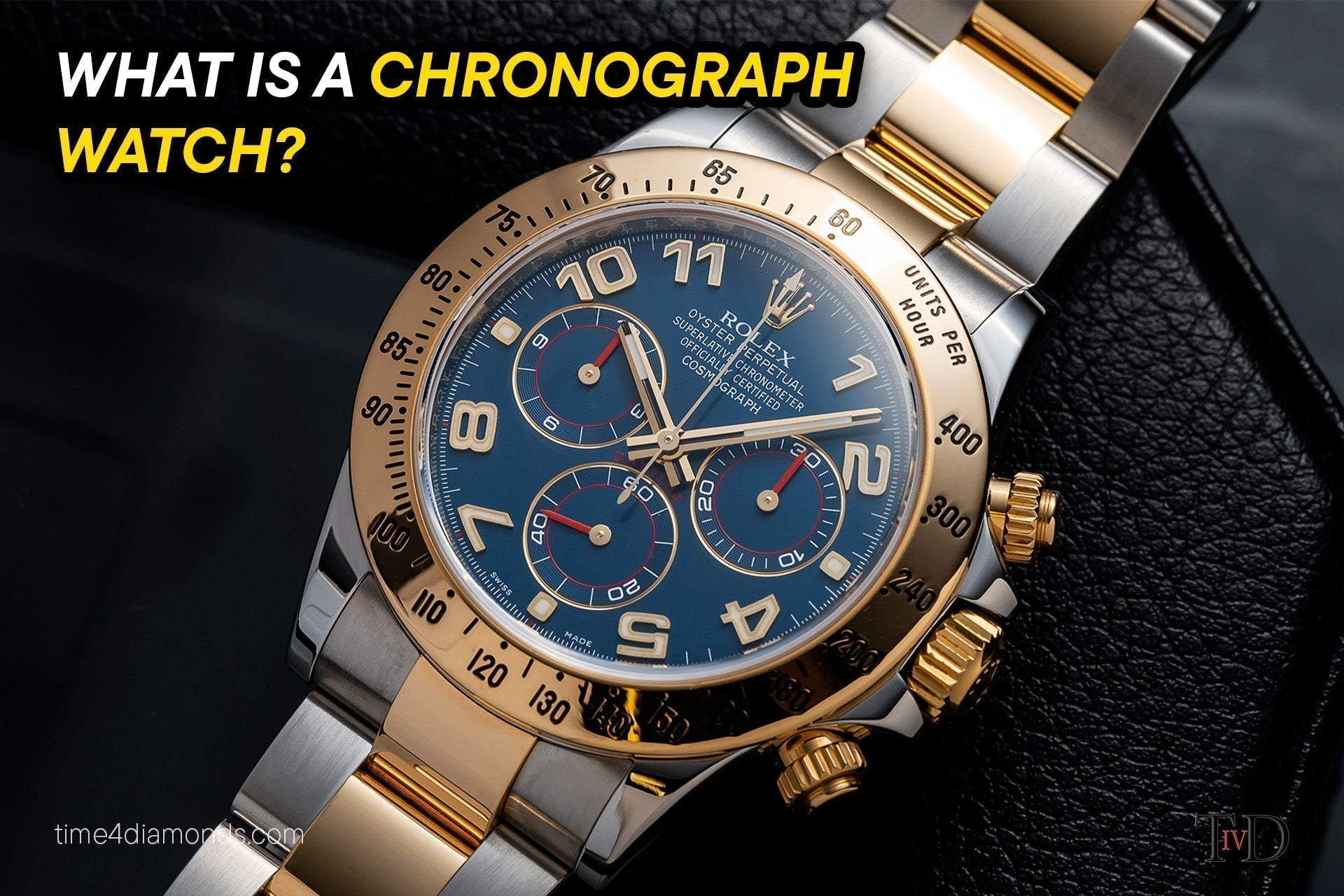
What is a Chronograph Watch?
A chronograph is a watch that combines standard timekeeping with a built-in stopwatch function, allowing for the measurement of elapsed time. The word itself comes from the Greek "chronos" (time) and "grapho" (to write), reflecting its original purpose of recording elapsed time.
Today, the chronograph is one of the most popular and widely produced watch complications, found in everything from affordable sports watches to six-figure luxury timepieces. If you have ever seen a watch with two or three small sub-dials on the face and pushers on the side of the case, you have almost certainly been looking at a chronograph.
In simple terms, we have answered the question of "What is a Chronograph?" But, in this article, we are going to explain it further, covering exactly how a chronograph complication works, the function it serves and the different types of chronographs you can find.
How does a Chronograph Work?

A chronograph operates through a secondary mechanism layered on top of the watch's standard timekeeping movement. It operates via a series of levers and gears, typically controlled by two pushers along the side of the case that a wearer can press to start and stop the function.
In a mechanical chronograph, pressing the top pusher (typically positioned at 2 o'clock) starts the chronograph. The central chronograph seconds hand, which is separate from the watch's running seconds hand, begins sweeping around the dial to measure elapsed seconds. Pressing the same pusher again stops the chronograph hand, freezing it in position so the wearer can read the elapsed time. Pressing the bottom pusher (typically at 4 o'clock) resets the chronograph hand back to the 12 o'clock position, ready for the next timing event.
The sub-dials on a chronograph face serve as accumulators. A 30-minute counter tracks how many full minutes have elapsed, while a 12-hour counter tracks hours. These accumulators allow the chronograph to measure events lasting up to 12 hours. The small seconds sub-dial, which runs continuously, shows that the watch movement is active and should not be confused with the chronograph function.
The Column Wheel vs Cam-Actuated Chronograph
Inside a mechanical chronograph, the start, stop and reset functions are controlled by one of two systems: a column wheel or a cam-actuated mechanism.
The column wheel is the more traditional and prestigious approach, using a rotating column (resembling a tiny castle turret) that precisely controls the engagement and disengagement of the chronograph mechanism. Column-wheel chronographs are valued for their smooth pusher feel and precise actuation, and are found in higher-end movements from manufacturers such as Audemars Piguet and Patek Philippe.
Cam-actuated chronographs use a shaped cam to control the same functions. This system is simpler, less expensive to produce and easier to service, which is why it is more commonly found in mid-range automatic chronographs. Whilst cam-actuated systems are sometimes considered less refined than column wheels, modern engineering has narrowed the performance gap considerably.
For the average wearer, the practical difference is minimal, though collectors and enthusiasts often prefer the column wheel for its mechanical elegance.
The Flyback Chronograph

As we have highlighted, a standard chronograph requires three pusher actions to restart a timing event: stop, reset, then start again. This differs from the flyback chronograph.
A flyback chronograph simplifies the stop-reset-start routine into a single action. Just by pressing the reset pusher while the chronograph is running, it instantly resets and restarts the timing, eliminating any delay between measurements.
This function was originally developed for pilots and navigators who needed to time successive intervals without losing seconds between resets. Flyback chronographs are found in higher-end pieces and add a layer of mechanical complexity that collectors appreciate.
The Split-Second (Rattrapante) Chronograph

The split-second chronograph, also known as a rattrapante (from the French "rattraper," meaning "to catch up"), is one of the most complex chronograph variations.
Through two chronograph seconds hands stacked on top of each other, the wearer can push the start button with both hands running together at the same time, but the wearer can stop one independently to record a split time while the other continues running. When released, the stopped hand snaps forward to catch up with the running hand.
This complication is particularly useful for timing multiple competitors in a race, which a standard chronograph cannot do. The split-second mechanism is a hallmark of haute horlogerie and appears in watches from Patek Philippe and A. Lange and Söhne.
Famous Chronograph Watches
The chronograph complication has produced some of the most iconic watches in history, from Omega, Rolex, Zenith, TAG Heuer and Audemars Piguet. We have ordered this by the year in which each of their iconic chronograph models was first released.
Omega Speedmaster Professional
The first, most recognisable and popular chronograph timepiece is the Omega Speedmaster Professional. Omega launched the Speedmaster in 1957, the reference CK2915, featuring the "Broad Arrow" hands and an engraved tachymeter bezel.
Although it was designed for motorsport, the Speedmaster became synonymous with NASA's Moon landing in 1969, being recognised as the "First Watch on the Moon" worn by astronaut Buzz Aldrin. But what made the Speedmaster an iconic staple was the aborted Apollo 13 mission to the moon a year later. After an oxygen tank exploded, astronauts were forced to abort and return to Earth, which wasn't as easy as it sounds.
The crew had to power down nearly every electronic system to preserve energy for re-entry to Earth. To return home safely, the crew had to perform a precise 14-second fuel burn to adjust their flight path. Timing this fuel burn was the Omega Speedmaster, which successfully timed it, meaning the astronauts could return to Earth. Due to the Speedmaster saving the astronauts, NASA awarded Omega the Silver Snoopy Award for the model's contribution to flight safety.
This iconic story is why the Speedmaster is also referenced and nicknamed the Moonwatch. It is also what makes the Speedmaster not just one of the most popular chronograph watches, but one of the most iconic timepieces of all time.
Rolex Cosmograph Daytona
Launched in 1963, the Rolex Daytona debuted, designed for motorsport racers to measure their time and speed. The Crown first released reference 6239, but it was called the Cosmograph; it wasn't until a year later that the name "Daytona" was added to the dial, which has stuck to this day.
Since the Daytona's inception, the model has had three different eras of movements: first powered by the manual-wound Valjoux 72 and 727 (1963-1987), then operated by a modified Zenith El Primero movement called the Calibre 4030 (1988-2000) and now functioning through Rolex's in-house calibres (2000-present). These in-house calibres are the Calibre 4130 (2000-2023), 4131 (2023-present) and 4132 (2023-present).
The aesthetics of the Daytona remain iconic, with its engraved tachymetric scale, popping sub-dial layout and high-quality craftsmanship. Today, it is one of the most in-demand and sought-after lines in the world.
Zenith El Primero
During the 1960s, there was a race for brands in Switzerland and Japan to produce an automatic chronograph watch called the "space race". The pair mentioned above, the Speedmaster and Daytona, were manual-winding. In January 1969, Zenith was congratulated for beating everyone and producing the first automatic chronograph watch, the El Primero (translating to "the first" in Spanish).
Whilst others eventually created automatic chronograph movements, Zenith's was far superior because it was integrated and high-frequency. But the success was short-lived, as in the 1970s, the infamous "Quartz Crisis" hit, and Zenith's new management halted all mechanical watch production in 1975, demanding that the specialised tools and blueprints for the El Primero be scrapped. Fortunately, senior watchmaker Charles Vermot saved all the equipment and blueprints for the El Primero in a walled-off attic.
When automatic and mechanical watches started to gain interest again in the 1980s, the Swiss luxury watch brand Ebel approached Zenith for its chronograph movement. Thankfully for Vermot, Zenith was able to restart the El Primero's production. Not only did Ebel approach Zenith, but also Rolex, which created a modified version called the Calibre 4030 for the Daytona.
Today, the El Primero still exists and has stamped itself in horological history as one of the most iconic and popular chronographs on the market.
TAG Heuer Monaco
Also part of the "space race", Heuer, before becoming TAG Heuer, teamed up with Breitling, Hamilton-Buren and Dubois-Dépraz in a secret collaboration codenamed Project 99. The result was the Calibre 11, which was unveiled in March 1969, two months after Zenith's El Primero.
To commemorate the creation of the Calibre 11, Jack Heuer wanted to produce an avant-garde watch. He did that with the Monaco, which features a square-shaped case designed by Ervin Piquerez and moved the winding crown to the left side, which is unconventional. In the very early years of the Monaco's production, it was a slow seller, but that all changed in 1971.
American actor Steve McQueen picked out the Monaco to wear in the movie Le Mans. Although this made the Monaco grow in popularity, the timing was unfortunate, as like the El Primero, the Monaco was discontinued in 1975 because of the "Quartz Crisis".
After a long spell away from the catalogue, the Monaco was resurrected in 1998, and the re-launch was an instant hit. Today, the Monaco lives on, and the collection is a brand pillar.
Tracking down a specific chronograph reference?
Vintage Speedmasters, early Daytona references, El Primero pieces and original Monaco models are sourced through our private collector network.
Chronograph vs Tachymeter

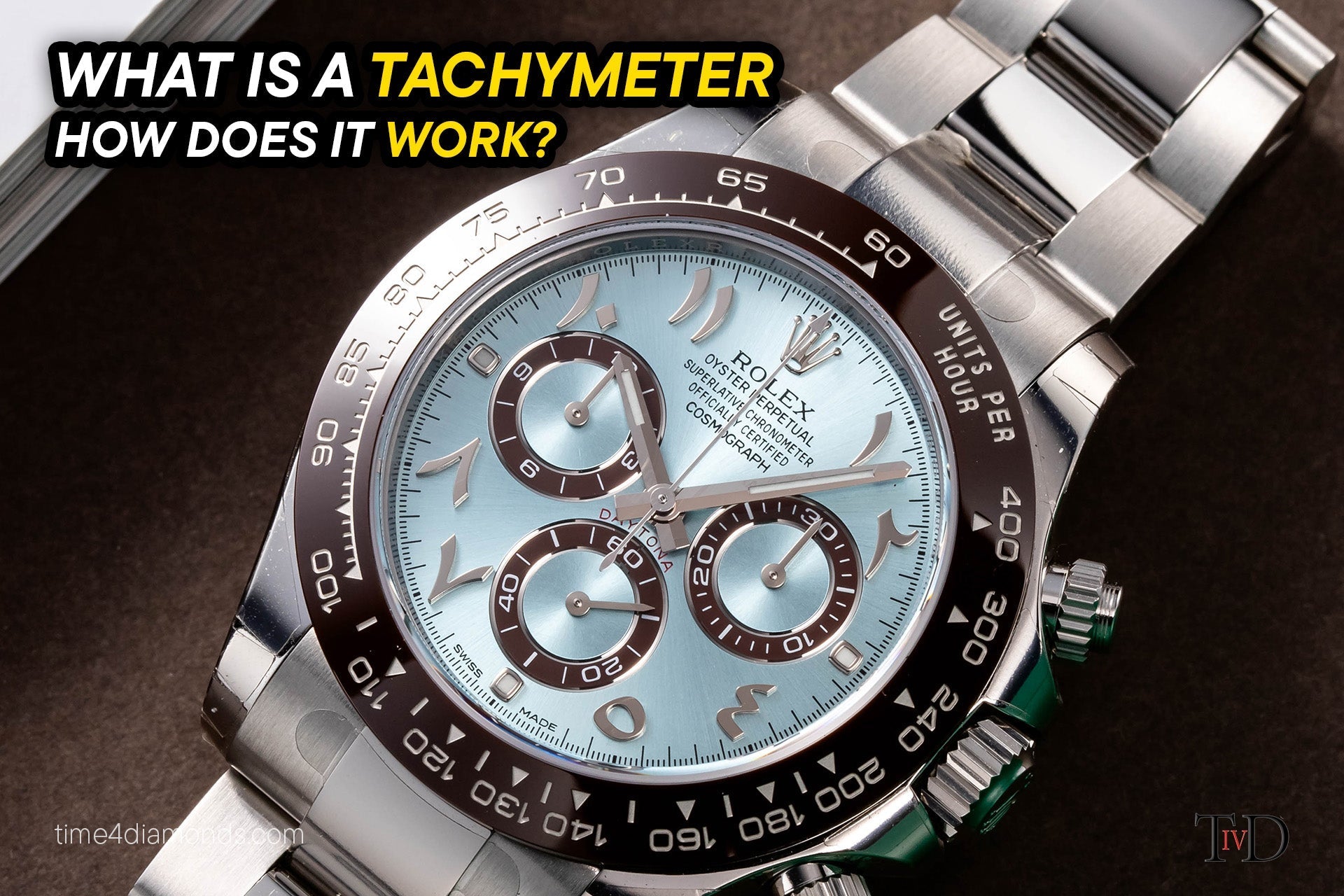
A common point of confusion is the relationship between the chronograph and the tachymeter scale that often appears on the watch's bezel or dial edge.
The tachymeter is not a separate complication but rather a printed scale that works in conjunction with the chronograph. To use it, the wearer starts the chronograph at a known starting point (such as a mile marker) and stops it at the next marker.
The position of the chronograph's seconds hand on the tachymeter scale then indicates the speed of travel. For example, if the chronograph hand points to 120 on the tachymeter scale after timing one mile, the speed of travel was 120 miles per hour.
Quartz vs Mechanical Chronographs

Chronographs are available with both quartz and mechanical movements. Quartz chronographs, powered by a battery, offer greater accuracy in timekeeping and are generally more affordable. Mechanical chronographs, whether manual-winding or automatic, are valued for their craftsmanship, heritage and the visible complexity of their movements.
In the luxury watch market, mechanical chronographs dominate, with brands like Rolex, Audemars Piguet and Patek Philippe exclusively using mechanical movements in their chronograph models.
Why the Chronograph Remains One of the Most Desirable Complications

Despite the availability of smartphones and digital timing devices, the mechanical chronograph remains one of the most popular and admired watch complications. Its appeal lies in the combination of practical function, visual complexity and mechanical artistry.
The additional sub-dials give a chronograph watch a purposeful, technical aesthetic that simple time-only watches lack, and the tactile satisfaction of operating the pushers connects the wearer to the mechanical heart of the watch in a way that few other complications can match.
Browse our collection of luxury chronograph watches from Rolex, Audemars Piguet and other leading manufacturers at Time 4 Diamonds. If you are interested in enhancing your chronograph with a custom bezel, dial or diamond setting, our team is ready to bring your vision to life.


%20a...)
Leave a comment
This site is protected by hCaptcha and the hCaptcha Privacy Policy and Terms of Service apply.