

What is a Tachymeter and How Does it Work?
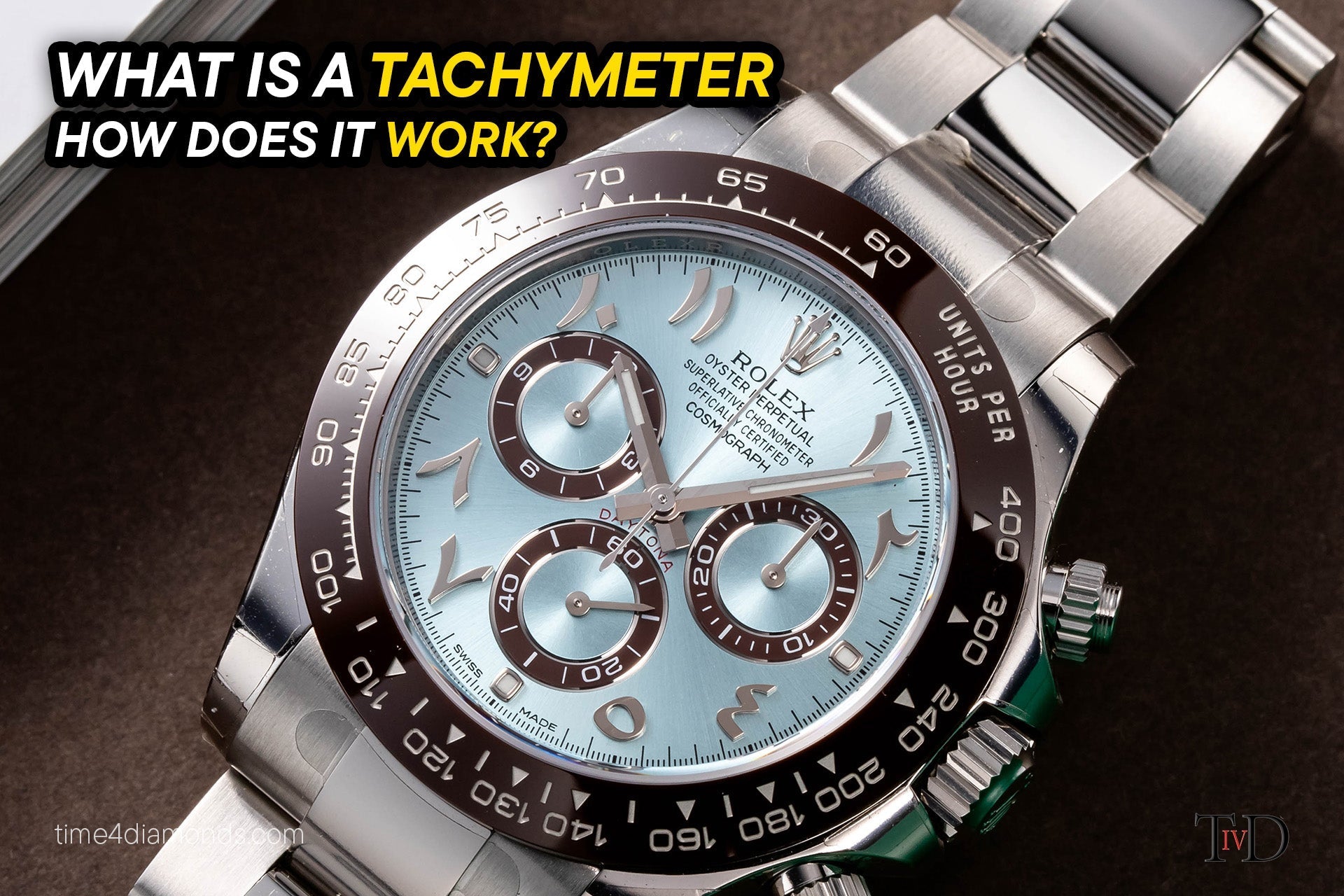
If you have ever looked at a chronograph watch and noticed a ring of numbers, typically starting at 500 and descending to 60, running around the outer edge of the dial or bezel, you have been looking at a tachymeter.
Visually, it is one of those features that most watch owners recognise, but very few actually understand. This is a shame, as the tachymeter is one of the most practical complications in all of watchmaking, with a fascinating history tied to motorsport, aviation, and the golden age of the chronograph.
In this guide, we are going to break down exactly what a tachymeter is, the simple maths that makes it work, and how to actually utilise one on your wrist. Also, we will suggest which luxury watches feature the best examples of the complication, like the Rolex Daytona.
Notably, if you own a Rolex Daytona or have been eyeing one, this is particularly relevant, as the Daytona's entire identity is built around its tachymeter-engraved bezel and chronograph function.
The Tachymeter Defined

A tachymeter is a graduated scale found on the bezel or the outer ring of the dial of a chronograph watch. Its purpose is straightforward: it converts elapsed time, measured in seconds, into a rate expressed in units per hour. Most commonly, that rate is speed miles per hour or kilometres per hour.
Still, it can just as easily represent any event that repeats over time, such as units produced per hour on a factory floor or laps completed per hour on a circuit.
The word itself is derived from the Greek takhys (swift) and metron (measure); it is sometimes spelt "tachometer," though that term is more commonly used for the engine RPM gauge in a car. In horological circles, "tachymeter" is the standard.
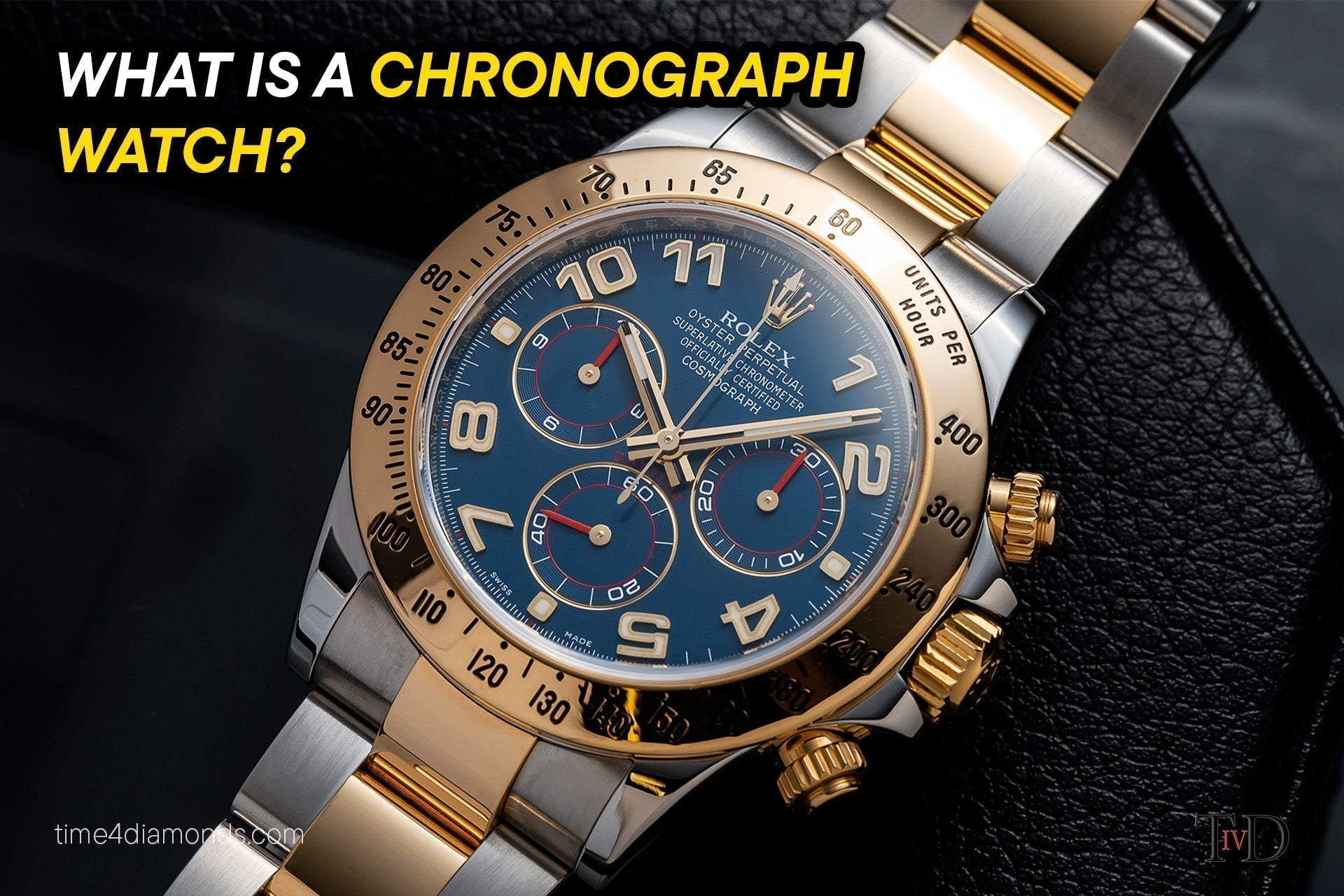
Crucially, a tachymeter does not work on its own; it requires a chronograph, which is the stopwatch function of a watch, to time the event being measured. The tachymeter scale reads out the result of a calculation that would otherwise require pen and paper. Think of the chronograph as the stopwatch and the tachymeter as the calculator printed alongside it.
A Brief History

The first-ever chronograph was invented in 1816 by French watchmaker Louis Moinet, who called it a Compteur de Tierces (pictured top left). Moinet's Compteur de Tierces was a remarkably precise pocketwatch, capable of measuring 1/60th of a second. The purpose of the Compteur de Tierces was to track astronomical movements. For his creation, Moinet was awarded two world records, the "World's First Chronograph" and the "First High-Frequency Stopwatch".
In 1821, French watchmaker Nicolas Mathieu Rieussec produced a clock housed in a wooden box featuring a chronograph (pictured top right), which was believed to be the first-ever chronograph before 2012. He built the device for timing horse races, with the ability to time every competitor participating on the track.
It wasn't until nearly 100 years later, in 1913, that the first-ever chronograph wristwatch was produced. Longines created a monopusher chronograph watch (pictured bottom left) through the Calibre 13.33Z, which utilised a single button integrated into the crown to control the start, stop and reset functions.
It wasn't too long after that, in 1915, when Breitling created their first-ever chronograph wristwatch (pictured bottom right), which was very similar to Longines'
For the first century of the chronograph's existence, reading speed from elapsed time required mental arithmetic or printed reference charts. That changed in the early 1900s when manufacturers began printing pre-calculated scales directly onto watch dials and bezels, and shortly after the first chronograph wristwatch in 1913, the tachymeter was born.
By the 1930s, the tachymeter had become a fixture of aviation and motor-racing timepieces. Pilots used it to estimate ground speed between navigation waypoints, whilst racing drivers used it to gauge average lap speeds.
When Rolex introduced the Cosmograph Daytona in 1963, the Crown engraved the tachymeter on the bezel, locking the complication's association with motorsport into the public imagination permanently. The evolution of the Daytona's bezel over the decades, from steel to ceramic, tracks the story of the modern tachymeter itself.
The Maths Behind the Scale

The tachymeter looks complicated, but the underlying formula is almost comically simple. Every value printed on the scale is derived from a single equation:
T = 3,600 ÷ t
T = the tachymeter value (units per hour) | t = elapsed time in seconds | 3,600 = seconds in one hour
That is it! As there are 3,600 seconds in an hour, dividing 3,600 by the number of seconds an event takes gives you how many times that event would occur in a full hour if repeated at the same pace.
The manufacturer pre-calculates this for every second and prints the corresponding values around the bezel or dial ring, so you never have to divide the numbers yourself.
For example, at the 36-second mark, the printed tachymeter value is 100, because 3,600 ÷ 36 = 100. At the 30-second mark, the value is 120, because 3,600 ÷ 30 = 120. At the 45-second mark, the value is 80, because 3,600 ÷ 45 = 80.
The spacing between the numbers is not uniform; they get closer together as you approach the 60-second mark because the relationship between time and rate is inversely proportional, not linear.
How to Use a Tachymeter: Step by Step

Measuring Speed
This is the most common and historically significant use of the tachymeter, and it requires a known distance of one unit, whether that be one mile, one kilometre, or one nautical mile.
The beauty of the tachymeter is that it is unit-agnostic: it does not care whether you are measuring in miles, kilometres, or any other unit of length, as long as you are consistent.
Worked Example
You are in the passenger seat of a car on a motorway, and you pass a mile marker. At that exact moment, you press the chronograph pusher to start the seconds hand. When you pass the next mile marker, you press the pusher again to stop it. The second hand has stopped at 40 seconds. You look at the tachymeter scale opposite the 40-second position and read 90. Your average speed over that mile was 90 miles per hour.
Verification: 3,600 ÷ 40 = 90. ✓
Had you been measuring in kilometres, you would perform the same procedure between two kilometre markers, and the reading would be in kilometres per hour instead. No conversion is necessary. This unit independence made the tachymeter so useful in international motorsport, where drivers and teams across different countries could use the same watch regardless of their local measurement system.
Measuring Distance
The tachymeter can also work in reverse to estimate distance, provided you maintain a constant, known speed. Start the chronograph and watch the second hand sweep around the dial. When the tachymeter value it is pointing to matches your current speed, you have covered exactly one unit of distance.
Worked Example
You are driving at a steady 80 km/h and want to know when you have covered exactly one kilometre. Start the chronograph and watch the second hand. When it reaches the point on the tachymeter scale that reads 80 — which corresponds to 45 seconds — you have driven exactly one kilometre.
Verification: At 80 km/h, you cover one kilometre in 3,600 ÷ 80 = 45 seconds. ✓
Measuring Production Rate
Here is a lesser-known use that takes the tachymeter off the racetrack entirely. If you are observing any repetitive event of items coming off a production line, like a machine completing one cycle or a barista pulling one espresso, you can use the tachymeter to calculate the hourly rate.
Time one complete cycle with the chronograph, then read the tachymeter scale. The value tells you how many of those events would occur in one hour at that pace.
Limitations You Should Know About
The tachymeter is a clever analogue calculator, but it has constraints that every owner should be aware of before relying on it for anything serious.
The 60-Second Ceiling
A standard tachymeter scale only covers events that last up to 60 seconds. If the event takes longer than a minute, the second hand will have swept past the lowest printed value (usually 60) and looped back around, making a direct reading impossible.
Of course, there are workarounds. You can measure half the distance and double the result, or time a smaller fractional unit, but these require mental arithmetic that partially defeats the convenience and purpose of the tachymetric scale.
Low-Speed Imprecision
Due to the tachymeter values being compressed tightly together at the low end of the scale (near the 60 mark), it becomes very difficult to distinguish between, say, 62 and 65.
The scale is most legible and useful for events lasting between roughly 7 and 45 seconds, which corresponds to speeds between approximately 80 and 500 units per hour.
Average Speed Only
The tachymeter tells you the average speed between your start and finish points; it says nothing about instantaneous speed at any given moment. If you accelerated hard, slowed for a corner, then accelerated again, the tachymeter reading blends all of that into a single number. Therefore, for real-time speed, you need a speedometer.
Tachymeter Bezel vs Dial-Printed Tachymeter

Not all tachymeters are created equal in terms of placement, as on some watches, the scale is engraved or printed on the bezel. Alternatively, on other timepieces, it is on the outermost ring part of the dial itself. Both function identically, but there are practical and aesthetic differences worth considering.
Tachymeter Bezel
A bezel-mounted tachymeter, like the one on the Rolex Cosmograph Daytona, sits slightly raised above the dial, making it easy to read at a glance and giving the watch a more layered, three-dimensional look.
On modern Daytonas, the tachymeter is engraved into the Crown's patented Cerachrom bezel, which means the markings are virtually scratch-proof and will not fade with UV exposure. This is a meaningful upgrade over older steel or aluminium bezels! If you are interested in upgrading or replacing a Daytona bezel, our Rolex bezels collection includes both factory and custom options.
Dial-Printed Tachymeter
A dial-printed tachymeter, found on many Omega Speedmaster variants, sits protected beneath the crystal glass. It cannot be scratched by external contact, but it does consume some of the dial's visual real estate and can make the face look busier on smaller case diameters.
Iconic Watches with Tachymeters
The tachymeter has appeared on thousands of watches over the past century, but a handful of models have defined what the complication means in the luxury space. These are the chronographs that collectors, enthusiasts, and historians point to when the subject comes up.
Rolex Cosmograph Daytona

The Rolex Daytona is arguably the single most recognisable tachymeter watch ever made. Introduced in 1963, the first Daytona model was the reference 6239, designed explicitly as a tool for endurance racing drivers. Its bezel-mounted tachymeter scale reads up to 200 or 300 units per hour, whereas modern Daytona models read up to 400 units per hour.
The transition from a steel tachymeter bezel on early references to the modern Cerachrom bezel on the current reference 126500LN is one of the most significant design evolutions in Rolex history.
If the Daytona interests you, our comparison of the 116520 vs. 116500LN references breaks down every difference in detail, and you can browse our full pre-owned Daytona collection to see what is currently available.
Omega Speedmaster Moonwatch Professional

Introduced in 1957, Omega released its first Speedmaster Moonwatch as a racing chronograph before NASA adopted it for the Apollo programme in 1965.
The Speedmaster features a dial-printed tachymeter scale and is heavily regarded as the watch that travelled to the Moon in 1969. The model remains in production today with relatively little fundamental change, which is a testament to how well the original design worked.
TAG Heuer Carrera

Launched in 1963, the same year as the Daytona, the Carrera was introduced, designed by Jack Heuer and created for racing drivers who needed legibility above all else.
The Carrera's tachymeter scale is printed on the dial's outer chapter ring, keeping the bezel clean and uncluttered. The Carrera is widely credited with proving that a tachymeter could be integrated into an elegant, wearable dress-sport watch rather than a purely utilitarian tool.
Quick-Reference: Tachymeter Readings at a Glance
The table below shows common elapsed times and their corresponding tachymeter values. Commit a few of these to memory, and you will be able to estimate speed on your wrist without even looking at the scale.
| Elapsed Time (seconds) | Tachymeter Reading | Meaning |
|---|---|---|
| 10 | 360 | 360 units/hour |
| 15 | 240 | 240 units/hour |
| 20 | 180 | 180 units/hour |
| 25 | 144 | 144 units/hour |
| 30 | 120 | 120 units/hour |
| 36 | 100 | 100 units/hour |
| 40 | 90 | 90 units/hour |
| 45 | 80 | 80 units/hour |
| 50 | 72 | 72 units/hour |
| 60 | 60 | 60 units/hour |
Tachymeter vs. Other Bezel Scales

The tachymeter is far from the only scale you will find on a watch bezel, so it is worth understanding how it compares to the other common types so you know exactly what you are looking at when shopping for a luxury chronograph.
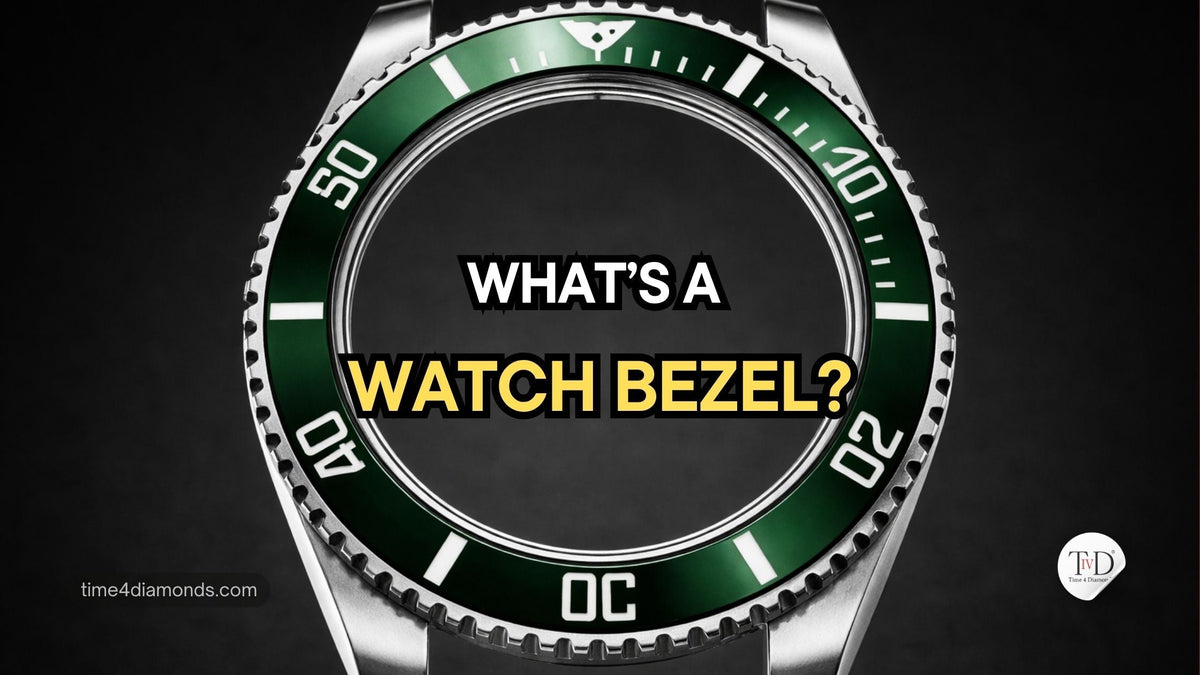
- A dive bezel, like the one on a Rolex Submariner, is a rotating, unidirectional bezel used to track elapsed time underwater. It measures duration, not speed.
- A GMT bezel, like the one on a Rolex GMT-Master II, displays a second time zone using a 24-hour scale.
- A telemeter scale, occasionally found on vintage chronographs, measures the distance of an event based on the speed of sound. It was designed for artillery officers to estimate how far away a cannon blast occurred.
- A pulsometer scale, used by physicians, calculates heart rate from a counted number of pulse beats.
Of all these, the tachymeter remains the most commonly found on modern luxury watches, in large part because of its association with motorsport and the cultural cachet of the Daytona and Speedmaster.
Does Anyone Actually Use a Tachymeter Today?
Honestly? Very rarely for its original purpose. A smartphone with GPS will give you a far more accurate and instantaneous speed reading than a wristwatch and a mile marker ever could. The practical utility of the tachymeter in daily life is limited.
But that entirely misses the point of why the tachymeter endures. In watchmaking, a complication's value has never been purely about utility; it is about craft, heritage, and the story a watch tells.
The tachymeter connects the watch on your wrist to a century of motorsport history, to Le Mans and Daytona Beach, to the cockpits of early aviation and the factory floors of the industrial age. When you look at the engraved numbers sweeping around the bezel of a Daytona, you are looking at the same scale that racing drivers relied on before telemetry existed.
And there is something satisfying about knowing how it works, with just one glance at your wrist, and you see the maths laid out. It is a small mechanical thrill in a world of digital screens, which can be used as a subtle flex.
Caring for Your Tachymeter Bezel
If your watch has a bezel-mounted tachymeter, the material of the bezel determines how much attention it needs.
Modern ceramic bezels, such as those on the Rolex Daytona Cerachrom, are extremely hard and resistant to scratching, fading, and chemical exposure. They require very little maintenance beyond an occasional wipe with a damp microfibre cloth.
Older watches with aluminium or steel tachymeter bezels are more vulnerable, so do follow our guidance and advice. Aluminium can fade with prolonged UV exposure, and steel can pick up fine scratches, so do take care of your timepieces, as you do not want to over-polish your watch.
If you own a vintage piece and the bezel is showing its age, a replacement can restore the watch's legibility and appearance. We carry a range of Rolex bezels, both factory originals and custom pieces, that can bring a tired Daytona back to life. For broader servicing needs, our watch servicing team can inspect, clean, and restore the entire timepiece.
Frequently Asked Questions
Is a tachymeter the same as a chronograph?
No, a chronograph is the stopwatch mechanism, the pushers, the seconds hand, and the sub-dials that measure elapsed time. A tachymeter is a printed or engraved scale that converts the chronograph's time reading into a speed or rate. The two work together, but they are separate features. Every tachymeter watch has a chronograph, but not every chronograph has a tachymeter.
Can you measure speeds below 60 units per hour with a tachymeter?
Not directly, because the standard scale only covers events lasting up to 60 seconds. However, you can work around this by measuring a fraction of the distance. For instance, if you want to measure a speed in km/h but the journey takes more than 60 seconds per kilometre, time half a kilometre instead and multiply the tachymeter reading by 0.5. Some watches with rotating tachymeter bezels offer slightly more flexibility here, but the standard fixed-bezel tachymeter has a hard 60-second ceiling.
Does the tachymeter work in miles AND kilometres?
Yes. The tachymeter is entirely unit-agnostic. It converts seconds into units per hour, so it does not know or care whether those units are miles, kilometres, nautical miles, or anything else. If you time one mile, the reading is in mph. If you time one kilometre, the reading is in km/h. The number on the scale is the same either way; only the unit label changes depending on what you measured.
Do all Rolex watches have a tachymeter?
No. Within the current Rolex catalogue, only the Cosmograph Daytona features a tachymeter, whilst other Rolex models use their bezels for different functions. The Submariner has a dive-time bezel, the GMT-Master II has a 24-hour GMT bezel, and the dress models like the Datejust and Day-Date have smooth or fluted bezels with no functional scale at all. To explore how Rolex models compare, our guide to 20 Rolex nicknames every beginner must know is a good place to start.
Can I add a custom tachymeter bezel to a watch that does not have one?
In theory, yes, but only if the watch has a chronograph and the case accepts a compatible bezel. At Time 4 Diamonds, we specialise in watch customisation, including bezel upgrades and replacements. If you are considering a custom build, our bespoke customisation service can walk you through the options.

Leave a comment
This site is protected by hCaptcha and the hCaptcha Privacy Policy and Terms of Service apply.