

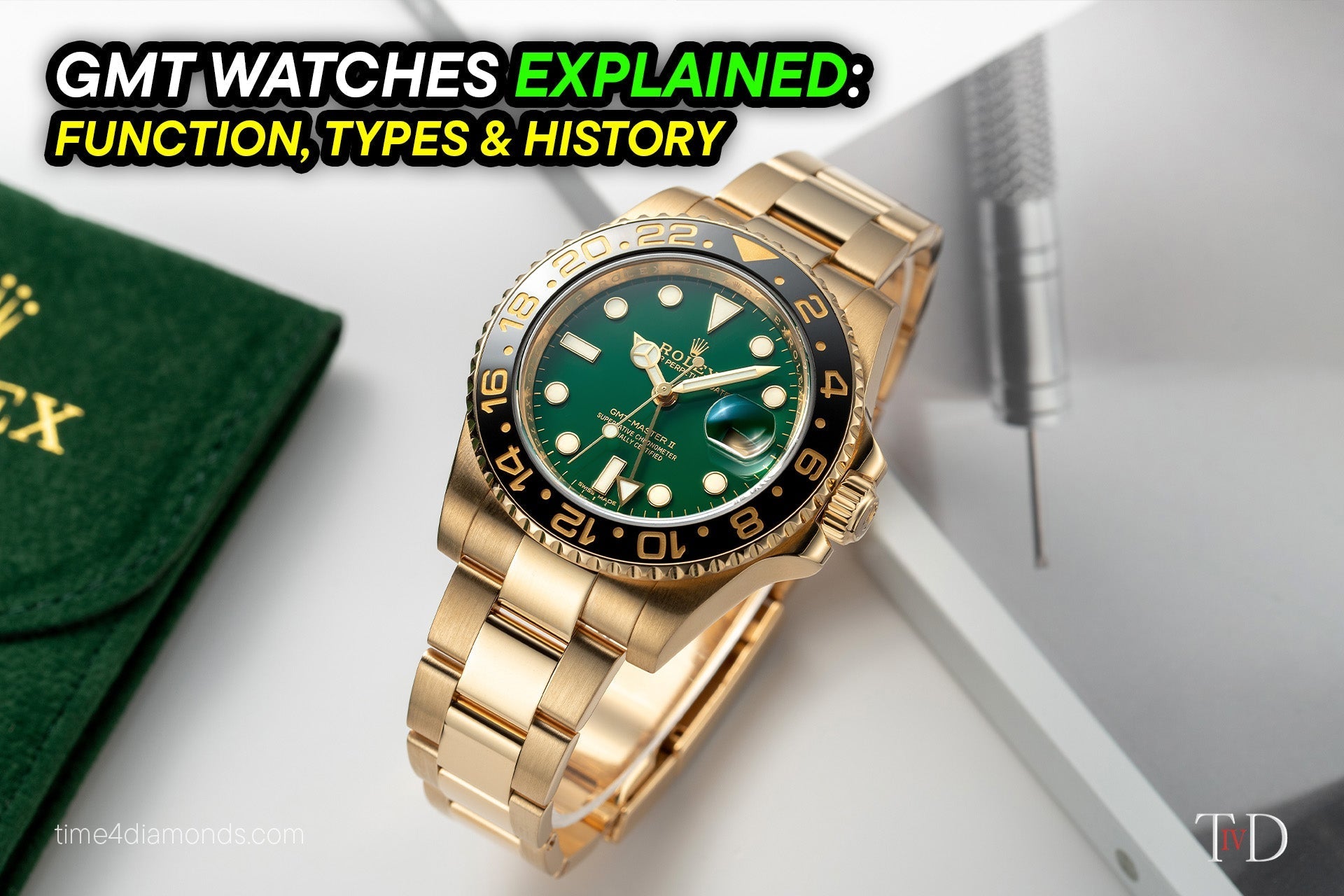
GMT Watches Explained: Function, Types and History
The GMT function is one of the most desirable functions built into a watch, with the ability to show more than one time zone at once. Alongside the usual hours, minutes and seconds, it carries a fourth hand that points to a 24-hour scale, so you can read a second zone at a glance and, with the rotating bezel, a third. The name comes from Greenwich Mean Time, the global reference the system was built around.
The complication has its clear origin in long-haul aviation in the 1950s, and it has since become one of the most practical features a mechanical watch can offer. Unlike other functions, like the chronograph or moonphase, the GMT complication is actually usable, which is why almost every serious brand now makes one.
What follows is the full picture: what a GMT watch is, how it works, the two mechanisms you will meet when buying, the history behind the first-ever GMT watch, and how GMT differs from a world timer and a dual-time watch.
What is a GMT watch?

A GMT watch is a timepiece that tracks at least two time zones using an additional 24-hour hand. The standard hour, minute, and second hands display your local time on the normal 12-hour dial. The extra hand makes one full rotation every 24 hours rather than every 12, so it can point to a second zone on a 24-hour scale without confusing morning and evening.
The 24-hour format matters because a second hand on a 12-hour scale could not tell you whether it was 8 in the morning or 8 at night in the other location. A 24-hour hand removes that ambiguity, which is the whole point of the complication.
As highlighted in the introduction, GMT stands for Greenwich Mean Time, the time at the Royal Observatory in Greenwich and the historical basis for the world's time zones. Coordinated Universal Time, or UTC, replaced GMT as the technical standard in 1972, but the name stuck in watchmaking and is now used loosely to refer to any watch that displays an extra time zone.
How does a GMT watch work?

A GMT watch works by combining the 24-hour hand with a numbered bezel. The 24-hour hand reads against a 24-hour scale that sits either on the bezel or on the dial. To track a second zone, you set that hand to the relevant time.
If a GMT watch is fitted with a rotatable bezel, then a third time zone can be achieved. You rotate a bidirectional 24-hour bezel by the number of hours you want to offset, then read the 24-hour hand against the new bezel position.
That bezel is central to the design; the very first GMT watches relied on it entirely, because the 24-hour hand was fixed to the main hands and could not be moved individually. The bezel does the same job on a modern GMT-Master II when you want a third zone, which is why a quality rotating bezel is part of what you are paying for. If you want the details on bezel types and how they are made, our entry on what a watch bezel is covers the ground.
The practical experience depends on one design choice the maker took, and that choice is the most important thing to understand before you buy. It splits every GMT watch into two camps.
Flyer GMT vs Caller GMT: the difference that matters
There are two ways to build a GMT, and they behave very differently in daily use: the Flyer and Caller GMT. A Flyer GMT, also known as the “True” GMT, lets you jump the 12-hour local hand independently in one-hour increments, whilst the 24-hour hand stays locked to your home time. You land somewhere new, jump the hour hand to local time, and you are done, with your home zone still running on the 24-hour hand.
Whereas, on a Caller GMT, the hour and minute hand move together like a conventional watch, letting you jump the 24-hour hand independently instead. That suits someone who stays in one place and tracks a distant zone, such as calls with colleagues or family abroad.
Whilst they are different in setting time zones, they look almost identical on the wrist, so the distinction is easy to miss and worth getting right.
|
Feature |
Flyer (traveller) GMT |
Caller (office) GMT |
|
Hand you adjust |
Local 12-hour hand jumps on its own |
24-hour GMT hand jumps on its own |
|
Changing local time |
One-hour steps, minutes untouched |
Set with the main hands |
|
Best for |
Frequent travellers who change zones often |
Tracking a fixed second zone from home or the office |
|
Typical examples |
Rolex GMT-Master II, Tudor Black Bay GMT |
Many accessible Seiko and microbrand movements |
Neither is better in absolute terms. A flyer GMT is the right tool if you actually fly between zones, because the action you repeat most often, changing local time, is the quick one. A Caller GMT is arguably easier for someone who rarely travels but wants to keep an eye on another place. Knowing which mechanism a watch uses tells you more about how it will fit your life than any spec on paper.
How to set and read a GMT watch

Setting a Flyer GMT, such as a Rolex GMT-Master II, follows a clear order. Set the 24-hour hand and the main time first, then adjust the local hour hand to wherever you are. The sequence runs like this:
-
Wind and set the watch so the 24-hour hand shows your home time on the 24-hour scale, with the bezel triangle at the top.
-
Pull the crown to the time-setting position and set the minutes and the running time.
-
Then move the crown to the intermediate position and jump the local hour hand in one-hour increments until it matches local time.
-
To add a third zone, rotate the bezel by the offset you need and read the 24-hour hand against it.
Reading the watch is then simple: the normal hands show local time, the 24-hour hand displays your home or reference zone, and the bezel gives the third.
A Short History of the GMT Watch
The first-ever GMT watch was the Airman, produced in 1953 by Glycine, designed with input from military servicemen and commercial pilots. It is celebrated as the first true GMT wristwatch, revolutionising timekeeping by allowing pilots to track multiple time zones simultaneously.
There were three key features of the Airman. The first was the 24-hour dial, instead of the 12-hour dial, which remains highly unconventional in modern watchmaking. Secondly, a 24-hour rotating bezel that moved independently and consisted of a locking mechanism. Lastly, there was a second mechanism called the Hack Mechanism, including an ingenious wire that would stop the seconds hand from moving when the crown was pulled out, allowing for precise synchronisation with air traffic control.
Many credit Rolex for creating the first-ever GMT wristwatch with the GMT-Master in 1954, which is a common misconception, as Glycine beat the Crown through the Airman a year earlier.
In the early 1950s, Pan American World Airways (Pan Am) asked Rolex for a watch that could show two time zones at once, so its long-haul crews could keep track of home time and local time as they crossed continents.
The answer, in 1954, was the Rolex GMT-Master reference 6542: a 38mm steel watch with a bakelite blue-and-red bidirectional 24-hour bezel, 50m water resistance, radium lume, the cyclops lens and no crown guards. The blue-and-red split doubled as a day-night indicator, and that scheme later earned the Pepsi nickname.
On that first GMT-Master reference 6542, the 24-hour hand and the 12-hour hand were linked, so you set local time on the main hands and then turned the bezel to line the second zone up against the 24-hour hand. It worked, but it meant the bezel did all the heavy lifting. The model that started it all sits within the wider story of the brand you can see across our Rolex range.
The leap came in 1982 with the GMT-Master II reference 16760, nicknamed the “Fat Lady” for its thicker case. Fitted with the Calibre 3085, the central hour hand could be set independently of the 24-hour hand for the first time, creating the Flyer GMT as we know it and allowing a true third time zone via the bezel.
Rolex dropped the original GMT-Master line in 1999, so every GMT-Master made since is a GMT-Master II. The table below maps the main mechanical generations.
|
Generation |
Years |
Calibre |
Power reserve |
Key point |
|
GMT-Master 6542 |
1955 - 1959 |
1036 |
Approx. 42 hours |
Linked hands, Bakelite then aluminium bezel |
|
GMT-Master II 16760 |
1982 - 1988 |
3085 |
Approx. 42 hours |
First independent hour hand, Coke bezel only |
|
GMT-Master II 16710 |
1989 - 2007 |
3185 |
Approx. 50 hours |
Aluminium bezels, Pepsi, Coke and black |
|
GMT-Master II 116710 |
2007 - 2019 |
3186 |
Approx. 48 hours |
First steel ceramic Cerachrom bezel |
|
GMT-Master II 126710 |
2018 - date |
3285 |
Approx. 70 hours |
Current generation, Jubilee option returns |
Rolex introduced its scratch and fade-resistant Cerachrom bezel on the GMT-Master II in 2005, first on an 18ct yellow gold model and then on the steel 116710LN in 2007. The two-colour ceramic Pepsi bezel stayed exclusive to precious metal until the current steel generation arrived.
GMT vs World Timer vs Dual-time
These three terms get used as if they mean the same thing, but they do not. In a nutshell, a GMT tracks two or three zones with a 24-hour hand and bezel, a world timer shows all 24 zones at once, and a dual-time uses a second sub-dial or hand without the 24-hour mechanism.
A GMT watch is the focused tool, ideal for showing the local home time, a second time zone for wherever you may be, and a third time zone thanks to the bezel.
A world timer is the broad one: a rotating city ring and a 24-hour disc let you read every major zone simultaneously, which suits someone who is a seasoned and constant traveller or deals with many regions but rarely needs to reset anything in a hurry.
A dual-time watch is the loosest term, covering anything that shows a second zone, often on a small sub-dial or an extra 12-hour hand, sometimes with a day-and-night indicator instead of a 24-hour scale. A GMT is technically a type of dual-time watch; the difference between a GMT and a dual-time watch is down to how the second time zone is displayed. GMT watches use a 24-hour hand and bezel, whilst dual-time watches use an independent 12-hour sub-dial, as if there are two separate clocks.
Customising a GMT-Master II

A GMT-Master II is one of the most popular bases for bespoke work, partly because the case and bezel lend themselves to it and partly because demand for diamond-set and blacked-out versions keeps growing.
At Time 4 Diamonds, the work is carried out in-house by watchmakers who previously worked at Rolex, which matters when stones are being set into a case or a movement is opened. Options vary from diamond-set bezels, pavéd dials, to PVD and DLC coatings.
If you want to design something from scratch, you can start on our customise your watch page, browse finished pieces in the bespoke watches collection or look at standalone Rolex bezels if you only want to change the bezel.
A good example is a diamond-set 116710LN, built on the steel black-bezel GMT-Master II and set after it leaves the factory.
 In stock · UK
Custom Diamond-Set Rolex GMT-Master II 116710LN
Ref 116710LN
- Base: 40mm Oystersteel
- Bezel: Black Cerachrom
- Setting: Custom diamond-set
- Movement: Calibre 3186, flyer GMT
Buying a GMT watch: what to check
When buying a GMT, the first question is the mechanism, because a flyer and a caller suit different lifestyles and cost different amounts. After that, the usual pre-owned checks apply: confirm the reference and serial against the case and papers, check the movement matches the reference and look closely at the bezel and bracelet for wear, since those are the parts that take a knock.
Box and papers add value and make resale easier, and a recent service gives you confidence that the movement is healthy. A GMT-Master II earns its keep here because modern references hold strong demand on the secondary market.
If you already own a GMT and want it looked after, our watch service and repair team handles servicing and bezel work. If you are funding a new piece by moving an old one on, you can sell your watch to us directly. For the wider catalogue, the luxury watches collection sits alongside the GMT models.
Worth knowing too: a GMT is not the only travel-friendly complication. A chronograph adds stopwatch timing, and our entry on what a chronograph watch is explains how that differs, while the scale on a chronograph bezel is covered in our piece on how a tachymeter works.
Disclaimer: Past performance is not indicative of future results. Watches should not be considered a substitute for traditional financial investments. Always seek independent financial advice before making investment decisions.
GMT Watch FAQs
What does GMT mean on a watch?
GMT stands for Greenwich Mean Time. On a watch, it refers to a 24-hour hand and scale that let you track a second time zone alongside your local time, and a third if the watch has a rotating 24-hour bezel.
How does a GMT watch work?
A 24-hour hand reads a second zone against a 24-hour scale, so morning and evening are never confused. You set that hand to your reference time, then read local time from the normal hands. Rotating the bezel lets you read a third zone.
What is the difference between a caller and a flyer GMT?
On a Flyer GMT, the local hour hand jumps in one-hour steps on its own, ideal for travellers. On a Caller GMT, the 24-hour hand is the one you adjust independently, which suits tracking a fixed second zone from home or the office.
Is a Rolex GMT-Master II a caller or flyer GMT?
The Rolex GMT-Master II is a Flyer GMT. Since the reference 16760 in 1982, its local hour hand has been independently adjustable, so you can jump to local time without stopping the watch or losing your home zone.
What are the Rolex GMT nicknames?
There are various, but the main ones are “Pepsi” for red and blue, “Batman” for blue and black with the Oyster bracelet, “Sprite” for the green and black left-handed model, “Root-Beer” for brown and black, “Bruce Wayne” for grey and black and “Coke” for the discontinued red and black.
Can you use a GMT watch without the bezel?
Yes. A GMT works as a two-zone watch using just the 24-hour hand, with local time on the normal hands. The bezel only comes into play when you want to read a third zone by offsetting the 24-hour scale.
Are GMT watches worth it?
If you travel or work across time zones, a GMT is one of the most useful complications you can own and is very easy to live with day to day. Well-kept references such as the Rolex GMT-Master II also tend to hold demand on the pre-owned market.
What is the difference between a GMT and a world timer?
A GMT tracks two or three zones using a 24-hour hand and bezel. A world timer shows all 24 zones at once on a rotating city ring and 24-hour disc, which suits people who deal with many regions rather than one or two.


Written by
Adam Dedman
Adam is a watch specialist at Time 4 Diamonds and a collector in his own right. He works with the pieces passing through the London showroom daily, covering condition, references and what separates a strong example from an average one.

Leave a comment
This site is protected by hCaptcha and the hCaptcha Privacy Policy and Terms of Service apply.