

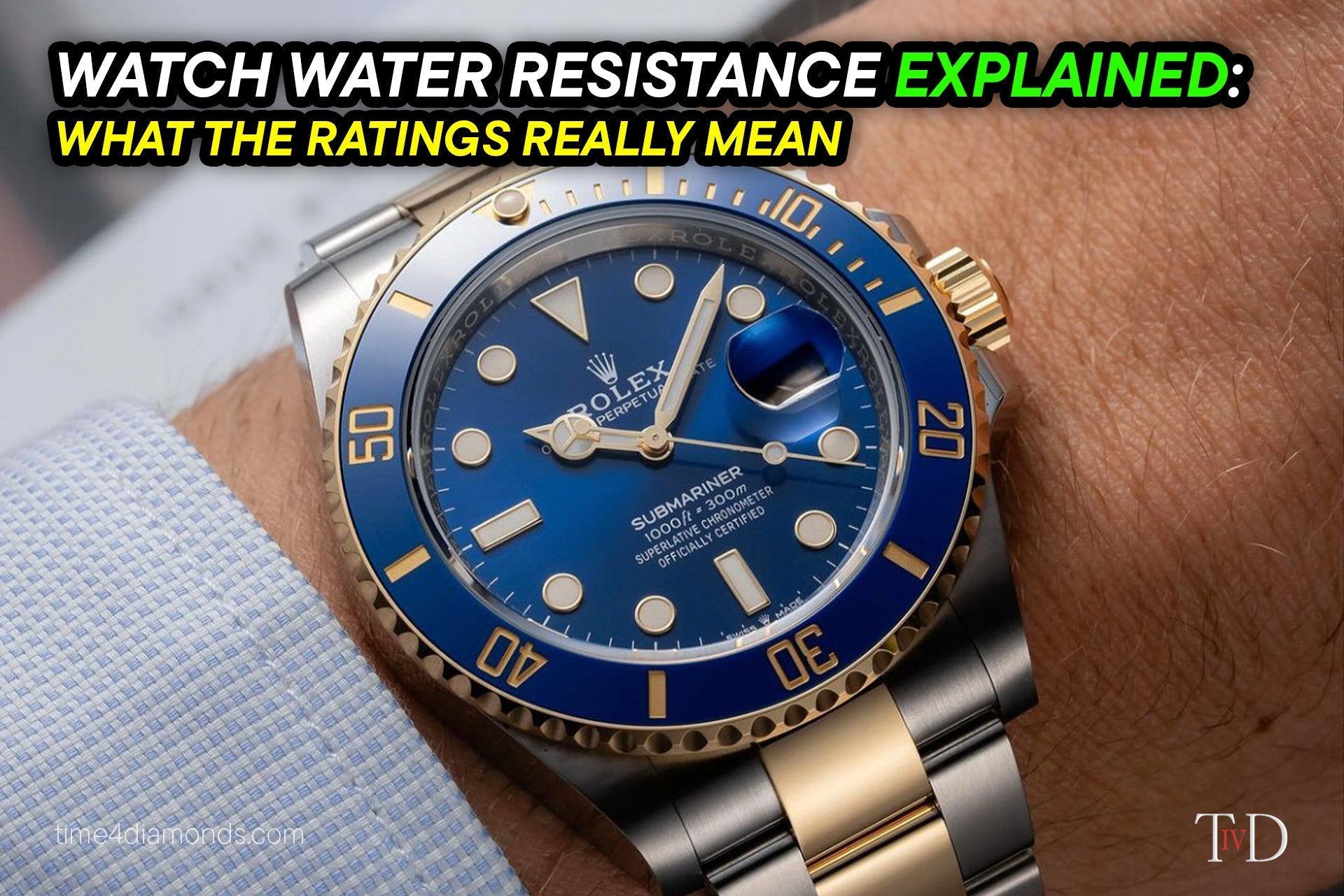
Watch Water Resistance Explained: What the Ratings Really Mean
Water resistance is one of the many key features of a watch, and whilst not every timepiece is water resistant, most modern ones are. To know whether your watch is water-resistant, there is typically a number stamped on the back of your watch or engraved on the dial, with a number followed by an “m” (the abbreviation for metres), such as 30m.
A dial that reads 30m sounds like you could take the watch 30 metres underwater, but actually, you cannot. That figure is a pressure rating measured in a laboratory under still conditions, not a depth you can swim to; read it the wrong way, and you can flood a perfectly good watch in the shower.
Despite water-resistance being one of the most popular and essential features in modern watchmaking, it is easily misunderstood. Therefore, this guide sets out what each rating means in practice, the two ISO standards that sit behind the numbers, the difference between water resistant and waterproof and exactly what you can and cannot do with a watch at every level.
Where it helps, I have flagged what we see come across the bench at Time 4 Diamonds, because the gap between a watch's stated rating and how it actually behaves in water is usually down to age and servicing, not the number on the case.
What Does Water Resistance Mean on a Watch?

Water resistance is a measure of how much pressure a watch case can keep out, tested in controlled conditions for a short period. It is expressed as a depth, but it describes pressure, not a usable diving depth. A watch is sealed at several points: the crystal, the case back, the crown and any pushers. This is possible thanks to gaskets, which are small rings usually made of rubber or a similar compound that sit at each of those joints and squeeze tight to hold water out.
You will notice that no serious maker prints the word waterproof on a dial, and that is deliberate. No seal is permanent, and resistance falls away over time as gaskets age, so the trade settled on water-resistant instead. The rating tells you what the case was built to resist when it left the factory, not a guarantee that water can never get in.
The other thing to hold on to is that the test is static; the watch sits still in a chamber while pressure is applied. In real life, water moving against the case during a swimming stroke, a jump off a board or a blast from a tap creates pressure spikes well above the static figure. That is why the rating is a ceiling under ideal conditions rather than a target to aim for.
What the Water Resistance Ratings Actually Mean

Here is what each common rating supports in practice. These are conservative manufacturer guidelines, and they assume the watch is in good order with its crown screwed down where fitted.
|
Rating |
Equivalent |
Suitable for |
Avoid |
|
30m |
3 ATM / 3 bar |
Rain, splashes, and hand washing |
Swimming, showering, or any submersion |
|
50m |
5 ATM / 5 bar |
The above plus brief, shallow swimming |
Snorkelling, diving in, hot showers and saunas |
|
100m |
10 ATM / 10 bar |
Swimming and snorkelling with confidence |
Scuba diving, board diving |
|
200m |
20 ATM / 20 bar |
Recreational scuba diving, all surface water sports |
Saturation diving |
|
300m |
30 ATM / 30 bar |
Serious recreational and most professional diving |
Nothing in normal use |
|
1,000m and above |
100 ATM and above |
Saturation and deep technical diving |
Nothing in normal use |
A 30m watch should stay away from water, beyond rain and a quick rinse of the hands. The jump that catches people out is between 50m and 100m: a 50m watch will survive getting wet and the odd shallow swim, but it is not built for regular swimming, so if you actually want to swim without thinking about it, 100m is the sensible distance.
ATM, Bar and Metres: How the Units Work
Three units describe the same thing, as a rating may appear in metres, in ATM (atmospheres) or in bar. One ATM is roughly 1.013 bar, and both are close to the pressure of about 10 metres of water, so 10 ATM, 10 bar and 100m all describe the same level of resistance. The conversion is worth knowing because the metre figure flatters the watch.
A 100m rating equals the static pressure of a 100 metre water column, but as soon as the watch moves through water, the real pressure climbs above that. Treat the metre number as a pressure equivalent reached in a tank, then knock it down in your head for real activity. That single habit prevents most water damage I see.
ISO 22810 and ISO 6425: The Standards Behind the Numbers
ISO 22810 and ISO 6425 are the two primary international standards that dictate how watch manufacturers can test and market the water resistance of their timepieces.
Two primary international standards dictate how watch manufacturers test and market the water resistance of timepieces. These are ISO 22810 and ISO 6425: ISO 22810 covers everyday water-resistant watches, whilst ISO 6425 covers certified divers' watches and is far stricter.
ISO 22810
ISO 22810 replaced the older ISO 2281, which the industry had used since 1990, and it remains the current reference after review. It sets the minimum requirements a watch must meet to be sold as water-resistant and defines the markings a maker may apply. Crucially, manufacturers can choose their own test plan and may test only a sample of production rather than every watch, provided the finished product meets the standard. Testing includes immersion, resistance to overpressure, a condensation check and exposure to different temperatures.
ISO 6425
First published in 1982, ISO 6425 sits in a different league. In 2018, this standard went through a major technical revision, marking its 4th edition. Now, demanding a minimum of 100m of water resistance, a dive time indicator that must be visible, magnetic resistance, shock resistance, and a bracelet integrity that withstands a pulling force of 200N.
Every single watch is tested for water resistance at 125% of its rated pressure, so a 200m diver is checked against a static pressure equal to 250 metres. On top of that, a sample from each run goes through a battery of further tests: 24 hours in salt water, magnetic resistance to a field of 4,800 amperes per metre, shock resistance simulating a one metre drop, thermal shock between hot and cold water, a pull test on the bracelet and its springbars, plus legibility at 25 centimetres in the dark and a working unidirectional bezel for timing a dive. Only a watch that passes may carry the marking Diver's Watch, followed by its depth.
One nuance matters for buyers. ISO 6425 certification is voluntary, and it costs money, so a number of the finest dive watches ever made meet or exceed every requirement yet never carry the formal label. A dial that says 300m on a properly built diver tells you most of what you need, but the standard is the benchmark that the engineering is measured against. If you want the related background on the rotating bezel that times a dive, our guide to watch bezels covers how it works.
Can You Swim, Shower or Dive With Your Watch?

Match the activity to the rating using the table above, but two practical points decide whether a watch actually keeps water out, regardless of the number.
Firstly, the crown. Many sports watches use a screw-down crown, which threads into the case to lock the main opening shut. It has to be fully screwed home before the watch goes near water, and you must never pull the crown out or press the chronograph pushers while the watch is submerged. An unscrewed crown defeats even a 300m rating in an instant, and a surprising share of flooded watches come in exactly that way.
The second is heat. Hot showers, saunas and hot tubs are harder on a watch than cold water at the same rating. Heat makes the steel case, and the rubber gaskets expand and contract at different rates, which opens tiny gaps, while soap, shampoo and chlorine attack the seals and the lubricants that keep them supple. Steam is fine enough to work into those gaps; for that reason alone, I keep even 100m and 200m watches out of the shower and well away from saunas. After a swim in the sea or a chlorinated pool, rinse the watch under fresh water and dry it.
What Watch has the most Water Resistance?
Of course, Rolex holds the record for creating the watch with the strongest and highest water resistance, with the Deepsea Challenge. In 2012, filmmaker and explorer James Cameron famously descended into the Mariana Trench’s Challenger Deep, with Rolex attaching the watch to the submersible’s robotic arm. Notably, this was a concept watch, which took the crown eight weeks to build, capable of surviving pressures at 11,000m (36,909ft)!
Rolex also produce three other dive watches: the iconic Submariner in non-date and date form, the trustworthy Sea-Dweller, and the immense Deepsea. The Submariner is water resistant to 300m, the Sea-Dweller is water resistant to 1,220m, and lastly, the Deepsea is water resistant to 3,900m. The Deepsea Challenge completely smashes its diving siblings out of the park; they do not compete with the Deepsea Challenge’s functions.
The Deepsea Challenge achieves this through core mechanisms and diving tools. Rather than the traditional case construction, the Deepsea Challenge relies on a reinforced internal three-layer architecture called the Ringlock System. Additionally, there is the Helium Escape Valve, which prevents tiny helium molecules from penetrating the case, and during decompression, any trapped gases could potentially explode the sapphire crystal. But the Helium Escape Valve safely releases the gas without damaging the watch. The last key feature is the Triplock Winding Crown, which is a triple-sealing mechanism that screws the crown down securely against the case to ensure the core is hermetically sealed.
To celebrate a decade since Cameron’s deep dive and the success of Rolex’s experiment, the Swiss king released the Deepsea Challenge reference 126067, which is the closest edition of the actual piece Cameron wore. Powered by the Calibre 3230, it is housed in a huge 50mm case, which was essential in achieving the high water resistance.
One key difference between the experimental watch Cameron wore and the official piece Rolex produced was the material. Cameron’s was crafted out of the brand’s patented Oystersteel, whereas the 126067 is manufactured from RLX titanium. Although the 50mm case makes the Deepsea Challenge unwearable, titanium is much lighter and more durable in comparison to stainless steel. In fact, it makes the 126067 30% lighter than Cameron’s experimental watch.
Does Customisation Affect Water Resistance?

Yes, and this is where a lot of otherwise sound watches come unstuck. Any time a case is opened, for a dial swap, a diamond-set bezel, a PVD or DLC coating or a service, the water resistance depends entirely on whether the gaskets are replaced and the watch is resealed and pressure-tested before it goes back on the wrist. A customised watch can look finished and still let water straight in if that step is skipped.
Done properly, the rating holds. At Time 4 Diamonds, the work is carried out in-house by watchmakers, several of them ex-Rolex trained, who fit new seals after any modification and run a pressure test on the case before the watch is returned. That is the difference between a coated case that is purely cosmetic and one that still performs to its original depth. You can read more on our customise your watch page or see what is possible across our bespoke watches.
A good example is our custom Rolex Submariner reference 114060, finished in black PVD in our workshop, where the case is resealed and tested after coating, so the original 300m rating still stands.

Custom Black PVD Rolex Submariner 114060
Ref 114060
- Case40mm steel
- FinishCustom black PVD
- Water resistance300m
How to Maintain Your Watch's Water Resistance
Water resistance is not a fixed property. The gaskets that do the sealing harden, shrink and perish with age, heat and exposure to chemicals, so a watch rated to 100m when new will not hold that figure forever without fresh seals. The rating describes the watch on the day it was sealed, and time chips away at it quietly.
The practical routine is simple. If you swim or dive with a watch, have its water resistance tested roughly once a year. If you do not put it in water, a test at each service is enough. A full service, typically needed every five to ten years, depending on the watch and how hard it is worn, includes new gaskets and a pressure test as standard.
Testing itself comes in two forms. A dry test applies air pressure and watches for the case to flex, catching a failing seal before water is ever involved. A wet test then submerges the watch under pressure and looks for bubbles escaping. A watch that fails is opened, resealed with new gaskets and retested until it holds. Our watch servicing team handles both, which is the only honest way to know a vintage or modified piece still keeps water out.
Final Thoughts
Treat the depth rating as a guide to pressure, not a licence to dive. A 30m watch belongs nowhere near a pool, 100m is the floor for carefree swimming, 200m and up covers scuba, and a true dive watch like the Submariner gives you far more headroom than recreational diving ever asks. Keep the crown screwed down, stay out of hot water and steam and have the seals tested when the watch is serviced. Do that, and the number on the case back stays meaningful for the life of the watch.
If you are weighing up a dive watch or want an existing one tested or customised without losing its rating, the team at Time 4 Diamonds is happy to help.
Frequently Asked Questions
Is 30m of water resistance enough for swimming?
No. A 30m, or 3 ATM, rating covers rain, splashes and hand washing only. The number is a static laboratory pressure, and the dynamic pressure of swimming strokes can pass the seals. For confident swimming, you want at least 100m.
Can I shower with a 50m water-resistant watch?
It is best not to. Hot water and steam make the case, and gaskets expand and contract at different rates, and soap breaks down the seals. Even watches rated higher than 50m are better kept out of the shower and the sauna.
What does 100m water resistance mean?
A 100m, or 10 ATM, watch is built to withstand a static pressure equal to 100 metres of water. In practice, that makes it suitable for swimming and snorkelling, but not for scuba diving or board diving.
Can you scuba dive with a 200m watch?
Yes. A 200m, or 20 ATM, watch is generally suitable for recreational scuba diving and all surface water sports, provided the crown is screwed down and the seals are in good order. Saturation diving calls for more.
Is water-resistant the same as waterproof?
No. No watch is truly waterproof, because its seals are finite and degrade over time, which is why makers use the term water resistant. The rating tells you how much pressure a watch was built to resist, not that water can never get in.
How often should a watch be pressure tested?
If you swim or dive with it, have the water resistance checked about once a year. Otherwise, a test at each service is enough. Any time the case is opened, the watch should be resealed and tested again.
Does water resistance wear off over time?
Yes. Gaskets harden and shrink with age, heat and chemical exposure, so a watch that was rated to 100m when new will not hold that figure forever without fresh seals and testing.
What is a helium escape valve?
It is a one-way valve fitted to deep-diving watches such as the Sea-Dweller, Deepsea and Deepsea Challenge. During saturation diving, helium works into the case, and on decompression, the valve releases that trapped gas so the built-up internal pressure does not force the crystal off.


Written by
Adam Dedman
Adam is a watch specialist at Time 4 Diamonds and a collector in his own right. He works with the pieces passing through the London showroom daily, covering condition, references and what separates a strong example from an average one.

Leave a comment
This site is protected by hCaptcha and the hCaptcha Privacy Policy and Terms of Service apply.