

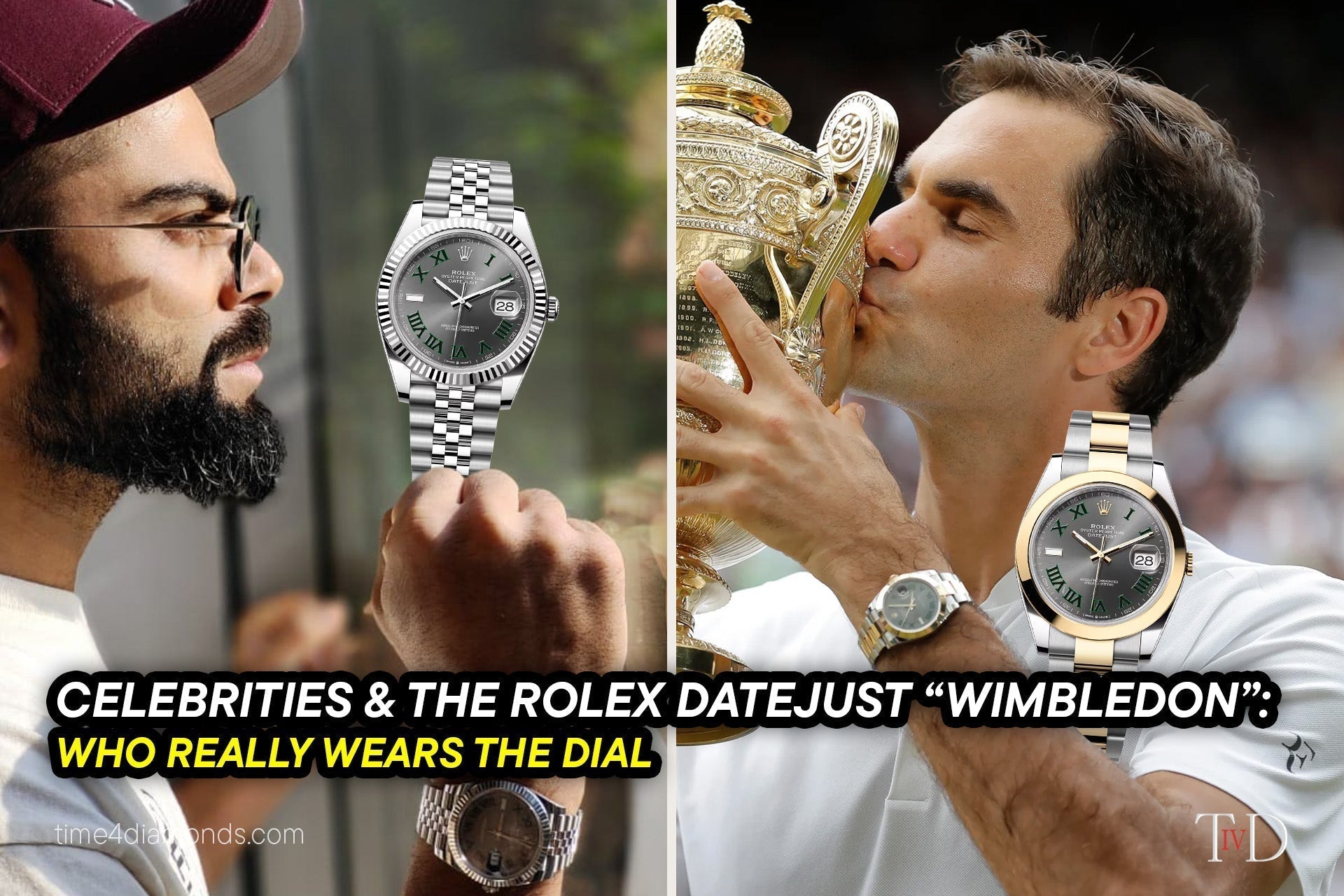
Celebrities and the Rolex Datejust "Wimbledon": Who Really Wears the Dial
The “Wimbledon” dial is one of the few Rolex faces you can identify across a room: slate grey, with green Roman numerals and a single luminous baton at nine o'clock. Despite not being an official piece dedicated to Wimbledon, it looks like a Datejust that has been to a tennis match, which is probably why watch fanatics nicknamed this dial after the tennis competition.
Search for the celebrities who wear it, though, and you run into something most articles will not admit. The list is short, in honest terms, two names long. This piece covers who actually wears the Wimbledon dial, why almost no other famous wearer can be verified, what the 2025 Wimbledon stars wore instead, and every reference the dial has appeared on.
What the "Wimbledon" dial actually is

The “Wimbledon” dial is not a separate model, and as highlighted, Rolex has never officially used the name; it was enthusiasts and fanatics who applied the name “Wimbledon” to the dial.
It is a dial configuration fitted to the Datejust, and the Datejust only. The recipe is fixed: a slate grey sunburst base, black enamel Roman numerals outlined in green, and a Chromalight baton at nine o'clock that replaces the numeral IX. The numerals themselves carry no lume, only that single baton, and the hands glow in the dark.
The colours are why the name stuck. Rolex has kept time at The Championships at Wimbledon since 1978, and collectors read the dial as a quiet nod to the grounds: slate for an overcast London sky and the roofs of Centre Court, green for the grass.
Rolex introduced the dial in 2009, part of the Datejust II line and never marketed it as a tribute; there was no commemorative edition and no press release. The association formed on its own, and the brand seems happy to let it run. After the Datejust II was discontinued, the Datejust 41 replaced it, with the “Wimbledon” dial staying put. It remains that way today and is also featured for the Datejust 36.
This precision matters because the market is loose with the term. A Datejust with Roman numerals on a white or champagne dial is not a Wimbledon. A Datejust with a solid green dial is not a Wimbledon either. The test is simple and worth remembering before you buy: a slate grey base, and green outlines around black Roman numerals. Miss either half, and you are looking at a different watch.
Roger Federer and the dial that carries his name

If the Wimbledon dial belongs to anyone, it belongs to Roger Federer. He has been a global brand ambassador for Rolex since 2001. The Swiss icon holds the record for the most Wimbledon singles titles with eight, and he is the reason the nickname moved from forum slang into common use. Some dealers now quietly refer to it as the “Federer” dial.
The defining moment came in 2017, when Federer lifted his eighth and last Wimbledon trophy, wearing the yellow Rolesor Datejust 41 reference 126303 with the “Wimbledon” dial, smooth bezel and Oyster bracelet. The model is powered by the Calibre 3235, which has a power reserve of up to approximately 70 hours.
For a player so often described in the same language people use for the watch, control, longevity, composure under pressure, it was the kind of pairing no marketing brief could have written.
The image that did the most work, oddly, came later in 2024, when Federer was spectating. On his wrist was the same Datejust model, paired with a grey suit to match the slate grey dial. No campaign, no product code sent to the press, just the right watch in the right place. That photograph is the one collectors' reference when they explain why this dial matters.
The closest piece held at Time 4 Diamonds is the Datejust 41 in steel and yellow gold, reference 126333, carrying the same slate and green face on a fluted bezel. For more on the players Rolex puts on Centre Court, our guide to Rolex brand ambassadors covers the wider roster.

Rolex Datejust 41 Steel and Yellow Gold Wimbledon
Ref 126333
- Case: 41mm Steel and Yellow Gold
- Dial: Slate Grey, Black Roman Numerals with Green Outline
- Bezel: 18ct Yellow Gold Fluted
- Movement: Calibre 3235
- Bracelet: Jubilee
Which other celebrities wear the Datejust “Wimbledon”?

There is only one other celebrity who we have spotted wearing the Rolex Datejust “Wimbledon, and that is Indian cricketer, Virat Kohli. Instead of yellow Rolesor, Kohli opted for white Rolesor, a model that features a fluted bezel and Jubilee bracelet.
Honestly, after Federer and Kohli, there is no one else who can be verified wearing a Datejust “Wimbledon”. Beyond the pair of sporting icons, there is no credible, dated image of a famous figure rocking the true slate grey Wimbledon dial. Names get attached to it constantly, Michael Jordan appears in a lot of dealer copy, but those claims arrive without a photograph, an occasion or a date. When you trace them, they collapse.
That is not a gap in the research. It is a real characteristic of the watch, and it tells you who the Wimbledon dial is for. A celebrity who wants to be seen reaches for a Daytona, a diamond-set Day-Date or a two-tone showpiece. The Datejust “Wimbledon” does the opposite, restrained, carrying no precious-metal flash on the steel versions, and you have to know what you are looking at to register it. That is exactly why collectors rate it. Wearing one reads as a deliberate choice rather than a status grab, which is a different kind of statement and a quieter one.
The other reason the celebrity list stays thin is conflation. A large share of the watches labelled “Wimbledon” online is nothing of the sort: a solid grey Datejust is not a Wimbledon, a Submariner with a green bezel is not a Wimbledon, an olive green Day-Date is not a Wimbledon, and Roman numerals on a pale dial is not a Wimbledon.
What the 2025 Wimbledon stars actually wore
The 2025 Championships are a useful case study in how rarely this dial appears, even among Rolex's own tennis players. Every major name on Centre Court was wearing a Rolex, yet none of them was wearing the Wimbledon dial.
Jannik Sinner won the men's title and lifted the trophy in an Everose gold Daytona with a Sundust dial, reference 126515LN. Carlos Alcaraz, the runner-up, wore the yellow gold Daytona with the turquoise lacquer dial, reference 126518LN, the same watch he has favoured throughout his recent run of finals. Our breakdown of the men's final and the watches on show goes deeper in our piece on Sinner's 2025 Wimbledon win.
On the women's side, Iga Swiatek took her first Wimbledon title wearing a Datejust, but again not the “Wimbledon”. Bjorn Borg, watching from the stands, wore a vintage gold Day-Date with a dark green dial and matching coloured leather strap to suit. The Wimbledon dial remains, against the odds, a signature of Roger Federer. Hopefully, we see it on someone else’s wrist at this year’s tournament.
Every Rolex Wimbledon reference, by size and metal
The dial has run across two case sizes and several metals since 2009. The table below maps the main references, which are the parts most buyers actually need when they start hunting.
Generation |
Size |
References |
Metal |
Movement |
Datejust II (2009 to 2016) |
41mm |
116333 |
Oystersteel and yellow gold |
Calibre 3136, 48-hour reserve |
Datejust 41 (current) |
41mm |
126300, 126331, 126333, 126334, |
Oystersteel, Oystersteel and Everose gold, Oystersteel and yellow gold, Oystersteel and white gold |
Calibre 3235, 70-hour reserve |
Datejust 36 (current) |
36mm |
126200, 126231, 126233, 126234 |
Oystersteel, Oystersteel and Everose gold, Oystersteel and yellow gold, Oystersteel and white gold |
Calibre 3235, 70-hour reserve |
A few details separate the references. The all-steel versions, 126300 and 126200, wear a smooth domed bezel, whilst the steel and white gold pieces, 126334 and 126234, get the fluted bezel that most people picture when they think of Wimbledon.
Every combination is offered on either the Oyster or the Jubilee bracelet, and the choice changes the character of the watch more than the price does.
The current calibre 3235 brings a 70-hour power reserve, a Chronergy escapement and a Parachrom hairspring, running at 4Hz with a rated accuracy of around two seconds a day. Whether you prefer the 41mm presence or the more classical 36mm comes down to wrist size and personal taste, and both sit in our Datejust 41 and Datejust 36 collections.
The steel and white gold 126334 on a Jubilee bracelet is the version most collectors mean when they say Wimbledon. Demand for it runs ahead of supply, so it is not always sitting in stock. When it is not, Time 4 Diamonds sources it to order.
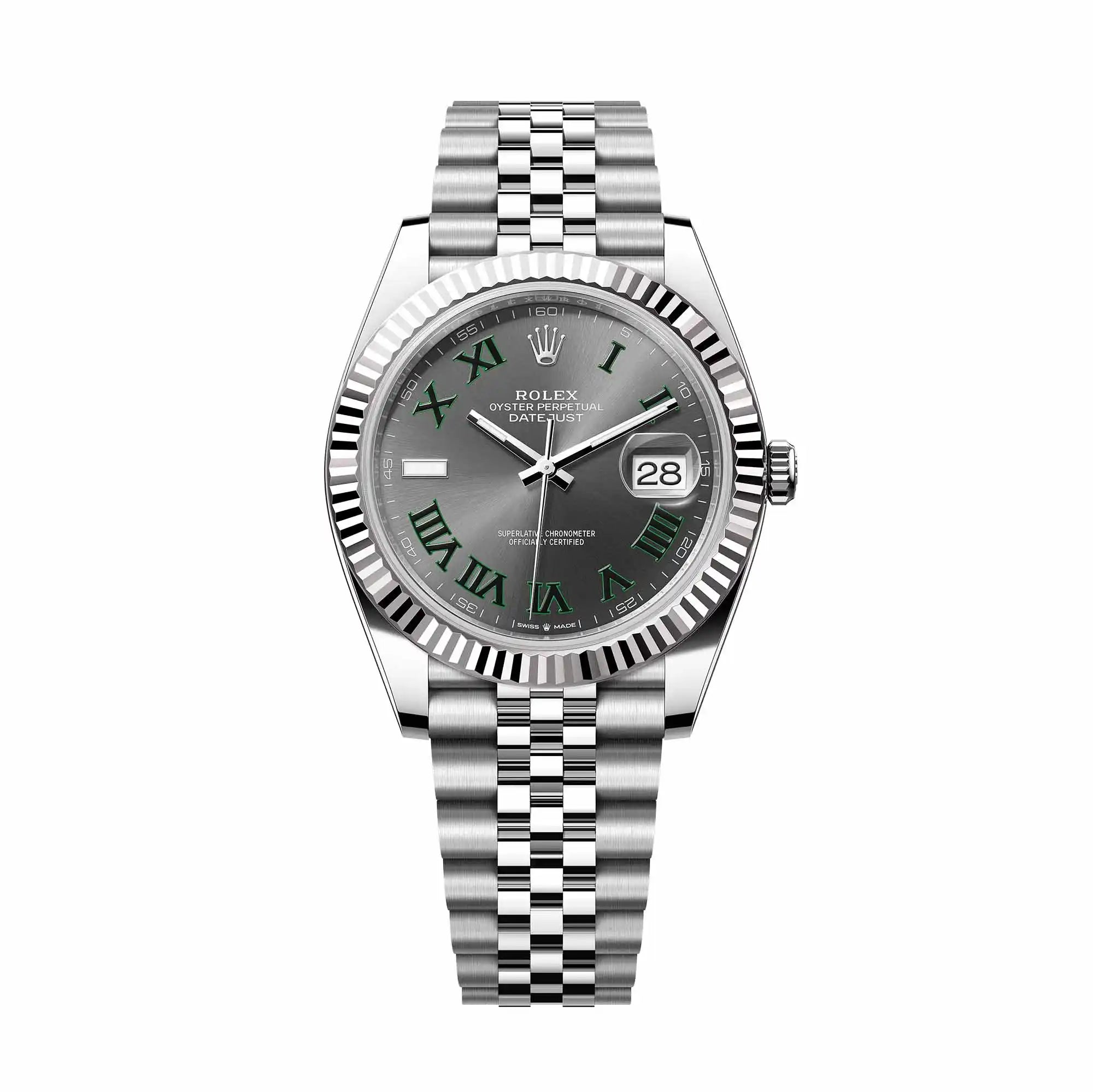
Rolex Datejust 41 Steel and White Gold Wimbledon
Ref 126334
- Case: 41mm Steel and White Gold
- Dial: Slate Grey, Black Roman Numerals with Green Outline
- Bezel: 18ct White Gold Fluted
- Movement: Calibre 3235
- Bracelet: Jubilee
What a Rolex Datejust "Wimbledon" costs

Pricing depends on size, metal, bracelet and condition, and, like most desirable Rolex configurations, the “Wimbledon” trades around its original retail on the pre-owned market.
For the Datejust 41, pre-owned and unworn examples generally sit in the region of £9,000 to £15,000, with the all-steel and white Rolesor pieces toward the lower end and middle of that band, whilst the two-tone gold versions sit slightly higher. Box and papers, year and overall condition move the number within that range. Prices shift with the market, so treat any figure as a snapshot rather than a fixed rate.
For the Datejust 36, new or unworn listings vary from £7,000 to £13,000, which is still a £6,000 range, but is slightly lower because of the size. Again, full Oystersteel and white Rolesor versions sit at the lower end of the range, and the two-tone models are at the higher end.
If the latest reference isn’t a huge preference, then of course, browse listings for the Datejust II reference 116333. This was the only reference with the “Wimbledon” dial in the Datejust II collection, making it easier to find values on the secondary market. A new or unworn model sits between £9,500 and £12,000, so check for further details, like whether it comes with a box and papers to justify the higher price tag.
Two things hold the value up. The “Wimbledon” dial is distinctive enough to hold its value better than the flatter black and silver Datejust dials, and production has never flooded the market. That combination tends to keep a “Wimbledon” firmer on resale than a standard Datejust face. If you want the broader picture of the model before committing, our Datejust 41 review goes through the case, movement and wearability in detail.
One last point for anyone set on a particular look. If your ideal dial is not one Rolex offers in the catalogue, the bespoke route is a separate conversation. Time 4 Diamonds builds custom dials and finishes on Datejust cases, which is its own craft and nothing to do with the factory Wimbledon dial covered here.
Frequently asked questions
Is the Rolex “Wimbledon” a real Rolex model name?
No. Rolex has never used the name “Wimbledon” for any watch. It is a collector nickname for a Datejust fitted with the slate grey dial and green Roman numerals. The brand has not adopted the term, though it has never discouraged it either, and most dealers now use it as shorthand.
Why is it called the “Wimbledon” dial?
The colours read as a nod to the tennis grounds: slate grey for the Centre Court roofs and an overcast London sky, green for the grass. Rolex has kept time at Wimbledon since 1978, and collectors connected the palette to the tournament when the dial appeared in 2009. The name spread from there.
Did Roger Federer wear the “Wimbledon” dial?
Yes, and he is the figure most associated with it. He wore the Wimbledon dial Datejust 41 when he lifted his eighth Wimbledon title in 2017, reference 126303 in steel and yellow gold, and again spectating at the 2024 tournament. He has been a Rolex ambassador since 2001.
Which celebrities wear the Rolex Datejust Wimbledon?
In documented terms, Roger Federer is the only public figure who can be credibly photographed in the true slate and green Wimbledon dial. Other names circulate online, but most trace back to a different watch or to marketing copy with no dated image behind it. It is a connoisseur's Datejust rather than a celebrity statement piece.
What references have the “Wimbledon” dial?
It debuted on the Datejust II reference 116333 in 2009, then was discontinued in 2016, replaced by the Datejust 41. The current Datejust 41 carries it on 126300, 126331, 126333, and 126334. Also part of the Datejust 36 range, on 126200, 126231, 126233, and 126234.
Is the Wimbledon dial discontinued?
No. The Datejust II versions from 2009 to 2016 are discontinued, but the dial remains in current production on both the Datejust 41 and the Datejust 36. Availability is tight due to high demand, so the steel and white gold versions in particular are not always in stock.
How much is a Rolex Datejust Wimbledon?
For the Datejust 41, examples generally fall between £7,500 and £15,000, depending on the metal, bracelet and condition. For the Datejust 36, models sit between £6,000 and £13,000, depending on the metal, bracelet and condition. For the Datejust II, the sole reference 116333 sits between £7,500 and £12,000.
The “Wimbledon” dial rewards the person who already knows what it is. If that is you and you want either the steel and yellow gold 126333 in stock now or the steel and white gold 126334 sourced to order, the team at Time 4 Diamonds can help. For more on the watches worn by sport and screen, our celebrity watch features run through the collections in detail.


Written by
Adam Dedman
Adam is a watch specialist at Time 4 Diamonds and a collector in his own right. He works with the pieces passing through the London showroom daily, covering condition, references and what separates a strong example from an average one.


Leave a comment
This site is protected by hCaptcha and the hCaptcha Privacy Policy and Terms of Service apply.